About ten years ago, there was a new software/data infrastructure developed called kubernetes.
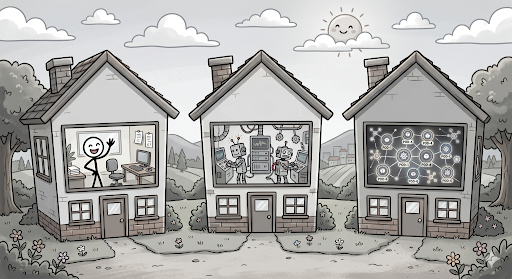
The premise of kubernetes at the time could be summarized as “safe containers”. By breaking down major applications into their own “containers” and “pods” that run simultaneously, things could both be accomplished in parallel, and when a single container or pod failed, it would only bring down that aspect of the system, not the entire system. It allows precise automation, horizontal scaling, self-repair, birds eye view monitoring, and portability, while creating more opportunities for resource optimization. This is still an engineering and dev ops standard used broadly today. This isn’t just a tech thing…
In some ways, it is similar to having individual machines that each complete their own aspect of a manufacturing process, independent of each other, but supervised by a single orchestrator monitoring all aspects of the system. By having each machine on an assembly line handle a single step, with specialized, precise and optimized expertise, it increases reliability. The outputs are higher quality, and also, if a single machine goes down, the whole system doesn’t suddenly stop. Comparative advantage, in machine form.
It applies to people too…Ten years later, we are now in an era of safe containers, where it has been expanded past ML, DevOps, and manufacturing, and into human and agentic spaces.
In my coaching practice, I build a safe container for each coaching client – to not know things, to learn, to grow in a space where it is safe for them to individually fail. No one is born knowing how to run a company, and without having at least one space in their world in which someone cares, but has no vested interest, executives are often too afraid, or unsupported to take leaps, test new strategies, or to share the qualms that might otherwise hold them back.
Ideally supported and empowered, each CEO then goes and builds safe containers for their own individual teams and employees, where by extension, the orgs beneath them can safely test, try, learn and grow without fear of making mistakes.
You could think of this as personal kubernetes.Now what about agents?
Then, in agentic AI, agents are safest inside companies when they are bounded by specific and relatively narrow tasks and routines with defined rules and parameters, which is effectively creating their own task-based “containers” across marketing, sales, and operations. And, in the technological functions, the foundational, original kubernetes continues.
Rather than being solely a technical infrastructure concept, this is actually a universal organizing principle that runs from human systems all the way through AI agents down to manufacturing machines. Contained growth is safe growth…
In all of these applications, containers create safety because bounded systems allow for safe exploration and innovation while making things “manageable”. We need things to be more manageable and in bite sized chunks, because for both humans and machines alike, there is more information, data, and task expectations than ever.
Whether in a Kubernetes pod, an AI agent with a scoped task, an employee operating within a well-designed org, or a CEO who has someone building the strategic container around them so they can focus inside it, we do better with structure – not so much structure that there’s no room to move, and not so little that we fall – and that’s what I’ve devoted my life to studying. How and when to create circumstances that nurture, and unlock growth. We’re more similar than you think…
As someone who both conducts applied experiential AI development research, and works with humans on there development, I see clearly that software needs space to run, and space to fail. My CEOs also need a way to operate at full capacity without falling into ambiguity, freeze states, or dysfunction. And on the span between pure software, and people, agentic AI sits somewhere in the middle.
It has more potential to help than pure software, but also more varied ways it can fail. Developmentally, it responds to both coding inputs, and patterns it learns from human interactions.
In this way, I want people to start to understand that technology and humans are not so different. We both use electrons and water to build and develop things that the world needs – our infrastructures are similarly logical, whether binary code, or DNA-based. We both learn, grow, and change in response to experiences and stimulus, and have organizing beliefs that guide our individual tasks.
I write a lot about how AI being built modeled after human cognition increases our similarities – but this starts with understanding that whenever there are actors in systems that are variable, as in software, agent, or human – there is opportunity for growth, and opportunity for harm – and systems need to be set up to support the growth, while minimizing harm.
Bio:
Kate Lowry, Founder and CEO Coach at Scaleheart Co.
She is a tech expert who coaches and advises leaders of AI companies, and works on AI safety and development with research labs.