Have you ever wondered why a perfectly designed, multi-million dollar marketing campaign sometimes utterly fails to move the needle at the actual point of sale?
It’s a frustrating paradox for any brand. You’ve nailed the consumer insights, your product innovation is top-tier, and the overarching brand messaging is flawless. Yet, when a shopper pushes their cart down the supermarket aisle, your star product is either hidden on the bottom shelf, mispriced, or—worst of all—simply out of stock.
Welcome to the harsh reality of the “Last Mile” in FMCG retail execution. While the global FMCG sector is on a massive upward trajectory, a shocking amount of potential revenue is bleeding out in the final three feet of the consumer journey. Industry research consistently shows that out-of-stocks, suboptimal merchandising, and poor shelf compliance cost brands billions annually in both lost sales and degraded brand equity.
So, why are highly sophisticated, data-rich brands still stumbling at the shelf edge? The answer usually isn’t a flawed macro-strategy; it’s an outdated execution model. But what if the secret to achieving your revenue targets isn’t about another boardroom pivot, but rather deploying artificial intelligence (AI) and technology that turns your strategy into an autonomous reality?
Let’s unpack the top retail execution mistakes FMCG brands are making today—and how intelligent AI automation is bridging the gap between the boardroom and the store aisle
Mistake 1: The Illusion of Shelf Compliance (and the “Manual Audit” Trap)
The Problem: Most FMCG brands operate under the “Perfect Store” framework, dictating exactly how products should look on the shelf. The mistake lies in relying on field reps to manually audit this compliance. This creates a “watermelon effect”—the dashboard looks green and healthy on the outside (reps report 95% compliance), but it’s red on the inside (actual compliance is closer to 60%).
What Causes This Problem:
- Human Subjectivity: Manual visual checks of planograms, facings, and competitor activity are naturally prone to error and bias.
- Misallocated Time: Reps spend up to 40% of their store visit acting as data-entry clerks rather than focusing on relationship-building and upselling.
- Data Lag: By the time clipboard data is uploaded, analyzed, and returned to the field, the shelf reality has already changed.
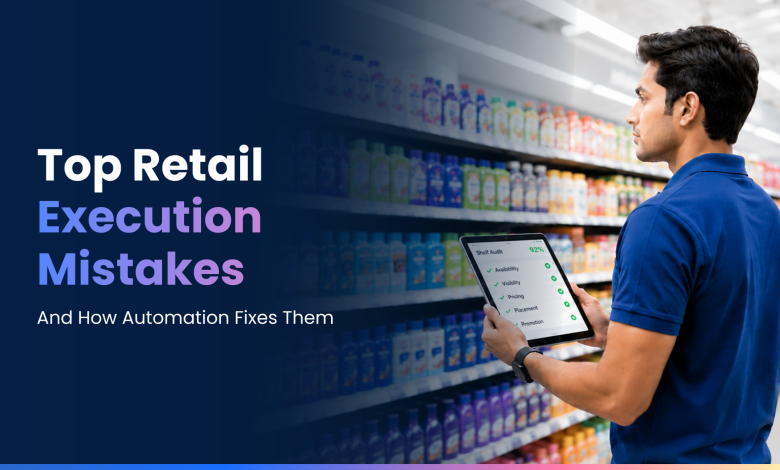
The AI Fix: Using Deep Learning, Computer Vision (CV), and Image Recognition integrated with SFA Software. Leading FMCG brands are retiring manual audits and equipping their field teams with AI-powered Image Recognition. Instead of ticking boxes, a rep simply snaps a photo of the shelf with their tablet. Within seconds, Machine Learning and Computer Vision algorithms analyze the image, instantly calculating share-of-shelf, verifying planogram compliance, and checking POSM placement with near-perfect accuracy. It transforms a subjective, 15-minute manual task into an objective, 30-second AI-driven process, prompting reps to fix missing facings before they even leave the store.
Mistake 2: The Forecasting Fallacy and the “Phantom Inventory” Nightmare
The Problem: Nothing kills brand loyalty faster than a stockout. Yet, a massive disconnect often exists between what the warehouse thinks is in the store and what is actually available for the consumer to grab. This “Phantom Inventory” leads to chronic out-of-stocks for high-demand items and bloated backrooms full of slow-moving goods.
What Causes This Problem:
- Reliance on Lagging Indicators: Replenishment models are too often based on historical sales data rather than real-time shelf velocity.
- Rigid ERP Systems: Traditional software struggles to adapt quickly to sudden shifts in hyper-local consumer behavior.
- Ignoring External Variables: Failing to account for local weather patterns, upcoming regional holidays, or sudden competitor stockouts.
The AI Fix: AI Demand Sensing and Predictive Analytics flip the script from reactive replenishment to proactive demand forecasting. By integrating Sales Force Automation (SFA) data with retailer Point of Sale (POS) data and external variables, predictive AI models forecast localized demand with hyper-accuracy. Emerging “Agentic AI” takes this a step further by taking autonomous action—generating smart SKU suggestions, triggering scheme prompts, and alerting distributors to prioritize delivery routes based on real-time depletion rates.
Mistake 3: Static Route-to-Market (RTM) and Field Force Burnout
The Problem: If your field sales teams are still driving static, pre-determined “beat plans” (visiting Store A on Monday, Store B on Tuesday), you are burning cash on fuel and wasting valuable human capital. This approach drives up the Cost to Serve while severely suppressing revenue opportunities.
What Causes This Problem:
- Lack of Real-Time Visibility: Reps don’t know which stores actually need attention until they arrive.
- Inefficient Routing: A rep might spend an hour driving to a fully stocked rural hypermarket while a high-volume urban convenience store nearby is completely sold out.
- Equal Treatment of Retailers: Failing to prioritize visits based on immediate, daily revenue potential.
The AI Fix: Using AI-Powered Dynamic Routing and Geo-Spatial Intelligence to plan a better sales day. Instead of static schedules, an intelligent system evaluates real-time data—current traffic, store sales velocity, and urgent out-of-stock alerts—to autonomously generate the most profitable daily route via advanced algorithmic optimization. The software directs reps to the exact locations requiring immediate attention, providing them with automated, AI-generated upsell cues the moment they step through the door.
Mistake 4: The Trade Promotion Black Hole
The Problem: FMCG brands spend an estimated 20% to 25% of their gross revenue on Trade Promotions like discounts and end-cap displays. Yet, pinning down the precise ROI of these promotions is notoriously difficult, leading to massive Trade Spend Leakage where brands pay for displays that are executed poorly or not at all.
What Causes This Problem:
- Data Silos: Marketing designs the promotion, sales sells it, but execution verification falls through the cracks.
- Lack of Execution Accountability: No reliable system exists to verify if a retailer actually built the secondary display according to the funded agreement.
- Disconnected Metrics: The inability to correlate in-store display compliance with localized sales spikes to determine true effectiveness.
The AI Fix: AI-Driven Closed-Loop Trade Promotion Optimization (TPO) Automation creates a strictly accountable, closed-loop system for promotional spend. When a trade promotion goes live, the SFA system automatically prompts field reps to verify the display parameters using AI-based Computer Vision during their route. It flags non-compliance instantly and cross-references the verified display data with real-time sales velocity. This allows C-suite leaders to pull funding from underperforming campaigns and double down on the schemes actually driving incremental volume.
The Bottom Line: It’s all about moving from “Observation to Orchestration.”
For decades, retail execution has been a reactive game of observation, sending armies of reps into the field to report back on what went wrong yesterday. But in a landscape defined by hyper-competition and razor-thin margins, observing the past is no longer sufficient.
The future of FMCG belongs to brands that use artificial intelligence and automation to orchestrate the present. By leveraging Computer Vision, Predictive AI Analytics, and Algorithmic Dynamic Routing, C-suite leaders can finally bridge the gap between high-level strategy and shelf-level reality.
When your data is integrated, your field teams are empowered, and your execution is automated by machine learning, the “Perfect Store” stops being an abstract framework and becomes your daily standard. The technology is here. The competitors are adopting it. The only question left is: how much longer can your brand afford to lose the battle at the shelf?