Why the next decade of supply chain AI is about cross-application orchestration, governance, and trust — not better forecasts
For most of the past decade, the conversation about AI in supply chain has been about better forecasts. First predictive. Then prescriptive — the long-promised step where AI doesn’t just anticipate disruption but recommends what to do about it.
That framing is now too narrow.
Generative AI and agentic systems have changed what software can do inside a supply chain, not incrementally, but in kind. The honest question for 2026 is no longer whether AI can sharpen predictions or surface recommendations. It is three questions. What does an AI-operated supply chain actually look like? What can it credibly do today versus a year from now? And what will it take to make the shift without breaking trust along the way?
This piece is a working answer, drawn from what we are seeing across innovative supply chains in pharma, retail, consumer goods, and high tech.
What actually changed in 2026
Three capability shifts converged this year, and together they redefine what is possible.
Reasoning across context. Large language models can now read across heterogeneous, semi-structured signals — supplier emails, internal notes, contract terms, news flows, alongside structured planning data — and produce coherent assessments that previously required a human to synthesize.
Multi-step action, not just response. Agentic systems don’t just answer questions; they plan a series of steps, call tools, write back to the systems they read from, and adjust mid-flight when something looks off. The unit of automation has moved from ‘the answer’ to ‘the workflow.’
Natural language as the interface. Planners no longer have to think in software metaphors. They describe what they need, and the agent translates that into the right query, the right scenario run, the right next action.
These three together change what AI can do, but they also raise the bar on what AI must prove.
Determinism, memory, traceability, and policy compliance have moved from afterthoughts to first-order requirements. A 2023 demo could get away with sounding smart. A 2026 production agent has to be auditable when it commits inventory or reroutes a fleet. The failure modes are concrete: an agent that fabricates a supplier ETA, a tool call that writes a wrong order quantity back to ERP, a recommendation defended with reasoning that does not reconcile with the numbers a deterministic engine just computed. Each is a real pattern from early rollouts. Each kills trust.
What today’s agents actually do — and what they don’t
The most useful way to understand 2026’s reality is to look at what agents are doing inside actual planning organizations right now. Three patterns recur.
Pattern 1: Exception triage. Agents absorb the analytical pre-work that used to fill a planner’s morning. Forecast-versus-consumption deviation review, supplier delivery variance, inventory exception ranking — pulling data from multiple systems, ranking by impact, and assembling the supporting evidence behind each candidate. The planner walks into a triaged view rather than a blank table. Multi-hour Monday-morning rituals collapse into a fifteen-minute review of an already-ranked list.
Pattern 2: Decision screening. Agents narrow large candidate sets against thresholds the planner sets. Which purchase orders to postpone in a busy quarter without compromising coverage. Which transfer orders to expedite. Which customer commitments are at risk under a new supply scenario. The agent does the screening, runs the as-is-versus-alternative comparisons, and presents the trade-offs. Same decision, a fraction of the time, with the working shown.
Pattern 3: Plan propagation. Agents scale a judgment-defined plan across hundreds or thousands of parts. The planner defines the rule and the exclusions; the agent applies it everywhere it should apply, commits the partial results, and surfaces the cases that need a second look. The planner moves from operator to reviewer.
A common thread runs through all three. Today’s most valuable agents are absorbing the work that planners had already exported out of their planning systems into spreadsheets, dashboards, and email threads, stitched together around the edges. The agentic layer is pulling that work back into a unified flow. Decision support, mostly. Some controlled execution under explicit rules. Almost no autonomous action.
The distance between ‘useful daily assistant’ and ‘autonomous orchestrator’ is larger than it looks from a demo. Closing it is the work that is upcoming.
The patterns generalize — but the path through them is industry-specific
The three patterns recur across industries. The order in which an industry adopts them, the rung of the autonomy ladder it climbs first, and the prerequisite that binds hardest are not the same.
Pharma’s binding constraint is GMP. Every agent capability that touches validated data needs its own change control, and the autonomy ladder moves slowly behind regulatory equivalence to existing process. Pharma programs typically lead with exception triage — high analytical value, low write-back risk — and hold off on plan propagation and autonomous action until the validation framework for AI-driven changes is settled. The advantage pharma carries: audit infrastructure already exists. Observability, the prerequisite that troubles most other industries, translates cleanly here.
Retail’s binding constraint is margin. Replenishment and allocation decisions run in the millions per day, and the unit economics of an agentic decision matter immediately. Cost per decision and infrastructure choice — when to invoke an LLM, when a deterministic engine is sufficient — become first-order design questions. Plan propagation tends to come first because that is where the scale lives, with screening and triage layered on later. Reasoning across context arrives last, applied selectively to the highest-value decisions.
Consumer goods is a permanent reconciliation between less predictable demand and constrained supply. Demand moves on promotions, retailer behavior, weather, e-commerce, and increasingly social signals; supply runs on long production campaigns, costly changeovers, and capital-intensive lines that need high utilization to be economic. Sitting between the two are retailer service-level penalties, trade promotion economics that consume a material share of revenue, and a SKU portfolio in the tens of thousands across pack sizes, formats, and channels. The strongest of the three capability shifts for CPG is reasoning across heterogeneous signals, and the highest-leverage pattern is the one that crosses applications: joining commercial signals (POS, retailer plans, promo execution), operational signals (production, inventory, capacity), and financial signals (trade spend, margin) in a single decision flow. CPG carries deep demand-side analytical maturity from decades of trade promotion and category management; the bottleneck is data ownership and organizational alignment across commercial, operations, and finance, not algorithmic.
Industrial manufacturing’s binding constraint is constraint depth. Multi-level BOMs, capacity and materials that have to be planned together, long lead times, and engineering changes that ripple through the plan — every decision touches many others, and errors show up months downstream rather than days. The advantage industrial carries is planning maturity — capacity, MRP, and S&OP discipline are well-established, and AI layers onto that rather than replacing it. The bottleneck is the semantic layer, which spans PLM, ERP, MES, and supplier portals and is reshaped continuously by engineering change. In regulated sub-sectors — automotive, aerospace, medical devices — autonomy moves slowly behind quality and traceability requirements.
The pattern beneath the pattern: every industry will reach AI-operated, but the key is to organize for each company around the constraints that actually bind them, as opposed to more generic technical features or autonomy claims.
What an AI-driven supply chain looks like — near and medium term
A working definition: an AI-driven supply chain is one where operational decisions — what to make, what to source, what to ship, what to hold — are increasingly made by AI agents working across applications, with humans setting policy, approving high-stakes actions, and handling novel exceptions. Not within a single planning tool. Across the stack: ERP, planning, execution, supplier networks, FP&A, and the unstructured signals that surround all of them.
Near term, the dominant mode is planner-side AI assistance reaching scale. The patterns above generalize: agents that absorb the scattered analytical work, rank candidates, run comparisons, and recommend. Planners stop doing data wrangling and start doing judgment. The capacity unlocked is significant, early adopters describe meaningful throughput gains on routine analysis cycles, in some cases two- to three-fold, with planner attention freed for the cases that genuinely need it.
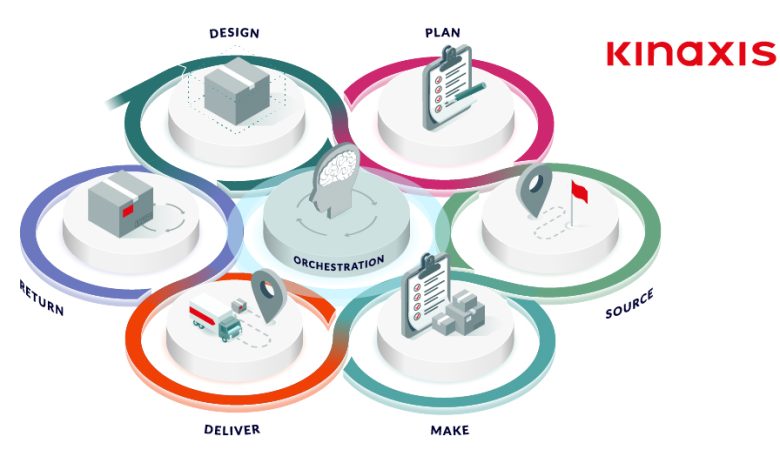
Medium term, the architecture matures. Skilled agents — demand, supply, supplier risk, logistics, procurement — operate within their domains. Orchestrated workflows coordinate across them when a decision spans more than one. Humans move further into a policy and exception role: setting the rules, approving the high-impact actions, intervening when the situation falls outside the agents’ training distribution. The supply chain control center becomes THE place where people set guardrails and resolve novel exceptions, not where they reconcile spreadsheets.
The crucial point here is that agentic layers succeeds only if it can traverse the stack. The commercial half of that is the harder half.
What it will take — six leader actions
A leader looking at the gap between today’s pilots and the AI-operated supply chain of next year needs verbs, not nouns. Six moves separate the early-adopter wins of today from operational AI at scale.
- Stand up a cross-system data product team for the semantic layer. Succeeding in autonomy requires a defined backlog of part / site / customer / scenario harmonization across ERP, planning, execution, and supplier networks. It is the unglamorous foundation everything else sits on, and no agent reasoning across systems works without it.
- Separate the deterministic and reasoning layers explicitly in your architecture. The most consistent failure mode in early agent rollouts is asking the LLM to compute the inventory position when it should be interpreting a position the deterministic engine just computed. Make the boundary a first-class design principle. Math, aggregation, and policy compliance live in the deterministic layer. Trade-off framing, option ranking, and planner communication live in the reasoning layer. Mixing them is where projects fail.
- Treat governance, observability, and security as first-class, and own them inside supply chain. Once an agent can act, the questions become operational: what is the audit trail when the agent commits material inventory, how does the explainability story stand up to a regulator or a CFO, what is the failure mode when an adversarial supplier email injects an instruction into the agent’s context? An agent that writes back to ERP, planning, or supplier systems is a new attack surface. The security review track runs in parallel with the build, not after. It is the supply chain’s accountability, not just IT’s.
- Build a staged-autonomy ladder for each domain and stop skipping rungs. The five rungs in order: agent does the analysis, agent makes a recommendation, agent acts under explicit human approval, agent acts autonomously under explicit policy, agent handles novel exceptions. Different parts of the supply chain will sit at different rungs simultaneously, and that is healthy. Every agent program failure we have observed has been a rung skipped. Make rung-by-rung promotion an explicit governance event with criteria, not a quiet drift.
- Document how planning actually works and bring HR in early. You cannot delegate a process you cannot describe, and the bottleneck has frequently not been technology. It is that nobody has written down what a planner looks at, in what order, with what thresholds. It’s that tribal knowledge. This is process owner work, not IT work, and it needs time on the day job. The role on the other side is a real shift: from operator to policy-setter, from data-wrangler to exception-handler. Get HR into the conversation before the first agent ships, not after.
- Define the unit economics before you scale. Agentic systems running on enterprise data are not free. Cost per decision matters; an agent that produces a four-cent insight at a forty-cent inference cost will not survive a budget review. The economics typically work for high-value, lower-frequency decisions before they work for high-frequency, low-value ones. Map your decision portfolio against expected agent cost early, not after the rollout.
A picture of 2028
Imagine the supply chain control center late on a Wednesday afternoon. A weather event has disrupted a key freight lane. Within minutes, a logistics agent has rerouted shipments under the policy the company set last quarter. A supply agent has identified the SKUs at meaningful risk and quantified the gap. A demand agent has flagged the customer commitments that need a heads-up. An orchestrator has surfaced two trade-off paths to the human team: one preserving service at the cost of margin, one preserving margin at the cost of service. The team picks one. The agents execute. The audit trail records every step.
How far is your supply chain from that Wednesday afternoon? For most companies in 2026 the honest answer is: about half the components exist somewhere in the organization, none of them are integrated, and nobody owns the program to integrate them.
That isn’t science fiction. The pieces all exist in 2026, scattered across vendors, in proofs of concept, in some early production. What is missing is the cross-application orchestration layer, the governance fabric, and the organizational maturity to operate it. Building those is the work.
The Monday morning ladder
For supply chain leaders reading this on a Monday morning: the shift will not come from a single AI purchase. It will come from a deliberate, sustained program. The shape of that program is increasingly clear.
- Fund the cross-system data team and pick key workflows — one — to instrument end-to-end as your proving ground.
- Stand up a working semantic layer across two or three core systems, a governance, observability, and security stack in production, and get a couple of workflows running on rungs two and three of the autonomy ladder.
- Re-shaped planner role described in HR terms, and the first cross-application autonomous action under explicit policy.
The companies that start that program now will be operating a different kind of supply chain. The ones that wait will be running their planners against agents.