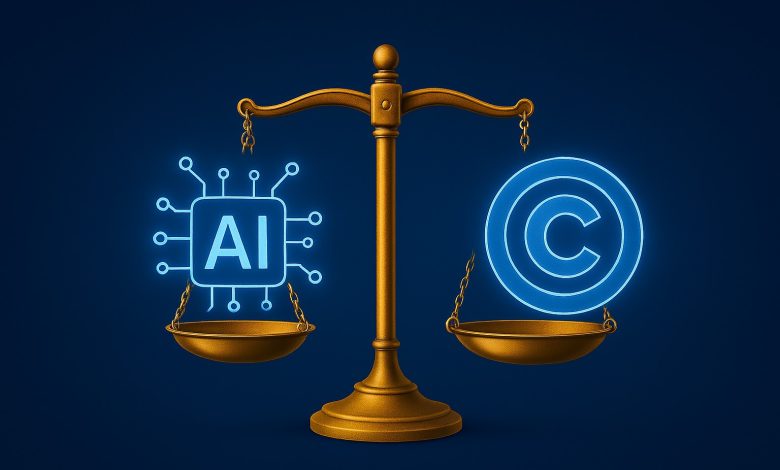
The Law Society of England and Wales welcomed the UK government’s consultation on copyright and artificial intelligence. The intersection of copyright law and AI is a critical area that directly affects the legal profession as both solicitors and the wider public increasingly use AI tools.
Copyright and AI are reshaping both what lawyers advise on and how they carry out their work on a daily basis. This creates significant opportunities while introducing new risks and ethical conundrums. AI tools automate time-consuming tasks allowing lawyers to focus on higher-value activities. However, there are unresolved questions regarding ownership of AI-generated content and copyright. Legal professionals have a duty to ensure the accuracy of AI outputs avoiding mistakes or “hallucinations” while always protecting client confidentiality.
The public also faces a growing risk of getting unreliable legal advice from AI that may include inaccurate, biased or outdated information. It is difficult for non-experts to know if the outputs are correct and who is ultimately responsible if that advice causes harm.
No clarity
The existing copyright framework lacks clarity in relation to the use of copyrighted material for training AI models. This creates friction among creators, AI developers, legal professionals and the public. The current regime is unfit for purpose. Legal ambiguity risks holding back AI development in the UK while simultaneously weakening protections for creators.
Impact on the legal profession
The Law Society highlights that legal data such as court documents, legal analysis and advisory material could be particularly sensitive if mined for AI training without appropriate safeguards. If not carefully regulated, this could erode trust in the legal profession, undermine confidentiality and affect the quality of AI used in legal services.
The EU Digital Copyright Directive allows rights in some contexts to be reserved “in an appropriate manner”. However, there are significant challenges. It is often difficult to identify the owner of online content. Even when ownership information is there, it is often stripped away when files are copied or moved. Additionally, because so much content is uploaded unlawfully, it is frequently impossible to tell who the rightful creator actually is.
Challenges for AI developers
AI developers may also struggle to verify copyright ownership, particularly where datasets are large, privately held or derived from complex contractual chains. In some cases, copyright ownership may be unclear or poorly documented.
It needs to be made easier to access such datasets through new rules or licensing solutions. Copyright is a complex web of different rights rather than singular and uniform. AI systems can copy work word for word so developers must build safeguards and filters to stop it.
Public interest
Excessive regulation could actually harm the general public. Certain datasets may serve a strong public interest enabling transparency, accountability and useful market analysis.
It is important to balance private ownership rights with legitimate public interest. For example, case law and legal data from the National Archives already exists. Although this is free to access, it is not formatted or built in a way that is AI-ready. Investment from government could make legal support more cost-effective and improve access to justice for both businesses and the public.
Support for smaller businesses
Complex compliance requirements could also disproportionately burden smaller companies while benefiting larger AI developers with greater resources. There should be fair rules for everyone. Government training and guidance should support smaller businesses and help everyone understand their rights. Safe testing environments can help during transitional periods and support all businesses innovate.
Clear legal ‘teeth’
There should always be a balance between regulation and innovation. But also enforcement should be practical. Ineffective or overly rigid systems risk being ignored.
It is important to have proportionate legal consequences linked to actual harm. For example, if a breach was found, a compensation fund for creators or rights holders could be created by mandatory annual contributions from AI developers.
The answer is clear legal “teeth”, potentially drawing on the EU AI Act that restricts market access for non-compliance.
Need for standardisation
There must be a universal system that acts like a digital ‘no trespassing’ sign that explicitly tells AI what it can or cannot use from the creators’ work. Existing approaches are too vague, have no legal power and can be ignored by bots that scan the web for available data. To fix this, technology experts and legal professionals must work together to create a robust, legally meaningful and technically adaptable new standard that AI bots have to respect.
Transparency
Transparency should be mandatory for large, high-impact models and voluntary or light-touch for smaller models and businesses.
Proportionate disclosure of training data sources, particularly for large companies developing general-purpose AI models, similar to those used in the EU, would benefit creators, providers and users alike.
Open-source models should also meet basic transparency rules and copyright requirements, with appropriate time to comply.
Beyond borders
Voluntary compliance alone is unlikely to be effective, particularly for overseas providers. So international collaboration is essential.
Any UK approach should be aligned with broader AI regulations rather than within copyright law alone. AI touches on so many aspects of the law that it is imperative to adopt a more generalist view.
Legal uncertainty
The current UK laws on AI and copyright are complex and not on par with international standards, leaving gaps on who ultimately owns content.
Clear and predictable rules that balance the interests of creators, users and innovators are needed. Private contracts are currently used to fill the gap but they are not reliable and do not offer legal certainty.
Labelling AI-generated outputs
Although there is merit in knowing who owns AI data and outputs and labelling it accordingly, there should not be a blanket requirement. Such requirements can be hard to enforce and may stifle innovation.
Instead, we should use existing safety rules to target deepfakes and fake news. For example, creating or requesting AI-generated intimate images without consent was made illegal in February under the Data (Use and Access) Act 2025, even if the image is never produced or shared.
Synthetic Data
AI-created or synthetic data should not be treated differently from any other data. It should be subject to the same transparency and copyright laws.
While synthetic data may be increasingly used to train AI models, its effectiveness and long-term legal implications remain uncertain.
Futureproofing
To make sure the UK lives up to its potential and ‘seizes the AI day’, we need to keep gathering evidence, talking to all relevant stakeholders and regularly revise the rules. We need to remain fair, flexible and engaged.
Cross-border collaboration is essential. The UK should regularly work with other countries to ensure compatibility and project leadership.
A balanced way forward
A new regulatory framework will allow regulation to evolve alongside technology.
The best solution would be to implement a clear rule that lets AI scan the web for data while giving creators an easy way to opt out. This would allow new technology to thrive but would also protect creators and their work.
This approach aligns closely with the European model. Restricting access to data would undermine UK innovation and in reality, offer no protection to creators.
Good AI rules need to be clear and enforceable. Done well, reform can benefit creators, developers, legal professionals and the public alike.
A comprehensive, balanced vision for reforming copyright law in the age of AI supports innovation while firmly protecting creators’ rights, legal certainty, transparency and public trust.