The enterprise AI market is currently undergoing a painful, if necessary, vibe check. After two years of breakneck spending on flashy generative AI pilots and proof-of-concepts, corporate buyers are demanding a return on investment. The problem? Most of these experiments are getting stuck in the sandbox.
According to industry data, less than 25% of enterprise AI initiatives ever successfully make it into production. When it comes to complex, document-heavy back-office workflows, that success rate drops even lower. Regulatory walls, data silos, and the unpredictable nature of large language models (LLMs) have turned promising demos into IT headaches.
To solve that, Sema4.ai announced a suite of new features to bridge the gap between “impressive demo” and “production-ready system.”
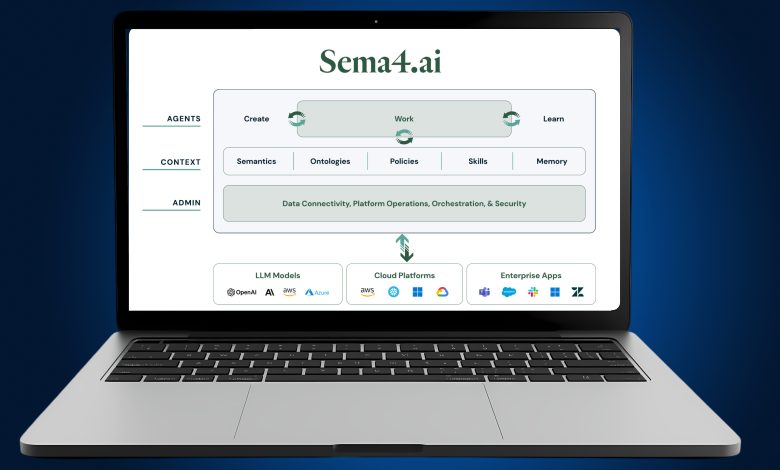
Unveiled this week, the upgrades focuses heavily on giving non-technical business users the tools to build agents, establishing a permanent memory layer for AI, and solving the complex data-governance issues that usually kill AI projects at the compliance phase.
“The gap between AI experimentation and AI production is not inevitable,” Tim Rottach, Sema4.ai’s VP of Product Marketing, noted in the announcement. “It is an architecture problem. And architecture problems have architecture solutions.”
Opening the Market to Non-Technical Employees
For years, the biggest bottleneck in automation has been a translation problem. The people who actually understand how a business process works, the finance analysts, supply chain managers, and operations directors, rarely know how to code. Conversely, the IT engineers tasked with building the software often lack the tribal knowledge required to handle weird edge cases or region-specific compliance quirks.
Sema4.ai is trying to eliminate this friction by allowing business users to design and iterate on AI agents using plain English or voice commands. Instead of drawing complex flowchart diagrams or waiting weeks for an IT ticket to be processed, users can define an agent’s “Runbook” simply by describing the process or uploading existing Standard Operating Procedures (SOPs).
Crucially, the platform isn’t just a static no-code wrapper. Over time, it monitors how the agent executes tasks and proactively recommends optimizations, such as clarifying its instructions or leveraging a different set of pre-built skills, grounded in real-world performance data rather than generic best practices.
To speed things up, the platform introduces composable, domain-specific operations out of the box, think data extraction, reconciliation, and exception detection. If a team builds a specialized tool for a highly specific task, like a non-standard regional tax calculation, they can package it as a custom, reusable skill that can be shared across the entire organization without touching a line of code.
Giving AI a Long-Term Memory
One of the biggest critiques of generic LLM tools in an enterprise environment is that they essentially start from scratch with every single prompt. If an analyst corrects an AI’s mistake on Tuesday, the AI is highly likely to make the exact same error on Thursday because it lacks contextual persistence.
Sema4.ai is addressing this with a new memory architecture designed to retain corrections, user preferences, and process exceptions over time.
The platform features what it calls “autonomous journaling.” As agents run background processes, the platform silently logs successes, failures, and structural variations in data into a persistent, compounding knowledge base. If an analyst flags that a specific vendor always formats their invoices slightly incorrectly, the system absorbs that feedback permanently.
According to Sema4.ai, this feedback loop means that processing the 500th document in a workflow costs a fraction of the first, because the agent is continuously optimizing itself based on past mistakes.
Bridging the Enterprise Data Jungle
The real nightmare of enterprise automation, however, isn’t the AI, it’s the data. In any given corporate back-office, data lives scattered across Snowflake instances, Postgres databases, legacy ERP systems, and an untold number of rogue Excel spreadsheets.
To make sense of this mess, Sema4.ai has built automatic ontology detection. When pointed at a company’s data sources, the platform uses AI to infer relationships between different data silos.
Once that semantic layer is established, the platform can run federated queries. A user can ask a complex question in natural language, and the platform will automatically break it down into dialect-correct subqueries across multiple different backends, pulling only the relevant rows rather than downloading massive datasets locally.
But because enterprises cannot rely entirely on the probabilistic (and occasionally hallucination-prone) nature of LLMs for financial or regulatory workflows, Sema4.ai is emphasizing verified logic. For frequently executed tasks, the platform locks down approved SQL and automatically promotes repeated operational patterns into versioned, deterministic Python modules. If the system encounters an edge case where it cannot confidently validate a pre-set business rule, it operates on a “fail-closed” design, immediately denying the action and escalating it to a human supervisor.
Enterprise Hardening and the MCP Ecosystem
Sema4.ai is also taking a swipe at the infrastructure complexities that slow down enterprise deployments. The upgraded platform is entirely web-based, eliminating desktop installation frictions, and is available across major cloud providers including AWS, GCP, Azure, and Snowflake. It runs entirely within an enterprise’s Virtual Private Cloud (VPC) with zero-copy data access, meaning sensitive corporate data never leaves the organization’s security perimeter.
To satisfy compliance officers, the system includes SOX-ready logging that outputs three distinct views: plain-language summaries for business analysts, formal compliance certificates for auditors, and raw execution traces for engineers.
Finally, the company is leaning into the open-source Model Context Protocol (MCP) ecosystem, launching an MCP Access Gallery with over 40 pre-built connectors to ubiquitous workplace tools like Slack, HubSpot, Jira, Asana, and Google Workspace.
The Market Take
Sema4.ai’s latest update drops at a highly competitive moment in the AI ecosystem. Tech giants like Salesforce (with Agentforce) and Microsoft (with Copilot Studio) are making aggressive plays to dominate the enterprise agent market. Meanwhile, a crop of well-funded startups like CrewAI and LangChain are tackling the space from a developer-first angle.
Sema4.ai’s strategy is clear: bypass the developer bottleneck and appeal directly to the line-of-business leaders who are feeling the squeeze to automate, while giving IT and compliance departments the deterministic rails they need to sleep at night. If the platform can truly deliver on turning those stalled 75% of enterprise AI experiments into active production workers, it will have solved one of the most expensive problems currently plaguing enterprise tech.
Read the full announcement at https://sema4.ai/blog/enterprise-ai-agents-platform-release-2026/.