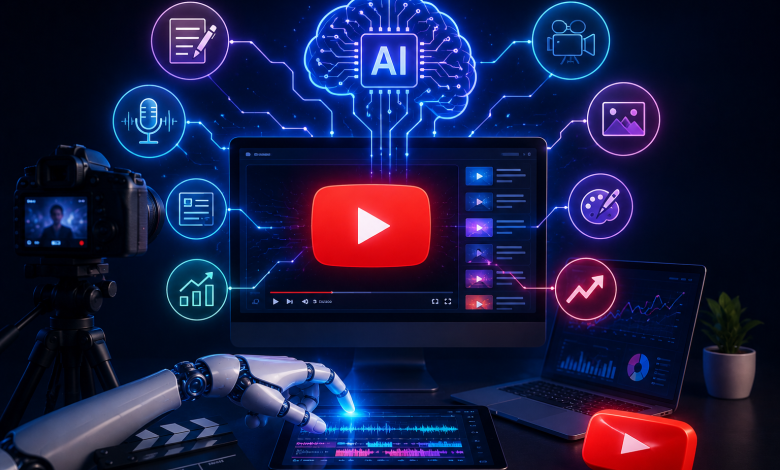
AI is no longer a “nice-to-have” in content creation — it’s becoming part of the default workflow for creators who want to scale faster without burning out. But here’s the nuance: AI doesn’t replace creativity. It removes friction.
Most creators don’t struggle with ideas. They struggle with execution — turning one idea into a script, then into a video, then into thumbnails, titles, clips, and content for other platforms. That’s where AI creates leverage. Used correctly, it helps you move faster, test more, and make decisions based on data instead of guesswork.
This guide breaks down 10 practical ways to use AI across your entire YouTube pipeline — from the first idea to the final thumbnail.
1. Generate Better Video Ideas (That People Actually Search For)
Coming up with ideas is easy. Coming up with ideas that people are actively searching for is harder. AI can help bridge that gap by analyzing trends, search patterns, and content gaps. Instead of brainstorming in isolation, you can use AI to generate ideas based on:
- your niche,
- audience behavior,
- competitor content,
- emerging trends.
The result is not just more ideas — but more relevant ideas. And relevance is what drives discoverability.

2. Turn Rough Ideas Into Structured Scripts
One of the biggest time drains in content creation is scripting. AI can take a simple idea and expand it into a structured outline or full script. It helps organize your thoughts, define the flow, and ensure your content has a clear beginning, middle, and end.
More importantly, it helps you avoid common problems:
- slow intros,
- weak transitions,
- lack of structure.
You still need to refine and personalize the script, but AI gives you a strong starting point — which is often the hardest part.
3. Improve Hook and Retention Strategy
The first 30 seconds of your video determine whether viewers stay or leave. AI can analyze high-performing videos and suggest stronger hooks, pacing improvements, and engagement patterns. It can also help you rewrite intros to make them more compelling and aligned with viewer expectations.
Instead of guessing what might work, you start with proven structures and adapt them to your style.
4. Generate YouTube Tags Faster and Smarter
Tags are no longer a primary ranking factor, but they still help YouTube understand your content. Instead of manually researching keywords, you can use an AI (YouTube) tag generator to quickly create relevant tag clusters based on your topic. This saves time and ensures your metadata stays consistent across videos.
The key is not to generate more tags — but to generate better-structured tags that reflect your content accurately. AI makes this process efficient and repeatable.
5. Write SEO-Optimized Titles and Descriptions
Packaging determines whether people click. AI can generate multiple title variations based on your topic, helping you test different angles — curiosity-driven, value-driven, or problem-solving. It can also help you write descriptions that include:
- relevant keywords,
- clear summaries,
- structured formatting.
This improves both discoverability and clarity. The advantage here is speed. Instead of rewriting everything manually, you can iterate quickly and choose the strongest option.
6. Create Thumbnails Faster With AI Image Generation
Thumbnails are one of the most important factors in YouTube growth. AI tools now make it possible to generate visual concepts quickly — from backgrounds to full compositions. Using tools like AI image generator by Lama, creators can experiment with different styles, emotions, and visual directions without relying entirely on manual design. This doesn’t mean replacing designers. It means accelerating ideation. Instead of starting from scratch, you start with options — and refine from there.
7. Turn Videos Into Multiple Content Pieces
One video can become dozens of content assets. AI makes it easy to:
- extract key moments,
- generate short-form clips,
- create summaries,
- repurpose content for different platforms.
This is where growth compounds. Instead of creating new content every time, you multiply the value of what you already have. Creators who scale fastest aren’t always producing more — they’re repurposing better.
- Generate Transcripts for SEO and Content Repurposing
Transcripts are one of the most underrated growth tools. AI transcription tools can turn your video into text in seconds, allowing you to:
- create blog articles,
- improve accessibility,
- extract quotes,
- optimize for search beyond YouTube.
This adds another layer of discoverability and gives your content a longer lifespan.
9. Analyze Performance and Spot Patterns
AI can help you move beyond surface-level analytics. Instead of just looking at views and watch time, you can analyze:
- retention patterns,
- audience behavior,
- content performance trends.
This helps you answer deeper questions:
- Why did one video perform better than another?
- Where do viewers drop off?
- What topics generate the highest engagement?
When you understand patterns, you stop guessing — and start optimizing.
10. Automate Repetitive Tasks
After publishing, creators often spend hours on repetitive work:
- writing captions,
- formatting descriptions,
- pulling quotes,
- creating social posts.
AI can automate much of this. This doesn’t just save time — it reduces creative fatigue. Instead of getting stuck in operational work, you stay focused on what actually drives growth: ideas and execution.
The Real Advantage: Speed + Consistency

Individually, each of these use cases saves time. Together, they create a system. AI allows you to:
- move from idea to upload faster,
- maintain consistency across videos,
- test more formats,
- scale without burnout.
And consistency is one of the biggest predictors of growth on YouTube.
What AI Can’t Do (And Why That Matters)
It’s important to stay grounded. AI can assist with structure, speed, and optimization — but it doesn’t replace:
- your perspective,
- your storytelling,
- your understanding of your audience.
Creators who rely entirely on AI often produce content that feels generic. It may be technically correct, but it lacks identity. The goal is not automation for its own sake. It’s augmentation.
One of the biggest mistakes is over-automation. When every part of your content is AI-generated, you lose differentiation. Another issue is skipping refinement. AI outputs are drafts, not final versions. Without editing, quality drops.
Some creators also use AI without a clear strategy, generating content without direction. This leads to inconsistency and weak positioning. AI is powerful — but only when guided.
Final Thoughts
AI is changing how content is created, but the fundamentals of YouTube haven’t changed. People still click based on thumbnails. They still stay for compelling content. They still subscribe when they feel a connection.
What AI does is make the process faster and more efficient. The creators who benefit the most are not the ones who automate everything — but the ones who use AI to remove friction, test ideas быстрее, and focus on what actually drives growth. Because in the end, YouTube success isn’t about tools. It’s about how you use them.