AI is under close scrutiny around the globe, with technology businesses and users waiting to see whether the UK government will go further than the high-level legislative blueprint it published in autumn 2025.
In the meantime commercial sectors are largely building their own guardrails – and some are finding the task simpler than others.
Across highly regulated industries including financial services, healthcare and utilities AI promises to accelerate operational speed, boost consistency and underpin the ability to scale.
But in environments where one mistake can result in litigation, fines and reputational damage, AI isn’t just a technical process. It’s an exercise in compliance, in transparency by design and in building trust. Those aren’t outcomes that an off-the-shelf model can deliver.
Memory over motherboard
There’s no longer any doubt whether AI will help organisations to construct defined compliance frameworks. The question now is how to create accurate, transparent systems which are genuinely useful for decision-making.
Careful design, ahead of rushing to a seemingly intuitive solution, is crucial. Competitive advantage rarely comes from simply having a platform that is deemed to be the most advanced technology around.
Instead, AI systems should be founded on institutional memory: the collective wisdom of employees who share decades, if not centuries, of experience between them; a litany of legacy decisions to access, analyse and learn from; past compliance pathways to follow.
All of this adds up to a knowledge base which no generic AI model could ever replicate. In regulated industries accumulated expertise is the engine of accuracy and consistency.
At Northell (part of HH Global) we have partnered with Clearcast – the advertising clearance service supporting brands and agencies to ensure compliance with UK broadcast rules – to develop its new AI-driven platform with institutional memory as the start point.
In conjunction with the organisation, we mined decades of clearance decisions, compliance rulings and advertising precedents to design a solution which amplifies historic knowledge rather than attempting to build something from scratch.
It may be a cliché, but context is king. AI is largely trained on existing information – wisdom of the past – yet without surfacing relevant patterns and precedent to help decision-makers find the correct way forward, the technology could cause more problems than it solves.
Transparency builds trust
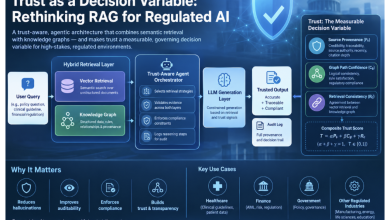
When the stakes are high, the ability to explain decisions and the process behind them is not a design preference; it’s a licensing condition for trust. Regulated environments must be able to defend and audit all of their decisions.
In Clearcast’s case line of sight is available to highlight for anyone wishing to see it. The technology handles pattern matching and information retrieval tasks which slow human users down. When a compliance issue is flagged, the AI surfaces similar historical cases, precedent and relevant passages of regulation. The technology also presents areas of uncertainty and an overall confidence score.
Every recommendation is transparent and justifiable. As such, this is a practical example of AI supporting ultimately human judgement – strengthening and validating the experts’ view, and their ability to interpret nuance, rather than replacing it.
That boundary is enforced by design. And design succeeds when it’s done backwards from trust, defining an appropriate level of oversight and explainability before the technology is selected.
Trust first, speed second
Northell’s platform is a case in point but the principles it’s built on exist across sectors.
Many AI initiatives have already failed not due to weak models but because they are considered to sit outside the flow of work within an organisation. They become another system to check, or box to tick, for teams which already feel under pressure.
Embedding intelligence directly into workflows preserves existing processes while also improving them. The result is a streamlined platform instead of scattered solutions. AI that is rapidly adopted, instantly useful, a durable asset not an ephemeral experiment.
Regulated industry leaders are recognising that the most effective AI is never the model with the fewest limits. Successful technology is shaped by the clearest and most intentional constraints.
Forget leading with speed: the real value lies in building trust since it is both slow to earn and fast to lose.
In an era of growing scrutiny, scepticism and severe consequences for organisations which make mistakes, AI that is trustworthy by design beats technology that is powerful by default – every time.