How Akhil Koduri Is Framing Governance for a New Enterprise Risk Layer
As AI coding assistants evolve into autonomous agents, enterprise security teams are confronting a new class of risks — ones that extend beyond code generation into execution, access control, and system integrity.
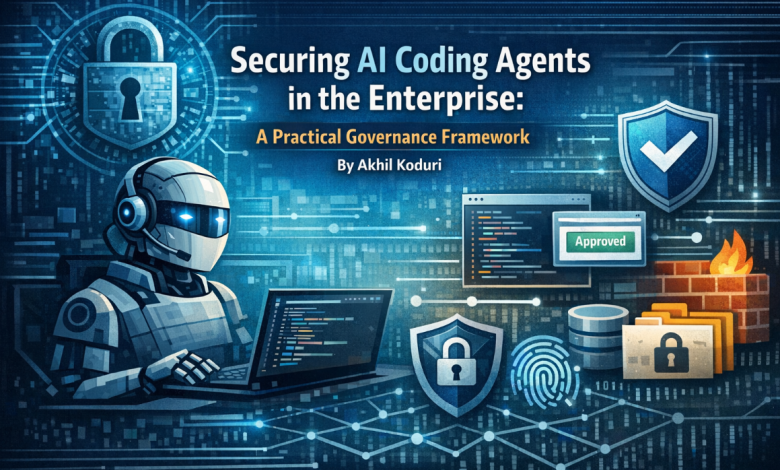
Akhil Koduri, an independent researcher and enterprise AI practitioner, is among a growing group of specialists analyzing these challenges and proposing structured approaches to address them. His recent work introduces a governance framework for AI coding agents, positioning them not merely as developer tools, but as a new execution layer within enterprise environments.
A Shift from Assistance to Autonomy
Traditional developer tools have largely operated within predictable boundaries. Even early AI-powered copilots required explicit human approval for most actions.
However, newer systems — such as terminal-based coding agents — can interpret high-level instructions, execute commands, modify codebases, and interact with external services.
“The risk is no longer limited to what the model generates. It extends to what the agent can execute, access, and propagate across systems.”
— Akhil Koduri
This distinction has important implications. While a flawed code suggestion can be ignored, an autonomous agent with access to credentials, repositories, or infrastructure introduces a significantly broader attack surface.
Emerging Risk Patterns in AI Coding Agents
Akhil Koduri identifies five key risk categories becoming increasingly relevant as enterprises adopt AI coding agents:
· Prompt Injection & Behavioral Manipulation — Malicious inputs embedded in code or documentation can influence agent behavior.
· Credential & Secret Exposure — Agents operating with access to environment variables or configuration files may inadvertently expose sensitive credentials.
· Supply Chain Vulnerabilities — Generated code may include insecure dependencies or outdated cryptographic patterns without automated validation.
· Uncontrolled System Access — Agents with broad permissions may interact with systems and repositories beyond their intended scope.
· Audit & Observability Gaps — Many agent actions — such as intermediate shell commands or in-memory operations — are not consistently logged or attributed.
These risks highlight a common theme: existing enterprise security models were not designed for systems that actively participate in execution workflows.
A Governance Framework for AI Agents
To address these challenges, Akhil Koduri proposes a layered governance architecture introducing controls across multiple levels of the AI agent lifecycle:
1. Developer & Interface Layer — Where agents are invoked through IDEs and prompt interfaces, governed by identity and access controls.
2. Orchestration & Policy Layer — A centralized control plane that evaluates every agent action using defined policies before execution.
3. Execution & Data Layer — Where code runs, files are accessed, and external systems are contacted — ideally within sandboxed, restricted environments.
A defining characteristic of Koduri’s approach is policy mediation. Rather than allowing agents to directly interact with systems, all actions are routed through a policy engine enforcing constraints such as allowed commands, accessible paths, and approved external endpoints.
Identity, Permissions, and Auditability
Koduri’s framework treats AI agents as non-human identities (NHIs) within enterprise systems — a concept increasingly recognized in cloud-native security architecture. Key measures include:
· Assigning short-lived, scoped credentials with automatic expiry
· Enforcing least-privilege access controls at repository, branch, and API levels
· Integrating with existing identity providers through SSO and MFA
· Generating structured, immutable audit logs for every agent action
“Every action an AI agent takes should be more auditable than a human developer’s.”
— Akhil Koduri
Aligning with Enterprise Compliance Requirements
Frameworks like this gain attention because they align with existing regulatory expectations. Controls proposed by Akhil Koduri map to widely adopted standards:
· SOC 2 Type II — access control, logging, and change management
· ISO/IEC 27001:2022 — information security governance
· GDPR — data protection and auditability
· NIST AI RMF — Govern and Manage function alignment
· EU AI Act — human oversight and logging requirements for high-risk AI systems
Embedding AI agent governance into existing compliance structures reduces the risk of introducing gaps while adopting advanced tooling.
Why This Matters Now
The adoption of AI coding agents is accelerating across the industry, driven by productivity gains and developer efficiency.
Koduri’s work reflects a broader shift in thinking: treating AI agents not as isolated tools, but as active participants in enterprise systems with real operational impact. As agents gain capabilities like multi-step planning, cross-system integrations, and autonomous execution, structured controls are essential to prevent unintended consequences at scale.
Looking Ahead
As enterprises integrate AI into software development workflows, frameworks like Koduri’s may shape industry best practices.
Rather than slowing adoption, governance models can enable faster, safer AI adoption, ensuring security, compliance, and auditability are built into the foundation.
The key question is no longer whether to adopt AI coding agents, but how to do so responsibly. Koduri’s framework treats these systems as a new layer in the enterprise execution stack.
About the Author
Akhil Koduri is an independent researcher and enterprise AI practitioner specializing in AI systems, governance, and applied machine learning. He is a Senior Member of IEEE and is pursuing a PhD focused on artificial intelligence. His research, presented at IEEE conferences, centers on the secure and compliant adoption of AI technologies within enterprises, with emphasis on emerging risks and architectural best practices for AI coding agents and autonomous systems.