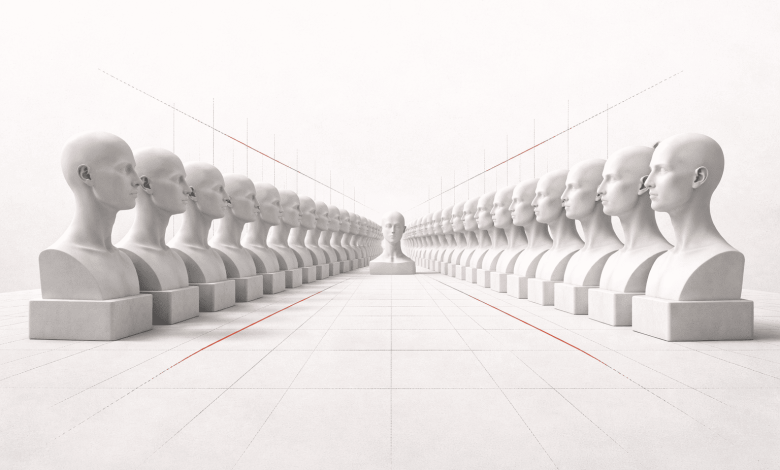
For more than two years, we’ve been told that AI will democratize innovation. It will lower barriers, unlock creativity, and hand every worker a new set of superpowers. While the tools themselves are extraordinary, the reality emerging beneath the hype tells a different story. AI isn’t unleashing a wave of differentiation. It’s driving a wave of convergence.
You don’t get the next Michelangelo, da Vinci, or Marie Curie by optimizing for what’s probable. You get them by tolerating the improbable deviations, the risks, and leaps that no statistical model would ever predict. Yet across industries, teams now generate the same content, the same “personalized” outreach, and the same prototypes. The creative frontier is compressing and models trained on averages reliably reproduce them.
Inside organizations, the pattern becomes even clearer. Early reporting shows that high performers gain exponential leverage, while others struggle to translate the tools into meaningful output. The work may look more standardized on the surface, but the underlying advantage concentrates in fewer hands. The number of true winners narrows.
This isn’t the dawn of a new creative renaissance. It’s the early stage of a creativity recession, driven not in spite of AI’s capabilities, but because of their very nature.
What Happens When Everyone Can Make Anything?
AI’s “creative flattening” effect has a simple origin: a large language model is a compression engine. It doesn’t search for what’s original; it searches for what’s probable. Ask it for a headline, a pitch, or a product idea, and it returns whatever sits closest to the statistical center of its training data.
The result is work that feels polished, but is ultimately interchangeable. Favoring the most probable “right” answers, the system suppresses the rare, non-linear moments where genuine breakthroughs usually occur. AI scales output, but it scales the safest, most familiar version. In practice, the model becomes the creative baseline, and baselines don’t push you forward; they pull everything toward the mean.
Once that normalized style saturates the market, the second-order effect becomes inevitable: oversupply. For the price of a monthly subscription, anyone can spin up an app, a brand identity, or a pitch deck in a matter of hours. But lower friction doesn’t yield better ideas. It produces more of the same idea. More of the same doesn’t diversify a market; it overwhelms it.
Categories fill with look-alike tools and near-identical messaging because everyone draws from the same generative patterns. When creation becomes frictionless, sameness becomes the default. Markets react predictably: discovery collapses, noise dominates, and incumbents consolidate power because brand is the only reliable proxy for trust.
AI democratizes production. It does not democratize originality, and it certainly doesn’t democratize outcomes.
AI is Widening the Performance Gap
This flattening effect doesn’t just play out across markets, it plays out inside companies. AI is quietly dividing teams into two groups – those whose performance accelerates, and those who stall.
The Wall Street Journal calls them “accelerators” and “laggards.” Accelerators – people with strong judgment and established workflows – use AI to amplify what they already do well, and their output compounds. Others hit diminishing returns almost immediately. They struggle to turn AI output into something usable or to evaluate its quality. So in practice, AI doesn’t close skill gaps. It expands them.
The result is that output looks more uniform, but performance grows more uneven. Top performers pull away, and the middle of the organization starts to look increasingly shaky. The same pattern appears across companies. Well-run organizations leap ahead; younger or less disciplined ones fall behind.
Declining Credibility
This widening performance gap creates a second problem: credibility. AI doesn’t just standardize creativity; it also standardizes presentation. And once everything looks polished, it becomes harder to tell which work reflects real insight.
We’ve already seen public examples. A Canadian education accord – a 10-year plan for school reform and ethical AI use – was published with more than a dozen citations to journals and films that don’t exist. And an international study led by the BBC found that leading AI assistants misrepresented news content nearly half the time. In both cases (and many others), the document looked professional. The rigor wasn’t.
Average ideas now arrive in immaculate packaging, with crisp formatting, confident language, and airtight structure, even when the thinking underneath is thin. AI rarely produces work that’s obviously wrong; it produces work that’s plausible enough to approve.
Inside companies, managers hesitate. Review cycles slow down. Teams start second-guessing whether a polished proposal represents judgment or just prompt-craft. And then? Trust erodes. Excellence becomes harder to recognize. And ironically, strong performers suffer – their best work now resembles everyone else’s AI-polished output.
The Way Out
When credibility collapses, organizations retreat to the traits AI can’t fake: depth, discernment, and the ability to decide what matters when the template stops working. If AI compresses the creative landscape, the only defensible strategy is to operate outside its reach – to exercise judgment under uncertainty, spot good ideas before they calcify into consensus, and recognize when a flawless draft is still the wrong answer. AI can produce work. It cannot assign meaning.
The usual rebuttal is that AI unlocks creativity by lowering the cost of experimentation and letting small teams move faster. At the micro level, sure. People feel more capable, more productive. But feeling creative is not the same as producing original work. When everyone relies on the same models, trained on the same averages, and constrained by the same guardrails, output scales while differentiation collapses. Organizations then double down: efficiency is rewarded, and risk-taking is quietly punished.
The real question isn’t whether AI will replace human creativity. It’s whether we’ll let convenience hollow out the kind of judgment progress actually requires. In other words, the real casualty isn’t talent, but the rare leaps that move the world forward. That’s the final nail in Da Vinci’s coffin.
So escaping that fate means developing talent, not just acquiring tools. It means designing for variance, not uniformity. AI may raise the floor but only human judgment raises the ceiling.