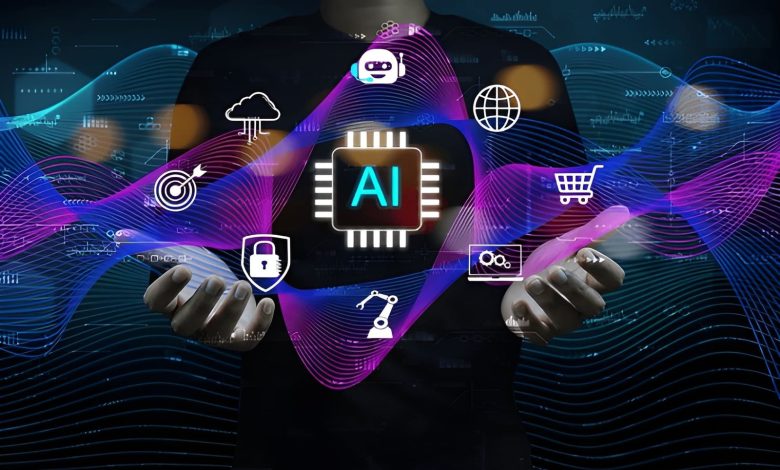
The pace of change in work is much faster than most people expected. From email drafting tools to decision prediction systems, Artificial Intelligence on the future of work is already influencing the way businesses operate. Some jobs are changing behind the scenes, some jobs are being rewritten, and in between, there’s a need to understand how people and intelligent systems work.
If you’ve been trying to figure out what this really means in practical terms, this will give you a clear and grounded view.
Artificial Intelligence on the Future of Work
The shift doesn’t feel dramatic at first. You might notice tasks getting quicker or tools becoming more helpful. Over time, those small improvements begin changing how work actually happens.
Instead, AI is more about incremental changes than revolutionary changes. Businesses are adapting to changes, and teams are adopting smart tools. The expectations are also changing. All of this is closely related to digital transformation because AI is part of the daily routine and not on the sidelines.
Key Trends of Artificial Intelligence on the Future of Work
Autonomous Systems
Some systems now run with very little human input. Inventory tools manage stock automatically, and customer support bots resolve basic queries on their own. These systems are already part of daily business operations.
This is where AI automation becomes visible. Repetitive tasks are handled by machines, which allows people to focus on work that requires judgment and decision-making.
Human–AI Collaboration
In most cases, the involvement of AI is with the human, rather than replacing the human. For a writer, it is a draft tool, for an analyst, it is a tool for gaining insight, and for a designer, it is a tool to help them think and come up with ideas. The final call is still in the hands of the human, but it is a more efficient process. In many cases, companies depend on custom software development to develop tools that align better with their internal workflows.
Automation & Productivity
One clear shift is speed; tasks that once took many hours can now be completed much faster. This doesn’t reduce work; it changes the type of work being done. Teams spend less time on repetitive steps and more time on strategy, problem-solving, and improvement.
Impact of Artificial Intelligence on the Future of Work on Jobs
Job Disruption vs Job Creation
Some roles are definitely being affected, especially those that rely heavily on routine tasks. However, the shift isn’t one-sided. New opportunities are also emerging at the same time.
According to the World Economic Forum, millions of jobs are expected to be created alongside automation. So instead of looking at it as a loss, it’s more accurate to see it as a transition.
Jobs Most Affected by AI
- Data entry and administrative roles
- Basic customer support functions
- Repetitive processing jobs in operations
- Entry-level analytical tasks
These roles rely heavily on predictable workflows, which makes them easier to automate.
Jobs Growing Due to AI
- AI specialists and data analysts
- Product managers for AI-driven systems
- UX designers working with intelligent interfaces
- Roles focused on strategy and decision-making
These positions require judgment, creativity, and adaptability, areas where human input still matters a lot.
Emerging Roles and Skills
The nature of work is shifting toward roles that didn’t exist a few years ago. At the same time, expectations from existing roles are changing.
Key Skills in Demand
- Ability to work with AI tools in daily tasks
- Understanding and interpreting data insights
- Managing and supervising AI-driven systems
- Connecting technical outputs with business decisions
This is where the idea of an AI-powered workforce becomes more practical. It’s not about deep technical expertise for everyone; it’s about being comfortable working alongside AI.
Shift in Work Nature
- Less focus on repetitive execution
- More emphasis on problem-solving
- Increased need for critical thinking
- Greater collaboration between technical and non-technical teams
Over time, this shift changes not just what people do but how they approach their work.
Benefits of Artificial Intelligence on the Future of Work
| Benefit | What It Means in Real Work Scenarios |
| Faster Operations | Routine tasks like reporting and scheduling are completed quickly, helping teams move faster without delays |
| Better Decision-Making | AI identifies patterns in large datasets, making it easier to make informed decisions |
| Cost Efficiency | Reducing manual effort and minimizing errors leads to lower operational costs |
| Improved Customer Experience | Faster responses and personalized interactions improve overall service quality |
| Scalability | Businesses can handle increased workloads without expanding teams at the same rate |
These benefits are already showing up across industries. Teams are able to move more quickly, make better calls, and handle more work without constantly increasing resources. In many cases, the shift feels gradual, but the impact builds over time.
Many companies scale these improvements through AI development services, especially when they want to apply AI across different parts of the business without disrupting existing systems.
At the same time, there are a few challenges that can’t be ignored. AI systems can reflect bias if not trained carefully, and data privacy is still a concern when large volumes of user information are involved. There’s also the human side—some teams adapt quickly, while others need more time to adjust.
How to Adapt to Artificial Intelligence on the Future of Work
- Start with small AI implementations instead of large-scale changes
- Focus on building skills, not just adopting tools
- Stay updated as AI continues to evolve
- Keep job roles flexible rather than fixed
- Encourage collaboration across teams
- Ensure ethical and responsible use of AI
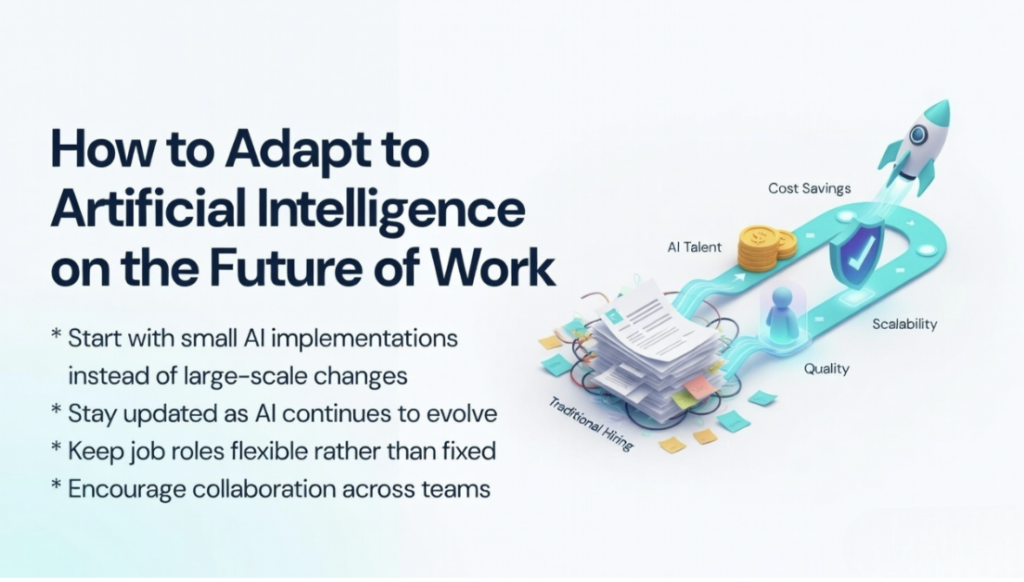
In many cases, adapting successfully comes down to mindset more than technology.
Conclusion on Artificial Intelligence on the Future of Work
When you look at the bigger picture, Artificial Intelligence on the Future of Work is about changing how work gets done rather than replacing people entirely. Some roles will fade, others will grow, and many will evolve into something new. The shift is already happening, and it’s likely to continue steadily. The real advantage comes from understanding these changes early and adjusting along the way.