
Artificial intelligence is rapidly transforming the way software is built — and one of the biggest changes is happening in cost.
Just a few years ago, building an app required large teams, long timelines, and significant investment. Today, AI-powered tools and no-code platforms are reshaping that reality, making development faster and more accessible.
But how much does AI actually impact app development costs in 2026? Let’s break it down.
The Traditional Cost of App Development
Traditionally, building an application required multiple specialized roles working together:
- Frontend developers
- Backend engineers
- UI/UX designers
- QA testers
- Project managers
Because of this structure, development was expensive and time-consuming.
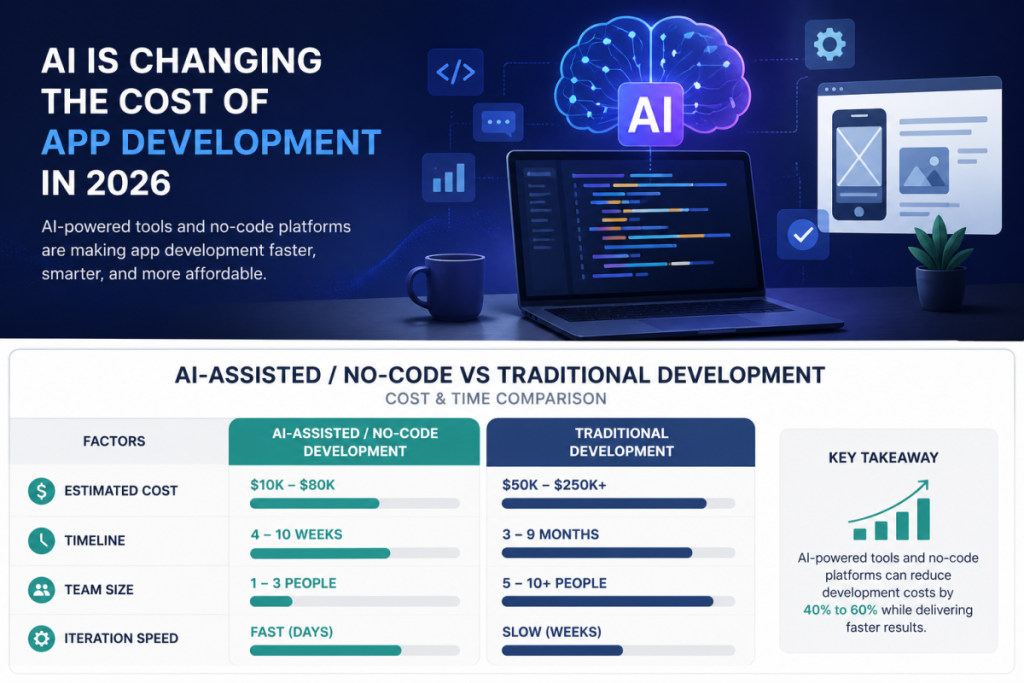
In the United States, a typical custom app could cost anywhere from $50,000 to $250,000 or more, depending on complexity, features, and integrations.
The main cost drivers included:
- Development time
- Team size
- Iteration cycles
- Ongoing maintenance
Even small changes could take days or weeks, increasing overall project costs.
How AI Is Changing the Development Process
AI is not replacing developers, but it is making them significantly more efficient.
Today, teams use AI to:
- Generate code faster
- Automate testing and debugging
- Build interfaces more quickly
- Improve performance
- Reduce repetitive work
This allows smaller teams to deliver results that previously required much larger groups.
In many cases, projects that once took several months can now be completed in just a few weeks.
According to recent advancements in artificial intelligence, development workflows are becoming increasingly automated, reducing both time and cost.
The Rise of No-Code and AI-Assisted Development
Another major factor reducing costs is the growth of no-code and low-code platforms.
Tools like Bubble and FlutterFlow allow developers — and even non-developers — to build applications visually, without writing extensive code.
When combined with AI, these platforms become even more powerful:
- workflows can be automated
- integrations become easier
- features can be built faster
This approach can reduce development costs by 40% to 60% compared to traditional methods.
Real Impact on App Development Costs
AI is lowering costs in several key ways:
- Faster Development Cycles
Less time spent building means lower overall cost.
- Smaller Teams
Projects that once required 5–10 people can now be handled by smaller teams.
- Lower Iteration Costs
Changes that used to take days can now be implemented in hours. AI vs
Traditional Development: Cost Comparison
Approach Estimated Cost
Timeline
Traditional Development $50K – $250K+ 3–9 months
AI-Assisted / No-Code $10K – $80K 4–10
weeks
While AI-assisted development is not always the best choice, it is becoming the preferred option for startups and businesses that need speed and efficiency.
When Traditional Development Still Makes Sense
Despite its advantages, AI is not a perfect solution for every scenario. Traditional development is still necessary when:
- highly complex systems are required
- custom infrastructure is needed
- performance at scale is critical
- advanced integrations are involved
Choosing the right approach depends on the project’s goals and technical requirements.
Understanding the Full Cost Breakdown
While AI can significantly reduce costs, understanding how pricing works is still essential.
If you want a more detailed explanation — including feature-based pricing, real-world examples, and ways to reduce development costs — check this app development cost guide.
The Future of App Development
AI is quickly becoming a core part of the development process.
As tools continue to evolve, we can expect:
- faster development cycles
- lower costs
- easier access to software creation
Businesses that adopt these technologies early will be able to build and launch products more efficiently.
Final Thoughts
The cost of building an app in 2026 is no longer fixed — it depends heavily on the tools and strategies used.
AI is making development more efficient, flexible, and affordable.
For companies looking to move fast without overspending, combining AI with modern development approaches is becoming the smartest path forward.