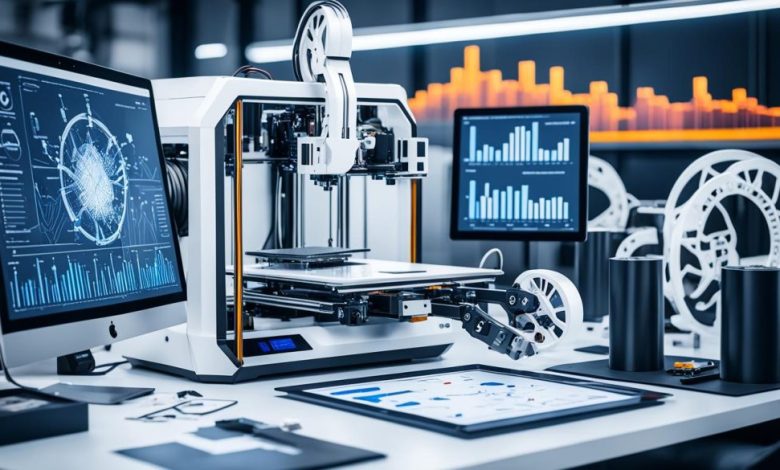
Additive manufacturing has always lived in a bit of a gray area. Some see it as the future of production, others still treat it as a prototyping tool that never quite scales. Most engineering teams land somewhere in between. What’s changed, though, is the role artificial intelligence now plays in that middle ground.
3D printing services are no longer just about producing parts quickly. They’re becoming part of a broader, AI-assisted workflow that helps teams make better decisions earlier in development. With the rise of generative design tools and machine learning-based simulation, additive manufacturing is starting to act less like a standalone capability and more like a connective layer between concept and production.
That shift is subtle, but it shows up in how teams approach uncertainty. AI doesn’t replace the need for physical validation. It changes when and how that validation happens.
Early Development Is Becoming More Predictive
The earliest stages of product development have always been messy. Designs are fluid, assumptions are everywhere, and changes are still cheap. That’s exactly where AI is starting to have the most impact.
Engineers are now pairing physical prototypes with AI-driven modeling tools that can simulate geometry, material behavior, and assembly constraints before anything is finalized. Instead of waiting for a prototype to reveal problems, teams can flag potential issues in advance. That doesn’t eliminate surprises, but it reduces how many make it through.
3D printing still plays a key role here. It acts as a fast validation step, but now it’s informed by predictive insights rather than guesswork. When those insights are missing, teams often find themselves correcting issues much later, when changes are slower and more expensive to implement.
Iteration Is No Longer Linear
One of the long-standing advantages of additive manufacturing is speed. Parts can be produced directly from CAD, often within hours or days. That alone changes how teams iterate.
What AI adds to that process is direction.
Instead of testing variations randomly, engineers can use AI to guide which iterations are worth exploring. A housing might still be printed in multiple wall thicknesses, or a feature adjusted across several versions, but those decisions are increasingly informed by simulation outputs and historical data.
The result feels different in practice. Development moves through tighter, more informed loops. Designs evolve through smaller, more frequent adjustments rather than large, high-risk revisions. It’s less about speed for its own sake and more about reducing wasted cycles.
Prototypes Are Becoming More Intentional
Not all printed parts serve the same purpose, and that distinction matters more as workflows become more data-driven.
Some prototypes are visual. They help teams understand form, scale, and how a product feels in use. Others are functional, meant to test fit, motion, or performance under load. Selecting the right rapid prototyping process helps teams create physical models that match the specific design, validation, or performance questions they need to answer.
AI is helping teams decide which type of prototype they actually need. Instead of defaulting to high-fidelity prints, engineers can use simulation results to determine whether a visual model is enough or if functional testing is necessary.
That decision-making layer often gets overlooked, but it can save both time and cost. Matching the prototype to the question being asked is where a lot of efficiency gains happen.
AI Doesn’t Remove Constraints. It Surfaces Them Earlier
There’s a tendency to think of additive manufacturing as removing design limitations. In reality, it shifts them.
Print orientation, layer adhesion, support structures, and post-processing all influence the final outcome. These factors don’t disappear just because a design looks clean in CAD.
What AI does is make those constraints more visible earlier in the process. Generative design tools can suggest optimized geometries, often reducing weight or improving strength. But those designs still need to be manufacturable.
Machine learning models are starting to predict print success rates based on geometry, flagging areas where distortion or failure is likely. That kind of feedback used to come after a failed print. Now it can show up before anything is built.
It’s not perfect. Engineers still need to interpret the results. But it shifts the feedback loop forward in a way that changes how designs evolve.
Material Decisions Are Still Grounded in Reality
Material options for additive manufacturing have expanded quite a bit, especially for polymers. Many now approximate the behavior of production plastics closely enough to support meaningful testing.
Even so, differences remain.
Printed parts can vary in strength depending on orientation. Surface finish may require additional processing. Long-term durability under stress or environmental exposure can differ from injection-molded equivalents.
AI can help model some of these variables, but it doesn’t eliminate the need for physical validation. Engineers are still looking for directional insight rather than perfect replication. The goal is to understand whether a design works well enough to justify moving forward.
Where AI-Driven Additive Manufacturing Delivers the Most Value
The real value of combining AI with 3D printing shows up in specific scenarios.
Early-stage development is the clearest example. Designs are still evolving, and committing to tooling too soon introduces risk. AI helps narrow down viable options, while additive manufacturing allows those options to be tested quickly, becoming a reliable part of custom manufacturing.
Complex geometries are another area where this combination stands out. AI-generated designs often include internal structures or shapes that would be difficult to produce using traditional methods. Additive manufacturing makes those designs physically possible without requiring extensive tooling.
There’s also a role in bridge production. When volumes are uncertain or tooling is still in progress, printed parts can fill short-term needs. AI can help forecast demand and optimize production runs, making that transition smoother.
Integration Is Quietly Changing the Workflow
Not long ago, working with 3D printing services involved a lot of manual coordination. Files were sent back and forth, quotes took time, and manufacturability feedback wasn’t always consistent.
That’s starting to change.
More integrated platforms now combine design evaluation, AI-driven feedback, and production workflows into a single environment. Files can be analyzed almost immediately. Potential issues are flagged early. Production moves forward with fewer interruptions.
It doesn’t feel dramatic, but it reduces friction in ways that make additive manufacturing easier to rely on. Over time, that consistency is what allows it to become part of a broader manufacturing strategy rather than an occasional tool.
A More Practical Role for AI in Manufacturing
AI hasn’t turned additive manufacturing into a universal solution. Most teams aren’t treating it that way, and that’s probably a good thing.
Instead, it’s helping define where 3D printing fits best.
Used in the right context, it reduces uncertainty. Designs can be tested earlier. Assumptions can be challenged before they become costly mistakes. Fewer surprises make it into production.
Traditional manufacturing processes still handle scale and efficiency. AI and additive manufacturing support those processes by improving the decisions that lead into them.
That balance feels more realistic. And for most teams, it’s where the real value shows up.