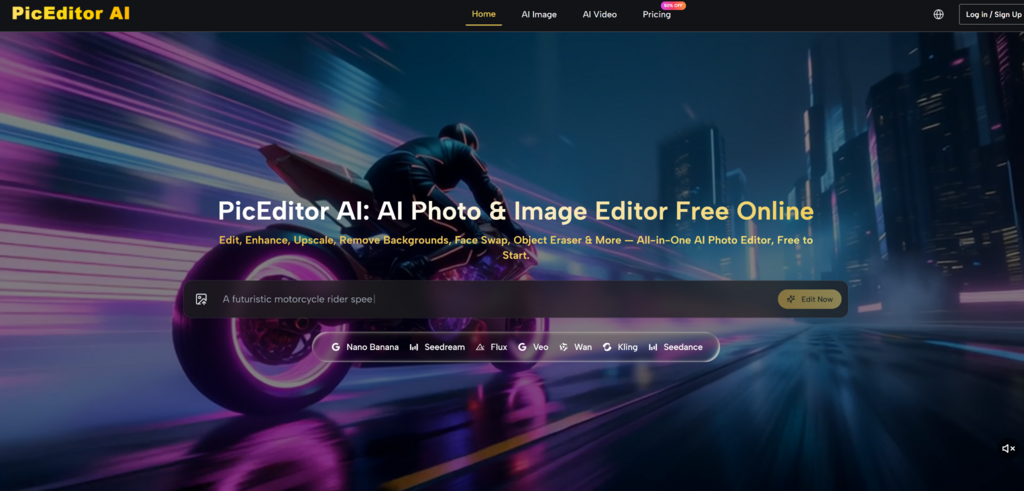
Many people do not struggle because they lack ideas. They struggle because turning an idea into a polished image usually means juggling too many steps, too many tools, and too many technical decisions. One platform sharpens the image, another removes distractions, another changes style, and yet another handles animation. The work becomes fragmented long before the creative vision becomes clear. That is where AI Photo Editor tools like PicEditor AI become interesting. Instead of asking you to build a workflow across separate apps, PicEditor AI presents image editing as a more unified process: upload, describe, refine, and export.
That shift matters because speed alone is not the real advantage of AI editing. The deeper advantage is continuity. When enhancement, generative editing, style transformation, and even photo-to-video live in one place, the user spends less time moving files around and more time deciding what the image should become. In practice, that changes the creative experience from software management to visual direction.
PicEditor AI is built around that kind of experience. It does not frame editing as a narrow utility. It frames it as an AI-assisted visual workflow that can move from correction to transformation to animation without forcing the user to restart the process in another environment.
Why Modern Image Editing Is Becoming a Workflow Problem
Traditional editing often assumes the user already knows what tool to use. That assumption breaks down quickly in real creative work. A seller wants a product image cleaned up, a marketer wants the background changed, a designer wants a consistent style, and a creator wants to turn the result into motion content. These are connected goals, but they are often handled in disconnected systems.
The Real Bottleneck Is Not Imagination
Most users can already describe what they want. They know they want sharper detail, cleaner composition, better lighting, removed objects, or a more cinematic look. The friction comes from translating those intentions into multiple technical actions. In older workflows, every improvement has its own method. In AI-assisted workflows, language becomes part of the interface.
That is one reason PicEditor AI feels aligned with where editing is heading. The platform is not centered only on manual adjustment. It is structured around guided modification. You upload an image, choose the kind of transformation you want, then describe the result you are aiming for. That is a much more natural bridge between idea and output.
Why Unified Platforms Feel More Useful
An isolated feature can be impressive in a demo. A unified workflow is more valuable in daily use. When a platform includes enhancement, object removal, background replacement, style transfer, image variation, and photo animation in the same ecosystem, the user does not have to rebuild momentum every time the goal changes.
That continuity is especially important for people who work iteratively. A first version may only need cleanup. A second version may need stronger style. A third may become a social video asset. The ability to evolve one visual idea across multiple stages is often more useful than having one excellent feature in isolation.
How PicEditor AI Actually Operates
At AI Image Editor level, PicEditor AI appears to follow a simple logic: reduce editing into a sequence that begins with an image and ends with an interpreted result. That sounds obvious, but it changes the design philosophy of the product.
Upload First, Then Direct the Change
The workflow starts with an uploaded image rather than a blank creative canvas. That makes the platform particularly suitable for users who already have source material: portraits, product shots, concept images, brand visuals, screenshots, or campaign assets. Instead of starting from nothing, the user starts from something existing and improves or transforms it.
This Changes the Role of the User
In a traditional editor, the user behaves like a technician. In a modern AI editor, the user behaves more like a director. The task is not to execute every micro-adjustment manually. The task is to define intent clearly enough that the model can interpret it well. That lowers the skill barrier without removing creative agency.
Choose a Tool or Model Based on the Job
One of the more distinctive aspects of PicEditor AI is that it is not presented as a single-model environment. It integrates multiple engines for image and video tasks. That matters because not every editing goal benefits from the same type of model.
Some tasks reward realism. Some reward speed. Some require precision in object-level edits. Some need stylistic flexibility. Some are better understood as motion problems rather than image problems. A multi-model platform gives the user a better chance of matching the tool to the job instead of forcing every request through one aesthetic or technical pipeline.
Why Model Choice Can Matter More Than Filters
Filters are fixed treatments. Model choice is a strategic decision. A user who wants photorealistic detail may prioritize a different engine than a user who wants fast iteration or context-aware modifications. In that sense, PicEditor AI is not just selling “editing.” It is selling access to different editing behaviors inside one platform.
Describe the Change in Plain Language
The platform’s underlying promise is that edits become easier when the system understands descriptive intent. That can mean asking for better detail, a new background, removed distractions, a transformed visual style, or a more polished commercial look.
Language Becomes the Control Surface
This is where the platform becomes more than a convenience tool. It reflects a larger change in creative software: language is starting to replace some of the complexity that used to live in menus and sliders. That does not eliminate the need for taste or judgment. It simply moves creative control into a more intuitive form.
What PicEditor AI Seems Best Suited For
The strength of a platform like this is not just what it can do, but what kinds of users benefit most from how it is structured.
A Better Fit for People Who Need Versatility
If someone only wants a single narrow function once in a while, almost any editor may feel sufficient. But if the user moves across cleanup, transformation, branding, and content production, versatility becomes more important than any one feature. PicEditor AI appears designed for exactly that broader use case.
Product and E-commerce Visuals
Sellers often need more than one adjustment at a time. They may want a cleaner background, better subject clarity, sharper resolution, and stylistic consistency across listings. A workflow that supports enhancement and generative editing in one place can reduce a lot of repetitive effort.
Creator and Social Media Workflows
Creators increasingly need still images and motion assets as part of the same publishing rhythm. A platform that can begin with image refinement and extend into photo-to-video makes more sense in that environment than a tool that stops at static editing.
Design Exploration and Concept Iteration
For ideation, speed is important, but so is variation. The ability to compare looks, test styles, and guide outputs with reference material can make the platform useful for concept exploration rather than just correction.
Why Reference Support Matters Here
Consistency is one of the most practical problems in AI image work. When a platform supports reference images, it becomes easier to maintain the identity of a character, the tone of a brand, or the visual direction of a campaign. That may sound like a small feature, but in repeated creative work it becomes a major advantage.
What Makes the Platform Feel More Advanced Than a Basic Free Editor
A lot of platforms call themselves easy. Fewer give the sense that they can scale with more demanding work. PicEditor AI appears to push beyond beginner convenience in a few meaningful ways.
It Balances Accessibility and Professional Ambition
The interface logic seems approachable, but the feature set is not limited to entry-level editing. It reaches into 4K-oriented output, context-aware modification, style transfer, object-level changes, and commercial usage scenarios. That combination is important because many users do not want to outgrow a tool too quickly.
It Expands from Image Editing Into Visual Production
Some AI editors improve a picture and stop there. PicEditor AI extends the workflow toward animation and multimedia. That matters because the border between image creation and content production is getting thinner. More users now expect a visual platform to support both still and moving outputs.
This Is a Bigger Shift Than It First Appears
When one platform handles the path from image refinement to animated result, it changes how users think about creative assets. A photo is no longer a final state. It becomes a starting point for multiple deliverables: a hero image, a stylized variation, an ad concept, a moving teaser, or a social clip.
How to Use PicEditor AI in a Simple Practical Flow
A straightforward way to think about the platform is this:
Step 1: Upload the Source Image
Start with the image you already have, whether it is a portrait, product shot, branded asset, or concept visual.
Step 2: Choose the Editing Direction
Decide whether the image needs enhancement, generative change, object cleanup, background replacement, style transfer, or motion.
Step 3: Describe the Outcome Clearly
Use direct language to explain what should change, what should stay, and what kind of look you want
Step 4: Compare, Refine, and Extend
Review the result, try another model or direction if needed, and continue into animation if the image is meant to become video content.
PicEditor AI Compared with Narrower Editing Tools
| Platform Type | Main Strength | Main Limitation |
| Single-purpose cleanup tool | Fast for one specific task | Limited creative range |
| Traditional manual editor | Deep control for skilled users | Slower and more technical |
| Basic AI image editor | Easy for quick edits | Often weak in model variety |
| PicEditor AI style platform | Broad workflow from edit to transformation to animation | Best results still depend on clear prompting and good source images |
Where Its Limits Still Matter
A strong AI editor can reduce friction, but it does not eliminate the need for judgment.
Not Every Request Is Equally Precise
AI-guided editing works best when the goal is clear. Vague instructions can still lead to outputs that feel close but not exact. That means the platform helps most when the user can communicate intention well.
Source Quality Still Influences Output
A better original image usually creates a better editing foundation. AI can improve, restyle, and reinterpret, but weak source material can still limit how clean or credible the final image feels.
Convenience Does Not Mean Infinite Control
That distinction matters. PicEditor AI seems designed to make powerful editing more accessible, not to replicate every microscopic control of a traditional professional retouching environment. For many users, that tradeoff is worth it. For certain highly exacting workflows, manual tools may still remain part of the final polishing stage.
Why PicEditor AI Stands Out Right Now
What makes PicEditor AI notable is not just that it offers AI image editing. Many platforms now do. What stands out is the way it frames editing as a connected visual process rather than a list of disconnected tricks. The product appears to understand that modern users do not only want sharper photos. They want fewer workflow breaks, more flexible output paths, and a better way to move from idea to finished visual.
That is why PicEditor AI feels more substantial than a simple novelty editor. It is not just helping users alter images. It is helping them manage creative momentum. And in a market crowded with one-feature promises, that kind of continuity may be the real differentiator.