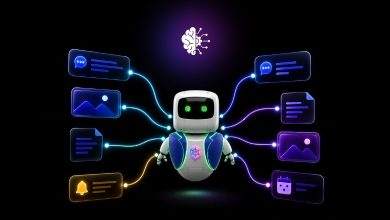
Most enterprise AI systems are not failing because of the models but rather because of the way they’re designed. When the MIT report sent shockwaves through the enterprise AI market last year that “95% of generative AI pilots deliver zero return on investment” a large portion of the discourse missed the quiet pattern that has emerged across enterprise AI deployments. The biggest failures are not coming from weak models. They are coming from how those models are embedded into existing workflow systems.
I have deployed AI across contact centres for Fortune 500 companies. In one deployment worked on, an AI agent handling a billing dispute would escalate the conversation to a human around 40% of the time.When this happens the user waits. Context is lost. The human reconstructs the issue. Resolution slows, costs rise and the experience degrades. This translates to the so-called “zero percent return on investment”.
This is not an edge case. It is the dominant operating model for AI in complex production environments today.
And it is fundamentally broken.
As large language models evolve from assistive tools into autonomous agents, most enterprises are still relying on interaction patterns designed for rules-based bots or early generative AI. Escalation paths and approval gates may reduce perceived risk, but they systematically degrade performance at scale.
The result is a widening gap between what AI systems are capable of and what they actually deliver in production.
Closing that gap requires rethinking not just the models, but the system itself.
The hidden cost of escalation based architectures
The default architecture is simple. The AI attempts to resolve a task, and when it encounters uncertainty, it hands off control to a human.
In practice, this creates structural inefficiencies which ultimately defeats the purpose of scaling AI.
Context fragmentation forces humans to reconstruct context even when transcripts exist. Latency and wait times spikes emerge as escalations introduce queueing delays that break real time interaction. Skilled operators are pulled into case management instead of high value decisions. Human interventions are rarely captured as structured feedback, limiting system learning.
From a systems perspective, escalation is a hard context switch. Execution halts, ownership transfers and continuity is lost.
It also creates a ceiling on automation. Even highly capable models encounter ambiguity, and in escalation driven systems, each of those moments reintroduces human labor as a blocking dependency. This isn’t scaling. It’s a bottleneck with better branding.
Why approval based human-in-the-loop models do not scale
Some organizations attempt to mitigate risk by requiring human approval for every AI generated response.
While this improves control, it introduces a different failure mode. In high throughput environments, such as the ones in customer contact centre use cases, this model leads to linear scaling of human effort, increased response latency and reduced system responsiveness. The system becomes human limited by design. This approach can work in low volume or highly regulated workflows. But in real time, multi-turn interactions, it collapses under its own weight. Ultimately, what is left is an expensive AI agent resulting in the same outcomes as the rule-based bots of the past.
A better model collaborative inference loops
The issue is not whether humans should be involved. It is how. Enterprises are targeting the highest value outcomes which are the most complex from both a real-world unpredictability perspective as well as from a system ecosystem perspective.
A more effective pattern is to treat human input as an embedded, on demand component within the system’s execution loop, not as a fallback. In this model, the AI agent retains control of the interaction but can request targeted human input when needed without handing off the entire task and only to unblock a specific point in the workflow.
The flow changes. The AI agent maintains full conversational context. When uncertainty crosses a threshold such as low confidence, policy ambiguity or missing data, the system generates a structured query. A human provides a scoped input such as a classification, approval or missing parameter. The agent incorporates that input and continues execution. Instead of breaking the system, human judgment becomes part of it. This preserves continuity, reduces latency and allows the system to scale without constant handoffs. Ultimately, it allows scale to complex implementations where the largest ROI exists for enterprises.
What this requires at the system level
Shifting to this model requires rethinking multiple layers of the stack.
Systems need to build three triggers; confidence thresholds, policy driven triggers and anomaly detection. These signals should be the basis to route decisions between autonomy, augmentation and escalation, with escalation as the exception.
Instead of full handoffs, systems generate targeted prompts such as which part of these two conflicting policy articles is correct, approving or rejecting an action such as a refund or providing a missing parameter such as an airport code. This scales human input to operate across many interactions.
Finally, we only get better if we learn so every human interaction should become structured training data. Decisions should be logged with context, surfaced to configurers for model corrections and fed into fine tuning or retrieval pipelines. In most systems today, human input resolves the present but does nothing for the future.
The operational unlock parallelizing human judgment
The most overlooked advantage of this model is its impact on productivity.
In today’s escalation based systems, let’s take contact centres, one human handles one interaction at a time on average across the industry. Work is sequential and blocking. In the above collaborative loop model, humans perform micro-interventions across many interactions simultaneously. Human agents don’t need to spend 3 to 4 minutes interacting with customers but providing 30 second instructions to AI agents based on the queries surfaced. The productivity gains become fundamentally better.
This enables higher effective concurrency, better use of domain expertise and lower cost per interaction.
Rethinking the role of humans in AI systems
As AI systems become more capable, the role of humans is shifting from executor to embedded decision layer within the system. The human is the instructor across workflows. This pattern extends beyond customer experience where human agents are becoming managers of AI agent teams.
In financial systems, humans validate edge cases without halting pipelines. In security operations, analysts classify ambiguous signals without interrupting detection flows. In machine learning operations, experts guide model behavior without full retraining cycles. In each case, the same principle applies. Integrate human judgment without breaking system execution.
The next bottleneck is not the model it is the system
For the past few years, progress in AI has been driven by better models.
But in production environments for enterprises, model capability is no longer the limiting factor. System design is. Enterprises that continue to rely on escalation heavy or approval driven humans in the loop models will face the same outcomes. Rising costs, degraded user experiences and stalled automation.
The organizations that break through will rethink the interaction model entirely. Not as a handoff between humans and machines, but as a tightly integrated system where both operate in the same loop.
The future of enterprise AI will not be defined by how often humans step in.
It will be defined by how seamlessly they are woven into the system, turning intelligence from something that pauses under uncertainty into something that scales because of it.
Bio
Panagiotis ‘Peter’ Coutoulas is a Product Lead at ASAPP, where he builds AI systems powering customer experience for Fortune 500 enterprises.