In asset-intensive industries, operational performance is directly tied to the quality of underlying MRO data. Despite significant investments in enterprise technology — including ERP, EAM, and CMMS platforms — organizations continue to experience suboptimal asset uptime, excess inventory, and procurement inefficiencies. The root cause is consistently traced back to fragmented, inconsistent MRO data across core systems, where unsynchronized material masters, equipment records, maintenance histories, and supplier data generate operational friction at scale.
This blog examines how structured MRO data management drives operational performance across five key business functions, why it is a strategic priority for asset-intensive organizations, and how MRO master data management services help.
Key Benefits of MRO Data Management
1. Improved Asset Uptime
Maintenance execution becomes more precise with accurate parts identification, verified asset specifications, and reduced resolution cycles — resulting in faster turnaround and a measurable reduction in unplanned downtime. Well-governed MRO data further enables inventory management strategies such as criticality-based spare management, where stocking decisions are aligned to asset risk and failure impact.
Operational Impact: Accurate and accessible spare parts data drives a reduction in Mean Time to Repair (MTTR) and strengthens overall asset availability — directly influencing plant reliability and maintenance cost efficiency.
2. Optimized Spare-Parts Inventory Management
Unstructured MRO data directly contributes to inventory inefficiency — characterized by duplicate SKUs, obsolete stock, and excess holdings that inflate inventory value and lock up working capital. Accurate classification, deduplication, and standardization of MRO master data provide organizations with a reliable and consolidated inventory view, enabling consumption-based demand analysis and systematic SKU rationalization.
Operational Impact: Standardized MRO master data enables SKU rationalization, reduces inventory carrying costs, eliminates capital tied up in obsolete and excess stock, and supports demand-driven stock level optimization across the spare parts portfolio.
3. Enhanced Maintenance Planning and Scheduling
Poor MRO data introduces friction into maintenance planning, where work orders referencing incorrect or unverified part numbers result in last-minute parts expediting and schedule slippage. Structured MRO data ensures that work orders are linked to validated material records, enabling accurate BOM alignment, reliable parts reservation, and material readiness for planned maintenance execution.
Operational Impact: Validated MRO data reduces unplanned parts expediting, improves work order accuracy, and strengthens the overall reliability of maintenance schedules.
4. Improved Procurement Control and Spend Visibility
Fragmented material and supplier records result in the same part being procured under multiple descriptions or SKUs — preventing spend consolidation on interchangeable materials and increasing off-contract purchasing. Standardized MRO data strengthens part classification and material master governance, enabling procurement teams to consolidate demand, enforce sourcing governance, and improve contract compliance. This is particularly important in high-SKU environments where inconsistent part descriptions distort procurement analytics and weaken category control.
| “High MRO procurement costs mean less working capital on hand, and less capital makes an organization financially vulnerable to sudden consumer or supply chain shifts. —-Amazon |
Operational Impact of Clean MRO Data: Clean & governed MRO master data improves spend visibility, reduces procurement tail spend, strengthens sourcing leverage, and minimizes invoice discrepancies and reconciliation effort.
5. Supports Predictive Maintenance and Reliability Analytics
Predictive maintenance and reliability analytics programs rely on accurate asset data, complete maintenance histories, and validated part-to-asset linkages to generate reliable outputs. When MRO data is structured and classified, it feeds analytical models that identify failure patterns and support condition-based maintenance decisions — enabling a shift from reactive to predictive maintenance execution. Without this data foundation, analytics outputs remain estimate-driven rather than condition-driven, limiting the effectiveness of any reliability program.
Operational Impact: Governed MRO data improves failure mode identification, supports condition-based maintenance scheduling, and reduces unplanned downtime — directly improving asset availability and lowering maintenance cost per asset.
The Digital Roadmap: Aligning MRO Data Maturity with Asset Performance Management
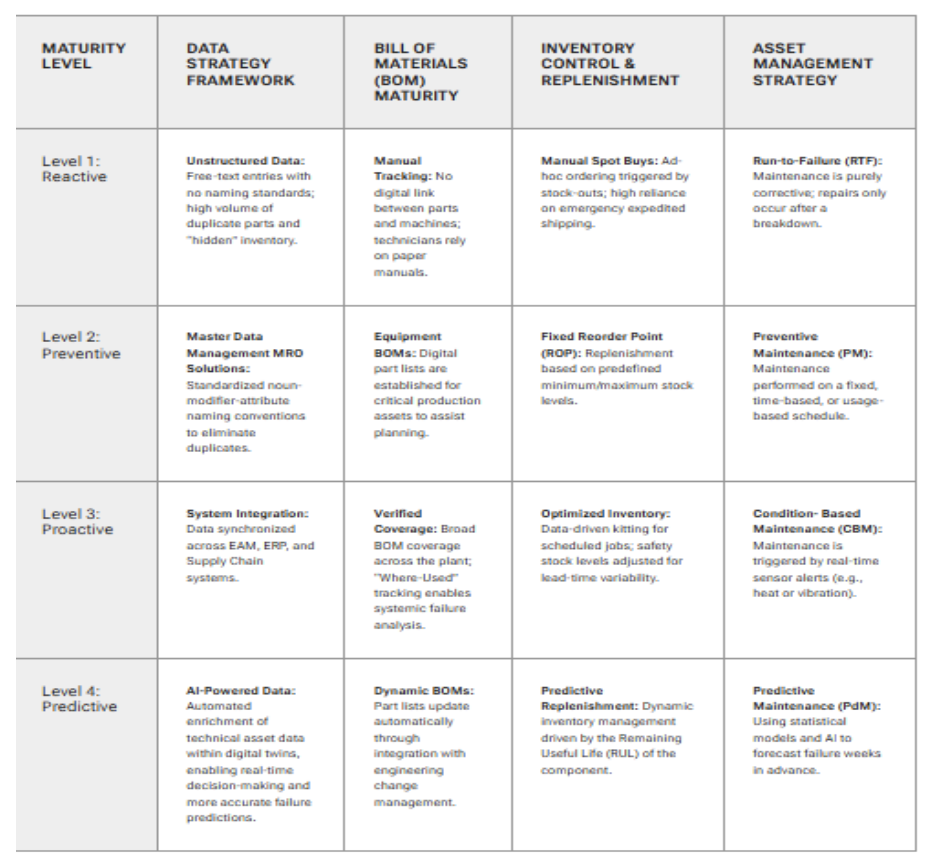
Source: SunTec India
MRO Data Management: Operational Impact Across Key Business Functions
| Operational Area | Fragmented MRO Data | Governed MRO Data |
| Asset Uptime | BOM inaccuracies and unvalidated part-to-asset linkages extend repair cycles and increase MTTR | Accurate BOM alignment and validated material records reduce MTTR and improve asset availability |
| Inventory Management | Duplicate SKUs and obsolete stock inflate inventory value and lock up working capital | Demand-based stocking and SKU rationalization optimize stock levels and free up working capital |
| Maintenance Planning | Unvalidated work order references and last-minute parts expediting cause schedule slippage | Material reservation against validated work orders and accurate parts linkages improve schedule adherence |
| Procurement Control | Inconsistent material descriptions drive maverick spending and reduce contract compliance | Standardized material master data improves spend visibility and enforces sourcing governance |
| Reliability Analytics | Inconsistent failure coding limits predictive maintenance effectiveness | Standardized failure coding and integrated asset histories strengthen predictive analytics reliability |
MRO Data Management Across Asset-Intensive Industries
- Oil and Gas — Safety-critical asset traceability and regulatory compliance depend on accurate, auditable parts and maintenance records across high-risk operating environments.
- Utilities and Energy — Consistent maintenance data across geographically dispersed infrastructure is essential for condition-based maintenance and unplanned outage prevention.
- Manufacturing — Clean MRO data underpins production continuity, enabling digital maintenance programs and reducing the cost of unplanned downtime on throughput-critical assets.
- Mining — Accurate parts classification and asset-to-part linkages are critical for managing spare parts availability in remote, high-criticality operations with long procurement lead times.
- Aviation — MRO operations require complete and accurate parts traceability, maintenance records, and certification documentation across line maintenance, base maintenance, and component overhaul — making structured MRO data a foundational requirement for regulatory compliance and operational continuity.
The Strategic Imperative: As asset-intensive industries become increasingly dependent on digital maintenance programs, predictive analytics, and lean inventory practices, the quality of underlying MRO data determines how effectively these investments perform. Managing MRO data at scale requires specialized taxonomy expertise, classification frameworks, and sustained governance capacity that most in-house teams cannot consistently deliver alongside core operational responsibilities.
Specialized MRO data management services provide the domain knowledge, standardization infrastructure, and dedicated capacity that organizations need to eliminate data-driven inefficiencies — ensuring accurate material masters, optimized inventory positions, and a reliable data foundation for maintenance and procurement performance.