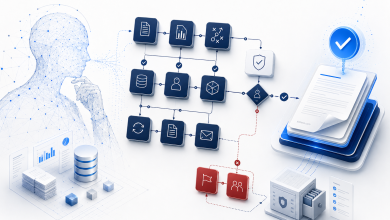
This article proposes a pre-implementation failure framework for AI procurement, identifying data fragmentation and governance misalignment as the primary drivers of project failure. While prior research has focused on model performance and algorithm selection, limited attention has been given to the organizational conditions that determine whether AI procurement systems generate measurable value. That gap is where most projects are lost.
According to MIT’s 2025 research, 95% of enterprise AI pilots deliver no measurable business impact. S&P Global Market Intelligence found that 42% of businesses scrapped most of their AI initiatives in 2025. With global enterprise AI investment surpassing $100 billion in 2024, these figures reveal a systemic pattern rooted in decisions made before implementation begins.
Across 15+ healthcare supply chain transformations over two decades — spanning Oracle PeopleSoft, Oracle Cloud, and Workday platforms — a consistent failure pattern emerges. Technology is rarely the problem. Failure almost always originates in how organizations think about, frame, and prepare for AI before the project officially begins.
We define this as the AI Procurement Failure Model (APFM): a three-mode framework identifying the pre-implementation conditions most predictive of project failure. The three failure modes are Data Readiness Failure, Organizational Absorption Failure, and Change Adoption Failure.
Failure Mode 1: Data Readiness Gaps
Most organizations that launch AI procurement projects believe they are ready. They have executive sponsorship, a vendor selected, and a compelling use case — reducing invoice processing time, improving spend visibility, or flagging contract anomalies. What they consistently lack is clean and connected data.
In the healthcare supply chain, the data problem is acute. Supplier records are duplicated across systems. Purchase items are categorized inconsistently across departments. Contract data exists in unstructured formats that have never been digitized.
Inventory data is siloed between ERP, materials management systems, and departmental spreadsheets. When this data is fed into an AI system, the model does not fail loudly — it fails quietly, producing outputs that appear reasonable but are structurally unreliable.
“As observed across implementations, model reliability is directly constrained by data quality — a constraint no algorithmic sophistication can compensate for.”
IBM’s 2025 AI Adoption Report identifies data accuracy and bias as the number one barrier to AI success, cited by 45% of enterprise respondents — consistent across three consecutive annual surveys. Organizations continue to launch AI initiatives without resolving this foundational issue, because data remediation is slow, expensive, and outside the scope of what most vendors are incentivized to prioritize.
Failure Mode 2: Governance Misalignment
Even when data quality is adequate, AI procurement projects consistently fail because the organization is not structured to act on what the AI surfaces. A functioning AI procurement system identifies anomalies in spend patterns, flags supplier concentration risk, and predicts cash flow gaps before they materialize.
Each of these outputs requires someone with both visibility and decision-making authority to act — often across departmental boundaries that were not designed with AI-generated insight in mind. What is observed repeatedly in large health systems is that AI outputs accumulate in dashboards that no one with sufficient authority reviews regularly.
Procurement sees the insight. Finance does not. Operations do not. Insight does not drive action.
McKinsey’s 2025 State of AI report found that only 22% of organizations have a company-wide AI scaling strategy in place, even as 65% of senior leaders expect AI to improve operating margins within two years. That structural gap — between expectation and governance readiness — is where AI projects consistently fail to scale.
Failure Mode 3: Change Adoption Gaps
The third failure mode is the least technically visible and the most organizationally consequential. AI procurement systems designed without meaningful involvement from the people who interact with underlying processes daily are consistently ignored, worked around, or actively undermined.
In healthcare, clinical and operational staff interact with procurement systems under significant time and cognitive pressure. An AI-generated recommendation that does not align with how they understand their own workflows — or that they had no role in shaping — will be overridden or disregarded, regardless of its analytical validity.
The result is a system that generates value on a dashboard and delivers none in practice. Organizations that have avoided this failure mode treated frontline users as co-designers, not end recipients. AI was positioned as a tool that augmented existing judgment rather than replaced it.
Pre-Implementation Diagnostic Framework
Based on the APFM, the following three diagnostic questions serve as a structured readiness assessment for any organization evaluating an AI procurement initiative. Honest answers — not aspirational ones — determine genuine readiness.
Q1. Can a purchase order be traced end-to-end without manual intervention across all relevant systems today?
If the answer is no, an AI layer will not resolve the underlying fragmentation — it will expose and amplify it. Data consolidation must precede model deployment.
Q2. Who in this organization has both visibility into AI-generated insights and explicit authority to act on them within 48 hours?
If that person cannot be named, a governance model does not yet exist. Insight accumulation without accountability structures produces no operational change.
Q3. Have the individuals who interact with procurement processes daily been involved in defining what a successful AI output looks like?
If not, adoption risk is high regardless of model quality. Co-design with frontline users is a structural requirement, not an optional engagement activity.
Conclusion
The organizations achieving measurable results from AI procurement did not begin with the model. They began with data consolidation, governance design, and structured user engagement. AI was introduced as a natural extension of organizational readiness rather than a catalyst for it.
This suggests that AI success in procurement is less a function of model sophistication and more a function of pre-implementation discipline. In a market where 95% of pilots consistently fail to scale, that discipline is the baseline condition for any return on investment.
The AI Procurement Failure Model offers a structured lens for organizations to assess readiness before committing resources. The three failure modes — data fragmentation, governance misalignment, and change adoption gaps — are not inevitable. They are addressable. But they must be addressed before the project starts, not after the system goes live.
Author bio:
 Pankaj Arora is a Healthcare Supply Chain Transformation Leader and Manager at Deloitte Consulting LLP, with over 20 years of experience leading enterprise technology and procurement transformations for major US health systems. As Workday Product Lead for Spend Management, he has delivered 15+ end-to-end supply chain implementations and pioneered the design of Dynamic Discounting in Oracle PeopleSoft — an innovation that generated $9 million in savings in its first year before being adopted into the product line as a standard feature. A published researcher and co-author in the International Journal of Applied Mathematics (2025), Pankaj is currently investigating how AI and predictive analytics can improve working capital efficiency in healthcare procurement. He writes at the intersection of operational reality and emerging technology — focused on what actually works, not what the demos promise.