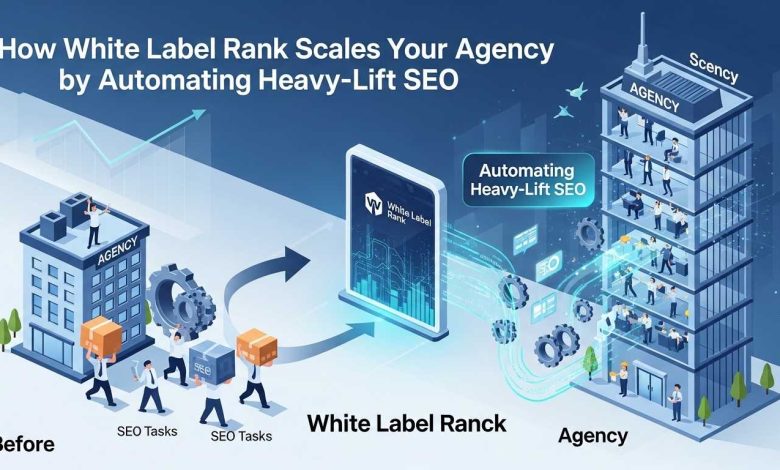
For agencies handling multiple clients, local seo is often where delivery pressure shows up first because it’s ongoing, competitive, and tied to constant changes (GBP updates, local competition shifts, location pages, reviews, citations, and proximity-based results). The agencies that scale profitably aren’t the ones doing “more work”; they’re the ones building a repeatable system that keeps execution consistent across every client, every month.
This is where White Label Rank-style automation becomes a real advantage: you standardize how work is discovered, prioritized, executed, validated, and reported so your account managers stay focused on growth and client strategy instead of getting buried in operational tasks.
Why Agencies Need SEO Automation to Scale
Once an agency crosses a certain number of accounts, the same issues appear:
- Too many recurring tasks (audits, GBP checks, on-page updates, reporting)
- Too much manual coordination (writers, VAs, devs, clients, approvals)
- Too much “tribal knowledge” (process lives in someone’s head)
- Too many quality slips (inconsistent execution and missed follow-ups)
Automation isn’t about removing humans, it’s about removing repeatable friction so humans can do higher-value work: decision-making, creative strategy, and relationship management.
1) Automated Intake and Standardized Client Setup
A scalable agency process starts with onboarding that doesn’t rely on long back-and-forth threads.
Automation helps you create a consistent “client setup pack” with:
- business details and service areas
- target keyword set + location modifiers
- competitor list and baseline snapshot
- tracking configuration and reporting schedule
- access checklist (GBP, GA4, GSC, website/CMS)
This ensures every campaign starts the same way: no missing inputs, no guessing, no inconsistent baselines.
2) Automated Keyword Tracking and Visibility Monitoring
One of the easiest ways for agencies to lose trust is unclear performance tracking. Clients don’t want vague updates—they want to know:
- what keywords are moving
- which locations are improving
- which pages are driving visibility
- what to do next
That’s why a structured tracker matters. If you want to rank your keywords (and prove it with clean reporting), white label rank tracker becomes the operational backbone: it keeps keyword visibility measurable and actionable across many accounts without turning your reporting team into a bottleneck.
A strong tracking workflow typically includes:
- scheduled ranking checks (weekly/daily depending on package)
- segmentation by city/area/service category
- tags for “money keywords” vs supporting terms
- alerts for sudden drops/spikes
- shareable client-facing views for quick updates
3) Automated Local Campaign Tasks That Repeat Every Month
Local campaigns aren’t “one-time SEO.” They’re a cycle. The smartest agencies automate recurring tasks so nothing slips.
Examples of recurring items automation helps manage:
- GBP post cadence and tracking
- review response prompts + review velocity monitoring
- citation consistency checks (NAP)
- service page refresh schedule
- internal linking checks for new pages
- basic technical health checks (404s, redirects, indexation)
Instead of rebuilding a to-do list each month, you run the same operational checklist only the insights and priorities change.
4) Automated Prioritization: What to Fix First (So Clients Don’t Get Overwhelmed)
One agency-killer is sending clients a long list of “issues” with no priority.
Automation helps convert “everything we found” into:
- P1: issues blocking visibility (indexing, broken pages, wrong canonicals, major GBP problems)
- P2: improvements that compound (location page structure, internal linking, schema, content gaps)
- P3: optimizations and polish (minor metadata, image compression, cleanup tasks)
This makes your execution predictable and your client communication simpler: “Here’s what matters most this month and why.”
5) Automated Content Briefs for Location Pages and Service Pages
Scaling local SEO content manually is slow because briefs take time—and inconsistent briefs lead to inconsistent results.
Automation helps generate standardized briefs that include:
- target keyword + secondary terms
- service area mapping (city/region modifiers)
- page intent (service page vs location page vs supporting article)
- outline structure and headings
- internal links to include (money pages + supporting pages)
- FAQ ideas based on customer intent
Your writers move faster, your content becomes more consistent, and your editors spend less time “fixing the brief” after the draft is written.
6) Automated Implementation Tickets (So Dev Work Doesn’t Stall)
Many agency campaigns stall at implementation not because the fixes are hard, but because tickets are unclear.
Automation helps create clean tickets with:
- what’s wrong + where it appears
- expected behavior
- steps to reproduce
- recommended fix
- acceptance criteria (how to confirm it’s solved)
- sample URLs and template references
This reduces dev friction and speeds up time-to-impact—especially when you’re managing multiple websites and multiple dev teams.
7) Automated QA and Validation to Prevent Regressions
Local SEO wins disappear when a website update breaks pages, redirects, schema, or indexation rules. Agencies that scale build QA into the process.
Automation-friendly QA includes:
- pre/post crawl comparisons after fixes go live
- checks for indexability, canonicals, and redirects
- monitoring new 404s and redirect chains
- internal link checks for new or updated pages
- structured validation for schema and page templates
This keeps delivery stable and reduces “surprise problems” that create client panic.
8) Automated Reporting That Doesn’t Waste Your Month
Reporting should not be a monthly fire drill.
Automation helps by:
- pulling the same KPIs every cycle
- generating executive summaries from rank movement + task completion
- highlighting anomalies (drops, spikes, indexation changes)
- turning deliverables into a clean “wins + next steps” report
When reporting is systematic, clients feel the campaign is managed—and your team isn’t stuck building slides for hours.
Conclusion
White Label Rank-style automation helps agencies scale by turning SEO delivery into a system: consistent onboarding, repeatable monthly execution, clear prioritization, fast implementation workflows, reliable QA, and reporting that proves progress without draining your time. For agencies managing many accounts especially in local markets the goal isn’t to “work harder.” It’s to build an operating model where outcomes are repeatable, quality is consistent, and growth doesn’t create chaos.
FAQs
1) Why is automation important for local SEO agencies?
Because local campaigns require recurring tasks and frequent updates automation keeps execution consistent across many clients.
2) Does automation replace SEO strategists?
No. Automation handles repeatable processes; strategists still decide priorities, direction, and risk.
3) What should agencies automate first?
Tracking, reporting, recurring checklists, brief templates, and ticket formatting typically create the fastest wins.
4) How do agencies keep quality high while scaling?
With SOPs, QA loops, standardized deliverables, and clear monthly priorities.
5) How do you prove keyword improvements to clients?
By using consistent tracking and transparent reporting this is where tools like White Label Rank Tracker are especially useful.