When OpenAI introduced ChatGPT Health and Anthropic extended Claude into healthcare workflows, the narrative around AI in medicine intensified. Headlines swung between utopian forecasts and dystopian fearmongering. Both reactions miss the deeper reality emerging across clinics, hospitals, and research labs globally.
Artificial intelligence is becoming part of healthcare infrastructure, not by displacing physicians entirely, but by reshaping the computational layers underneath delivery, diagnosis, research, and administration. What we see now are the early roots of a new clinical stack where machine throughput supports ( but does not replace) human judgment.
Refactoring the Physician Role
Medicine has evolved into a multi-layered profession. Today’s clinician must interpret complex medical data, navigate regulatory requirements, draft structured documentation, communicate outcomes compassionately, and coordinate care through fragmented systems. This accumulation of duties has turned physicians into data managers as much as diagnosticians.
Generative AI systems are increasingly absorbing the parts that are repetitive, high-volume, and data-intensive. Ambient AI scribes such as DeepScribe automatically generate clinical notes from patient conversations, capturing structured records previously dictated manually, a task that drains huge swaths of a clinician’s time.
In oncology, companies like Tempus apply machine learning models to genomic and clinical data to support personalised treatment optimisation, while Flatiron Health mines aggregated oncology records to accelerate research insights and pattern discovery.
Radiology workflows increasingly incorporate algorithms that flag abnormalities in imaging at scale, helping prioritise urgent cases and reduce backlog delays. Across administrative systems, AI models automate prior authorisation requests, risk scoring, readmission risk prediction, and trial matching all tasks that once ate into clinician bandwidth.
These tools are deployed in practising clinical environments, integrated with electronic health records, and regulated under established safety and governance frameworks. They illustrate transformation at the workflow level rather than replacement at the professional level.
LLMs as Knowledge Infrastructure
Large language models (LLMs) such as those powering ChatGPT Health and Claude’s healthcare assistant act as interface layers between unstructured human communication and structured medical logic. They interpret free-form symptom descriptions, summarise clinical guidelines, surface relevant evidence, and draft human-readable outputs for clinicians and patients alike.
From a systems viewpoint, this is infrastructure – not automation of the entire care process. LLMs accelerate knowledge synthesis and reduce friction in accessing medical intelligence, but they do not operate independently within regulated clinical decision pathways. Real-world deployments place humans in the loop, with models supervised, benchmarked, and monitored for drift and safety.
This distinction between assistance and autonomy matters both technically and legally.
Accuracy, Responsibility, and Clinical Context
AI models increasingly match or exceed average human performance in constrained analytical tasks like imaging analysis or structured pattern recognition. That performance is part of why surveys show growing public confidence in AI’s potential to improve diagnostics and outcomes. Independent research mentioned that many people believe AI could elevate diagnosis quality and broaden access to care in underserved areas, addressing chronic healthcare problems such as wait times and variability in provider availability.
However, clinical decision-making exists in the context of accountability, ethical judgment, patient values, and consequences. A model can propose possibilities, but responsibility for final clinical decisions remains firmly a human prerogative.
In practical deployments, AI outputs are interpreted within a clinical context and verified by trained professionals, not executed autonomously.
Hitting Healthcare’s Structural Bottlenecks
One of the strongest arguments for AI in healthcare today lies in its potential to address systemic inefficiencies rather than replace clinicians. Chronic challenges such as high costs, long wait times, and uneven outcomes have plagued healthcare systems for years. One Forbes analysis pointed to AI’s ability to reduce administrative load, accelerate diagnosis at scale, and compress research cycles, potentially lowering overall costs and broadening access.
In the United States alone, where physician shortages are projected to grow and access inequities persist, AI can help triage initial queries, pre-structure clinical data, and automate back-office functions so clinicians can focus on high-skill decision tasks. This aligns with trends documented across industry: when systems automate repetitive work, clinicians reclaim time for care that requires empathy, trust, and nuanced judgment.
Moreover, AI is playing a growing role in drug discovery and clinical research, where models can screen vast molecular spaces far faster than traditional methods, accelerate trial matching, and help design better, more targeted therapies – innovations that eventually filter back into clinical practice.
The Clinical Stack of Tomorrow
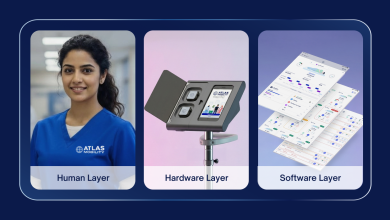
If we visualise healthcare as a layered architecture, AI increasingly accelerates the foundational layers, such as data ingestion, knowledge synthesis, pattern recognition, while leaving the top layer of accountable clinical judgment to licensed professionals. This division of labour is not arbitrary; it reflects regulatory structures, ethical expectations, liability frameworks, and the inherently human components of care.
What’s emerging is a system in which doctors are supported by AI that manages scale, complexity, and volume. Physicians remain the decision authorities, interpreting outputs, contextualising recommendations, and communicating risk.
Human Authority Meets Machine Throughput
In the coming years, AI will continue to expand its role in analytical domains, detect patterns earlier than ever before, streamline workflows, and improve the scalability of care. It will make treating high caseloads more manageable and may significantly lower the cost of routine diagnosis and predictive risk assessment. Most importantly, if integrated responsibly with appropriate governance mechanisms, AI can help shift healthcare from reactive to proactive management, improving preventive insights long before pathology progresses.
Yet in this evolution, physicians are not being sidelined. They are being supported by higher-throughput intelligence layers that amplify their capacity rather than replace their role.
Healthcare is therefore not automating away clinicians. It is building around them.
The disruption is real, measurable, and valuable, but the replacement narrative mistakes infrastructure evolution for occupational extinction.