
In the corporate world, becoming a CEO has historically been the preserve of seasoned execs with decades of experience under their belts. It’d be unheard of for a recent college graduate to move straight into a leadership position at one of these legacy corporations.
However, we find a very different story in the tech industry. Both Bill Gates and Mark Zuckerberg were 19 when they decided to launch their respective ventures, which are now two of the largest and most successful tech companies of our time.
Rather than being ruled out due to their age and relative lack of experience, younger entrepreneurs have long been encouraged in Silicon Valley. This sector is built on finding the next ‘big idea’ and disrupting the status quo with emerging technology and visionary newcomers often help to make this happen.
Further, building a successful startup in 2026 is a completely different equation thanks to the rise of AI. As this emerging technology completely changes the way that companies are built and the value proposition they offer, visionary young entrepreneurs are rising to the surface once again.
This is already reflected in the data. The average age of AI unicorn founders fell from a peak of 40-years-old in 2021 to 29-years-old in 2024, according to a new report from venture capital firm Antler.
Their rise is not accidental. It’s the product of a unique convergence of accessible tools, cultural shifts, and a rapidly evolving technological landscape. We expect this average will continue to drop as AI enables a growing cohort of younger teens to build competitive software products with much smaller overheads.
As AI reshapes how products and companies are built, deployed, and commercialized, the new cohort of AI-native founders boasts a highly intuitive relationship with the technology. This means they can spot the opportunities on the horizon and push the frontiers of innovation forward.
Alexandr Wang launched Scale AI at just 19 years of age, and became the youngest self-made billionaire by the time he was 25. In 2025, Meta invested a staggering $14 billion to secure a 49% stake in the data labelling startup and appoint Wang as the head of its superintelligence unit.
Still, Wang has openly highlighted just how much influence AI technologies had on his meteoric rise to success. “It’s impossible to understate the degree to which I’ve been radicalized by AI coding,” Wang said. “You just have to figure out how to use the tools maximally.”
The good news is that aspiring founders from around the world now have unprecedented exposure to programming, data science, and AI concepts through online courses, communities, and competitions. As a result, founders are emerging not just from traditional tech hubs, but from cities and regions that were previously underrepresented in the startup ecosystem.
Amidst this diverse cohort, here are five AI founders making headlines with their startup AI ventures in 2026.
Bob Chopra becomes one of the youngest Edtech founders thanks to IvySchool.ai
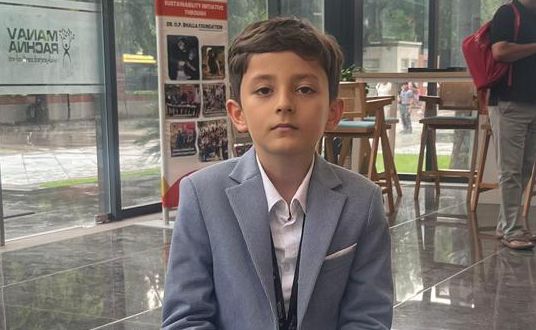
At just nine years old, Bob Chopra (article’s featured photo) is one of the youngest founders in the world. He decided to enter the edtech market with IvySchool.ai to help develop critical skills to help them thrive in the digital-first world of tomorrow.
Despite attending one of the most prestigious schools in Miami, Chopra felt that the computer science curriculum in particular wasn’t meeting his needs or preparing him for the competitive environment ahead. Although tools like Kodable were being taught, this was essentially the ceiling of education for students in his age group.
After a period of self-led experimentation, Chopra founded IvySchool.ai to bring modern, AI-era education to students early, in a structured and practical format. Instead of waiting until college or the workforce to discover technology, entrepreneurship, or innovation, Chopra wants students to experience it while their curiosity and creativity are still at their peak.
The platform curriculum is modeled on the standards and frameworks taught at leading institutions such as MIT, Stanford, Harvard, and Wharton, exposing students to the same concepts, methodologies, and problem-solving approaches used at the world’s top universities.
Toby Brown secures $1m deal with Silicon Valley investors at 16
At just 16 years old, Toby Brown has swapped the classrooms of London for Silicon Valley after securing a $1m deal for his AI platform, Beem.
Beem is on a mission to change how we interact with technology and address many of the teething problems associated with the widespread adoption of AI. The platform aims to streamline mundane tasks while keeping humans in the loop. Although
Designed to streamline mundane tasks while keeping the human in the loop, Beem could change the way we interact with technology. Imagine having an AI assistant that intuitively manages mundane tasks like organizing emails, synchronizing calendars, or booking travel accommodations. This is the vision behind Beem, an AI-native computer that, in Toby’s words, “handles all the boring stuff.”
At seven, Toby started coding by creating maths games to master his times tables. By age ten, he had built his first computer. His passion led him to join Hack Club, a global community of teenage programmers, where he became the youngest member of its leadership team at 13.
The inspiration for Beem stemmed from the rise of AI chatbots like ChatGPT. “We are kind of doing what Apple did with the iPhone,” he explained, “starting with the user experience and working back into the tech.” Beyond AI, Toby Brown has expressed an interest in ethical technology and ensuring that AI-driven tools remain accessible and beneficial to everyday users. He believes that the future of AI lies not in replacing human intelligence but in augmenting it to make people’s lives easier and more efficient.

How Ibrahim Hasanov built a high-growth startup in his mid twenties
Ibrahim Hasanov has been building hardware since he was six. He began coding at the age of eleven, and launched his first startup at thirteen due to an innate desire to solve problems and build systems that make people’s lives easier, simpler and more connected.
This foundation laid the groundwork for Hasanov’s company Myuser, an AI-powered platform that is turning B2B customer acquisition from a laborious, manual process with unreliable results into a powerful growth tool that helps other founders scale in a cost-effective manner.
Myuser helps companies expand their customers and move into larger-quantity sales opportunities by automating the complete acquisition pipeline with an intelligent AI engine. Built for startups, SMBs, and enterprises looking to supercharge their outreach efforts without the overhead of a traditional sales process, the AI-powered platform handles lead generation, hyper-personalized outreach, scheduling and communication.
This is a prime example of how the next generation of AI founders are not only leveraging the capabilities of AI to build their own ventures, but finding ways to share these gains with others in the ecosystem to improve efficiency and help other startups scale in an agile manner.
Serial founder Jessi Li builds AI app for power users
Jesse Li is a software entrepreneur and engineer based in Atlanta. He is currently the co-founder and CEO of Cedar, where the mission is to make every user a power user.
With eight years of experience, he blends hands-on software delivery with startup leadership, having founded Meetr and built an eight-person operations team.
Cedar aims to “make every user a power user” by providing a React framework that builds next-generation AI-native applications. Cedar offers AI copilots that provide contextual, step-by-step guidance rather than just chat interfaces, assisting in navigation, workflow, and in-product analytics.
Cedar was founded by Jesse Li and Isabelle Ilyia (CTO), who were friends from their time at Georgia Tech and the company is part of the Y Combinator Winter 2025 batch.