AI is forcing a reinvention of consumer leadership, not just the consumer experience. The consumer sector has always been where commerce meets daily life. As artificial intelligence reshapes how we shop, interact and experience brands, leaders face a simple question: will technology deepen this human connection or dilute it?
For years, digital transformation in consumer industries often meant moving the same processes onto a screen. AI is different. It is a new engine for value creation. To understand what this shift means for leadership, we spoke with three executives who live it every day:
Vipin Gopal, former Chief Data & Analytics Officer at Eli Lilly and Walgreens Boots Alliance; Vivek Vashishth, a Partner at BCG specializing in consumer and retail; and Anantha Sundararajan, Chief Data & AI Officer at Dream Sports and formerly at Novartis. Across these conversations one theme was clear. AI in consumer industries is not just about automation or efficiency. It is about creating human connection at scale and a new operating system that demands human-led leadership with empathy, curiosity and data-driven judgment.
Where the Value Is: Use Cases That Actually Matter
When our clients come to us to hire an AI leader, we start with a discussion about priority use cases. AI may be on the tip of every leader’s tongue, and every board presentation may now have an “AI” slide, but ROI often remains elusive. The key to unlocking value is to get clear on the concrete problems AI should solve.
In consumer, the highest impact use cases are clustering around a few big domains:
- Hyper-personalization at scale: AI has made true, one-to-one personalization possible, not just by demographics or purchase history, but by moment-to-moment context. Companies can tailor each consumer’s experience in real time, creating relevance that feels intuitive rather than intrusive. As Sundararajan puts it, “Hyper-personalization was always important. But AI and ML was a game changer.”
- Sales and marketing reinvention: Generative AI is reinventing the creative and commercial side of consumer businesses. What once required weeks of work can now happen in hours, allowing brands to test, refine and localize at a scale not seen before. Vashishth observes that “teams of four to five are now shrinking to teams of one to two.”
- Product and assortment development: AI is compressing the traditional six-month product cycle into a few weeks by integrating consumer insight, design and supply chain data, spotting trends on platforms such as TikTok and Instagram, running sentiment analysis and helping merchandisers decide which new products to launch.
- Operations and supply chain optimization: AI is turning historically reactive operations into more predictive and self-correcting systems. Today’s tools can support advanced demand forecasting, where models integrate macro signals such as weather, events and social buzz with transactional data to forecast demand more accurately at SKU or store level.
- Agentic shopping and decision making: The next frontier lies in agentic AI, systems that act on behalf of consumers and shift shopping from active searching to more automated satisfaction. Gopal expects agentic AI to scale faster in consumer industries than in many others. Brands such as Nike and Estée Lauder are already experimenting with agent-based shopping tools, although, as Vashishth notes, nothing distinctive has yet “stuck,” underlining how early the experimentation still is.
Across this expanding landscape, from personalization to decision automation, the thread that binds the most powerful applications is not technology but humanity.
How AI Is Rewiring Consumer Firms
Inside companies, AI is not just a tool. It is already reshaping how work is organized and who does what.
Flatter, more fluid structures: As AI automates grassroots tasks in customer service, analytics, marketing operations and coding, teams can be smaller and more self-sufficient. People move between projects as needs evolve because AI lowers the barrier to switching domains, making rigid functional silos less necessary and putting a premium on learning agility.
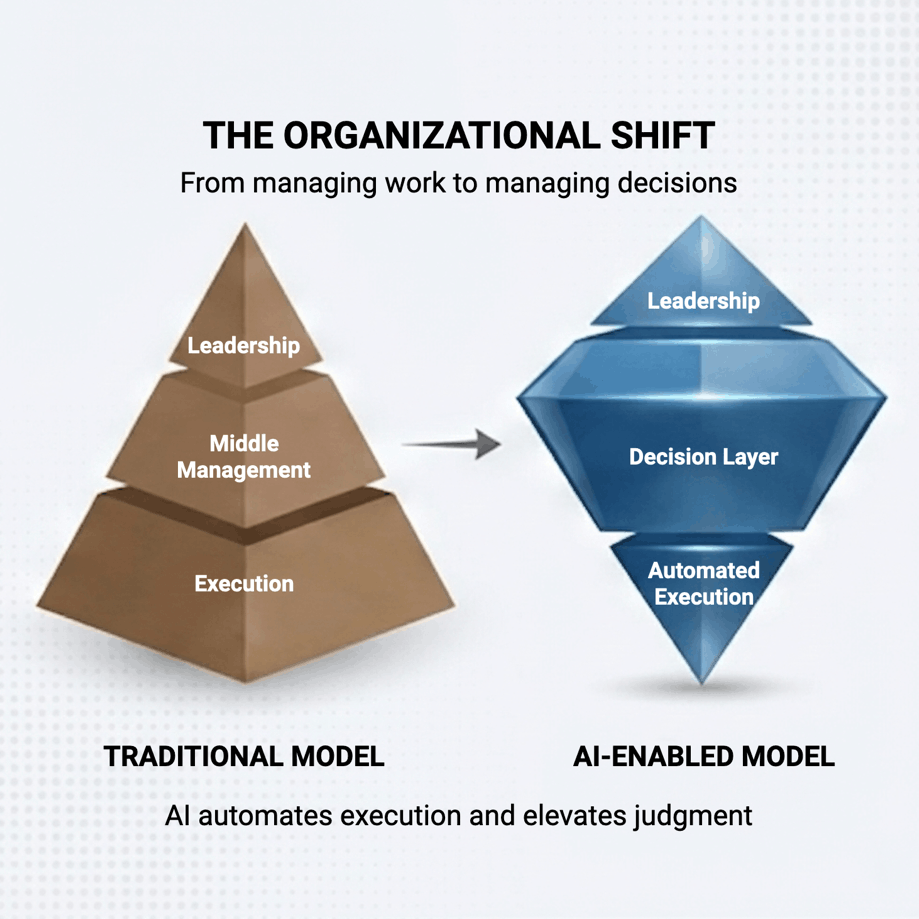
A shrinking pyramid base: Routine work such as report building, data cleaning, simple creative editing and basic customer service is being absorbed by automation. As Vashishth notes, the organization starts to look less like a classic pyramid and more like an inverted diamond, with fewer people at the base and a higher concentration of work in the middle. The pressure then moves upward. Middle and senior leaders must add more value through judgment, integration and direction, not just coordination.
In this model, the companies that thrive will be those that invest not only in AI infrastructure, but also in leaders who can work in this new operating system. They need to be agile, adaptable and collaborative, with a sharper relational toolkit: deeper empathy, the ability to translate insight into human stories and the discipline to build trust.
The New Consumer AI Leader
Gopal is clear that AI leadership is “not a tech leadership role… Chief AI Officers are primarily business leaders… who should be in place to create business value and help the business to think differently.” Vashishth stresses that “you do not need to be extremely technical… but you do need to stay abreast of what is happening… things are happening by the second, not even by the day.”
The emerging AI leader in consumer will be:
A business strategist first: Grounded in strategic vision, change management and data-driven decision making, they start from use cases and value, not tools, and link AI initiatives directly to enterprise priorities.
A technology translator: Curious about technology and skilled at cross functional collaboration, they understand enough about models, data quality and limitations to spot hallucinations, challenge vendors and ask the right questions, while keeping the focus on outcomes.
A disciplined portfolio manager: They kill pilots that do not scale, double down on what works and treat experimentation as a means to value, not an end.
A culture shaper: They tackle the emotional side of AI, including fear that “AI will take my job,” confusion about where to start and fatigue from hype. They frame AI as a colleague and amplifier that frees people from low-value work while keeping humans accountable for judgment and ethics.
AI leadership is no longer confined to a Chief AI Officer role. Business unit heads, CFOs, CMOs, COOs and CHROs will all be expected to bring an AI lens to their roles.
Read more on the AI competencies here: Assessing AI Skills in Leadership: Why it Has Become Critical for Business Leaders
Managing Risk and Reward
If the consumer sector is one of the biggest winners from AI, it is also one of the most exposed. Gopal notes that “the consumer industry is also the industry where the guardrails and risks are on the higher side… data privacy, transparency of how data is used and how algorithms work.” Sundararajan is equally clear that “ethical AI is not optional, it is foundational. The privacy aspects and risk aspects should not just be in the fine print. It needs to come out of the fine print.”
This sector runs on high volume, intimate and frequent data, from location and browsing behavior to purchase histories, preferences and even health or financial proxies. The same capabilities that enable magical personalization can easily slide into something that feels intrusive, like overreach, or create the conditions for real harm.
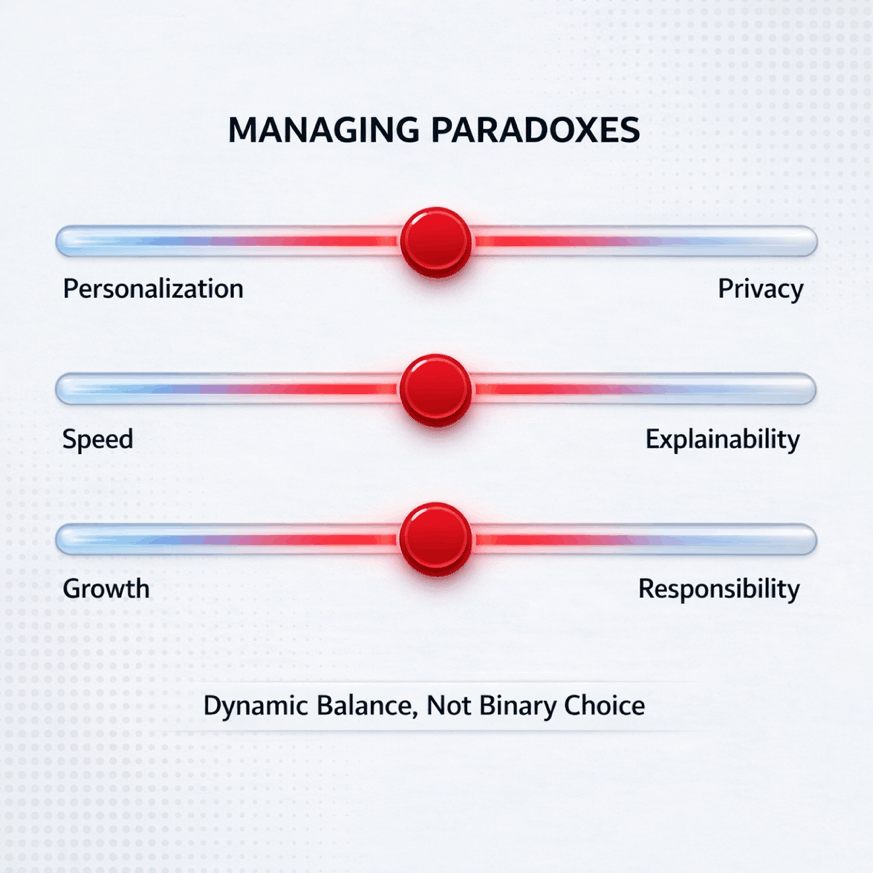
As AI reshapes the consumer economy, leadership becomes an exercise in handling tensions rather than simple tradeoffs, demanding a “both and” mindset that balances boldness with caution and data with human judgment. Three paradoxes in particular stand out:
- Personalization vs. privacy. How far can you infer needs without breaching trust.
- Speed vs. explainability. Decisions made in milliseconds still need to be auditable and understandable, so that scale never outruns accountability.
- Growth vs. responsibility. AI can unlock significant commercial upside, but regulators, consumers and employees are increasingly asking at what cost and under what safeguards.
These paradoxes will not be solved; they must be actively and continuously balanced. The most effective leaders will learn to pivot between these poles fluidly and to make those balances transparent to their customers and their teams.
AI’s Real Story: Choices, Not Tech
The impact of AI on the consumer sector is no longer about whether it will matter but about how it will matter and who will shape that trajectory. Personalization will get sharper, agentic shopping more common and organizations leaner, faster and more fluid. The real differentiator will not be who has the so-called best model but who can hold the balance between ambition and responsibility, automation and human judgment, speed and trust.
AI is giving consumer companies a new set of superpowers. The choices leaders make about how they use them, and how they protect human connection in the process, will define the next decade for consumers, brands and the people who work in this industry.