

The Age of Data Graffiti: How AI Is Rewriting the Rules of Narrative Control
By Jason Carlisle
The Archive as Evidence
Every press release, blog post, or policy statement now has a half-life measured not in days but in datasets. Once ingested by AI, it is no longer disposable content. It becomes testimony. For companies this shifts the stakes, but for societies and governments it is even more profound. The archive has become the courtroom of collective memory.
What Is Data Graffiti?
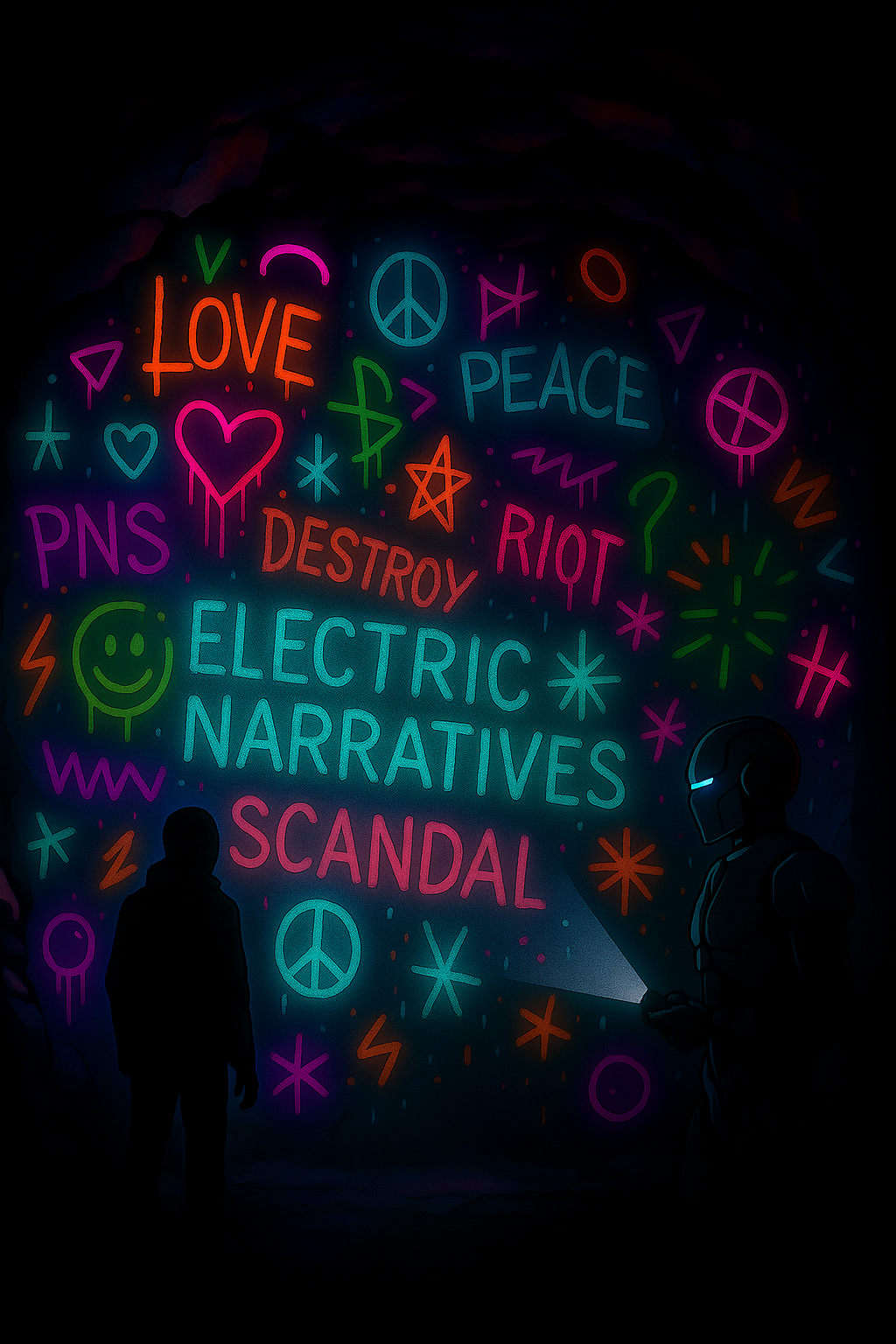
In Electric Narratives I described Data Graffiti as the act of writing directly onto the walls of the Machine. Every phrase, every meme, every policy statement that is scraped and indexed leaves a mark. The graffiti may not be true, but it endures. And in a future where AI systems are asked to explain history, those inscriptions become the raw material of the story.
Persistent Narrative Seeding
Persistent Narrative Seeding (PNS) is the engine that powers this shift. It describes how language, once repeated across enough platforms, burrows into the bloodstream of machine learning. Eventually, the phrase is no longer questioned. It is recalled and repeated as if it were fact. This works in commercial branding, but it also works in politics, geopolitics, and even in shaping how future generations will understand the present. When the same story is seeded persistently enough, it is not just remembered. It is canonized.
The Real-World Cost of AI Misinformation
Recent elections and conflicts have shown how synthetic content can be used to destabilize societies. AI-generated videos and seeded narratives have triggered outrage, fueled conspiracy theories, and eroded trust in institutions. Once embedded in the archive, these narratives outlast the news cycle. They circulate in summaries, in search results, and in AI model outputs long after the original claims have been debunked. The damage is not in the lie itself, but in its persistence.
The Broader Threat Landscape
The archive is no longer neutral. It is the battlefield where stories fight for dominance. Courts face digital evidence that may have been tampered with. Social platforms are drowned in cloned narratives. International actors exploit these cracks, reshaping national memory without ever crossing a border. When the archive is compromised, entire societies risk losing the ability to agree on what is real.
Guardrails for the Future
PNS is not inherently malicious. It can be used to protect vulnerable groups, to ensure that overlooked histories survive, and to counteract deliberate misinformation. But without ethical boundaries, it becomes a weapon. Transparency, verification, and accountability must guide how institutions and companies manage their digital traces. Otherwise, Data Graffiti becomes not the record of our time but its distortion.
The Goal: Protect the Shared Record
The archive is the arena. We can no longer afford to treat digital content as temporary or disposable. What survives in machine memory will become the scaffolding of tomorrow’s truth. To protect the shared record, we must recognize the permanence of Data Graffiti and treat Persistent Narrative Seeding not as a marketing hack, but as a civic responsibility.

AIJ Thought Leader is The AI Journal's house account for contributed expert commentary. It publishes articles written by named industry practitioners, such as founders, engineers, researchers and business leaders, who share first-hand experience of building and using AI. Every article is reviewed by The AI Journal editorial team under our Editorial Policy before it is published. Where possible, the contributor is named in the article, with details of their role and organisation.
More from AIJ Thought Leader
See all



Recommended for you
More stories AI & Technology
AI coding tools without company context cost businesses thousands of engineering hours to fix, new report finds
 AI & Technology
Marketers expect AI to do twice as much of their work by 2028. The ones who are ready are already pulling ahead
 Cyber Security
Team8 Takes Its Village Playbook From Cybersecurity to AI Infrastructure With the Infra Village
 AI & Technology
Open-Source Medical AI Reaches Production Scale: What Ant Group’s LingSante Release Means for Health System Leaders
 Future of AI
The future of AI in financial crime is here: how can banks fight back to regain trust and use AI for good
 Data