

According to WalkMe’s fifth annual State of Digital Adoption report, 54% of workers bypassed their company’s AI tools in the past 30 days.
The gap between leaders and their teams is wider still. Only 9% of workers said they trust AI for complex, business-critical decisions, compared with 61% of executives.
In biopharma, the skepticism is sharpest where the stakes are highest. For instance, in a survey reported by Fierce Pharma, 65% said they don’t trust AI to create regulatory compliance content, while half said they trust it to help review materials.
That hesitation isn’t irrational. Every document a biopharma company produces, from a journal publication to a slide deck for a payer, can shape how a physician treats a patient, and the people who sign off on that content answer for every claim in it.
But resistance to new ideas is nothing new in medicine. In 1847, Ignaz Semmelweis showed that handwashing sharply reduced maternal deaths in his Vienna clinic, and much of the medical establishment rejected his findings for years.
Practices that are now standard, from randomized controlled trials to evidence-based guidelines, each had to win over skeptics before they were accepted.
What history teaches about resistance
That question shaped one of the sessions at Articulate 2026, a summit that Prezent Vivo hosted on October 1st at the Museum of the American Revolution in Philadelphia, a fitting venue for a conversation about how new ideas overcome opposition.
The invitation-only forum brought together senior leaders to explore how AI and human expertise are changing the way complex science is shared.
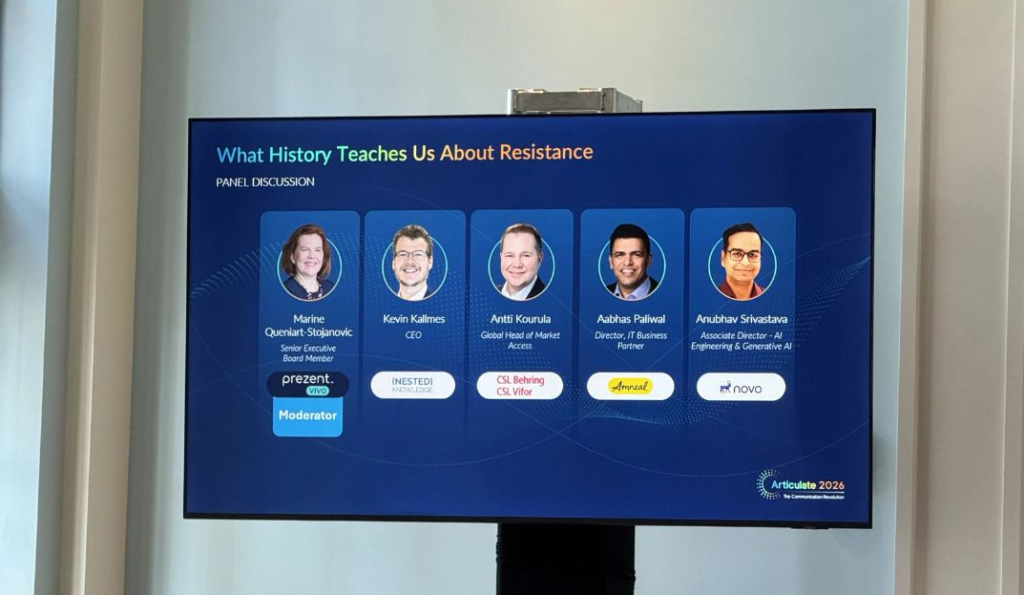
The panel “What History Teaches Us About Resistance,” moderated by Marine Queniart-Stojanovic, brought together Kevin Kallmes, Aabhas Paliwal, Antti Kourula and Anubhav Srivastava to discuss where AI meets hesitation inside biopharma and how leaders move their organizations forward.
Kallmes is CEO of Nested Knowledge, which builds software for literature review and evidence synthesis, and his earlier work includes the National Library of Medicine.
Evidence synthesis may be one of the clearest tests of whether scientists will trust AI. A systematic review has to account for every relevant study, and a single missed or misclassified paper can change the conclusion a clinician or regulator draws from the evidence.
Kourula, a physician, is global head of market access at CSL, where the strength of the evidence determines whether payers cover a therapy and patients can get it.
Aabhas Paliwal and Anubhav Srivastava brought important perspectives to the conversation as well. With Queniart-Stojanovic guiding the panel, the discussion moved between the people who generate scientific evidence, the people who use it to win access for patients and the people building the tools that now help process it.
Resistance as a signal
The panel started from a simple observation: every great idea in history met resistance before it was accepted. AI is following the same path.
In regulated work, resistance often points to a real gap. When a medical reviewer asks where a claim came from, who checked it and what happens if it’s wrong, those questions amount to a list of requirements any AI tool has to meet before it earns a place in the workflow.
The survey data supports that reading. Pharma professionals were far more willing to trust AI as a reviewer than as an author, a sign that hesitation tracks with risk rather than with hostility to the technology itself.
The panel’s central conclusion was that the teams that succeed turn resistance into an opportunity to improve.
In practice, that means treating objections as design input: showing reviewers the source behind every claim, keeping a person accountable for final sign-off, starting with tasks where errors are easy to catch and measuring whether the tool actually saves time.
It also means closing the gap between leaders and the people doing the work. When executives are far more confident in AI than their teams, a mandate rarely changes behavior. As the WalkMe numbers suggest, employees will simply work around it.
Semmelweis had the evidence on his side, but evidence alone didn’t win over his colleagues, and handwashing took decades to become standard practice.
For biopharma, the lesson is that being right about AI isn’t enough. The teams that move forward will be the ones that listen to their skeptics, fix what they find and earn trust one use case at a time.