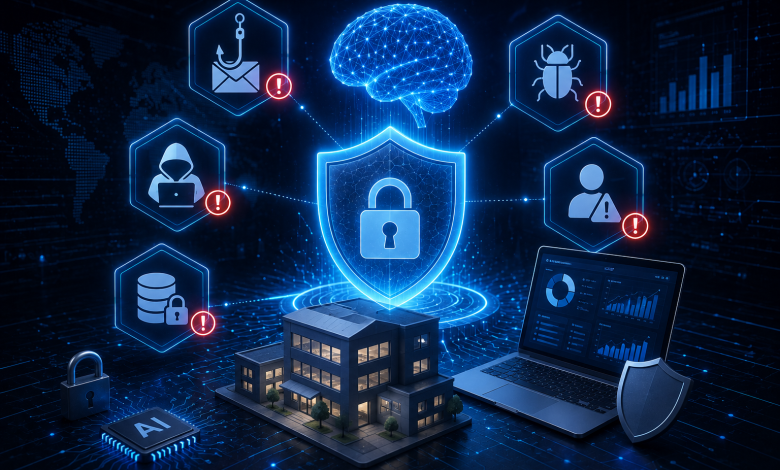
AI allows cybercriminals to launch convincing, highly targeted attacks with less time, money, and technical skill. At the same time, everyday business use of AI can create new openings for data exposure and system manipulation.
Five risks stand out in 2026 for their potential to disrupt operations, compromise sensitive information, and cause financial losses. Understanding how each threat works can help business leaders strengthen security before an attack reaches critical systems.
1. AI-Enhanced Phishing
Generative AI can produce polished phishing emails without the spelling mistakes or awkward language that once exposed scams. Attackers can also personalize messages using details gathered from company websites, social media, and breached databases.
A 2024 Nationwide survey found that roughly one-quarter of small-business owners had faced a generative-AI scam during the previous year. So, employees should no longer assume that professional wording makes a message legitimate.
Warning signs, like the following, still offer valuable clues:
- Unexpected requests create unnecessary urgency
- Login links lead to unfamiliar domains
- Payment instructions bypass normal approval procedures
Regular phishing simulations can help employees recognize how AI has changed familiar scams. Strong email filtering and simple reporting procedures can stop suspicious messages before one mistake becomes a larger breach.

2. Deepfake Impersonation
Voice-cloning and video-generation tools allow criminals to impersonate owners, executives, vendors, and clients. A convincing voice message might request an urgent wire transfer, payroll update, password reset, or confidential document.
Malicious actors use AI-generated voices alongside text messages and fraudulent links. SMBs should require secondary verification through a known phone number or approved communication channel before employees complete sensitive requests.
3. AI-Related Data Exposure
Employees may paste customer records, financial figures, source code, contracts, or internal notes into generative-AI platforms to save time. Information entered without approval could be retained, processed externally, or exposed through poorly configured applications.
Clear AI-use policies should define which tools are approved and what information employees may submit. Access controls, data-loss prevention, and regular training can also reduce accidental exposure while allowing teams to use AI productively.
4. Prompt Injection
Businesses adding chatbots or AI assistants to their workflows face risks inside the technology itself. Attackers may use prompt injection to override instructions, reveal protected information, or trigger actions the system was never supposed to perform.
Prompt injection is a leading risk for AI applications. Human oversight remains essential whenever an AI system can access files, customer data, email, or business software.
5. AI-Assisted Malware
AI lowers the technical barrier for creating malicious code and finding vulnerable systems. Criminals can use it to modify malware, automate reconnaissance, generate attack scripts, and test different approaches at greater speed.
Older devices and unpatched applications give automated attacks more opportunities to succeed. SMBs need consistent patching, endpoint monitoring, secure backups, multifactor authentication, and network segmentation rather than relying on antivirus software alone.
Outsourced Support Strengthens IT Monitoring
Small internal teams may struggle to monitor AI cyber risks around the clock while maintaining systems and supporting employees. Outsourcing can provide broader security expertise, proactive maintenance, and faster responses.
And by outsourcing, your business doesn’t have to build a large in-house department for IT monitoring.
Using efficient tech support for IT services means you don’t have to worry about the financial and productivity consequences of downtime and data loss. Instead, you’ll have 24/7 support.
Staying Ahead of AI Cyber Risks in 2026
AI will continue to change how businesses operate with their IT processes and how criminals approach potential targets. SMBs do not need to predict every new tactic, but they should treat cybersecurity as an ongoing business priority rather than a one-time project.
Hopefully this article has been helpful. If so, take a moment to explore some of our other AI-related content.