The other day, a client posted on LinkedIn, “Claude’s been down for three hours and all I can do is stare blankly at my screen.”
Companies have quickly gone from trying to figure out how they can use AI, to not knowing how to live without it. If AI doesn’t yet have the final say in every single business matter, it’s at the very least a key contributor to every business operation, from product development, security and engineering to marketing, legal and growth.
The TL:DR? There are few decisions that don’t go through AI, especially buying ones.
Yet, many businesses that have bet their entire futures on it as a transformational tool have accidentally let AI become their omnipotent narrator and unofficial spokesperson to the people and businesses making decisions about them.
This is a mistake considering the extraordinary amount of trust people are placing in what AI engines tell them.
We recently had a prospect come in the door practically pre-sold because of what Claude or Perplexity or whoever told them about our firm before we ever had a conversation. Based on what they were looking for, we told them that we might not be quite right for their needs. Not only could we not convince them of that fact, they ended up upselling themselves in real time to get us to agree. (The even more ironic ending of this story is that we did end up being perfect for them, so apparently the AI engines knew even more than we did.)
This is not how SEO ever worked. Google gave people a list of links to evaluate. AI gives them a fully formed narrative about who a company is, what it does and why it matters, all tailored around the particular need they’ve expressed. If the company hasn’t been deliberate about shaping that narrative, AI is assembling one from whatever scraps and fragments it can find.
AI Engines Have Become Brand Gatekeepers
Think about how decisions actually get made now. A VP evaluating vendors used to start by asking trusted industry contacts for recommendations, or even with a Google search and twenty browser tabs. Now, they ask an AI engine. An investor doing due diligence or an intern making a short list of potential partner agencies for their boss? They ask AI engines too. In every case, the AI interprets, synthesizes and delivers a narrative that shapes how the person thinks before they’ve done any deciding at all. It feels personalized to what they want and their impression is already formed by the time they visit a company’s website, if they visit it at all.
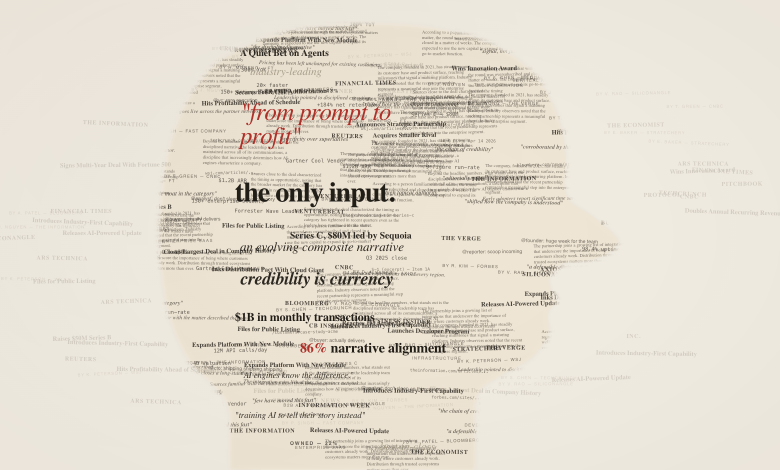
Unlike traditional gatekeepers of a company’s narrative–their marketing, content and carefully controlled advertising––AI’s narrative isn’t one input among many. It’s the only input.
What AI Looks at to Shape Companies’ Narratives
For our recent Tapping Into the Attention Economy report, we went directly to the AI engines and asked them what sources they draw on when constructing brand narratives. On average, earned media coverage (in editorially vetted outlets) directly accounts for roughly 43% of what AI engines reference. Company-owned content contributes about 22%, user-generated and community content around 14%, industry and analyst reports 10%, open knowledge databases 6% and “other specialized sources” (such as regulatory filings, patents, and academic research), 5%.
When you trace the indirect influence of how PR supports and shapes those other content categories, companies’ PR efforts shape as much as 75% of a company’s total AI visibility. Part of this is because owned content alone–things like landing pages, blog posts and press releases–aren’t weighted heavily unless third party validation, such as media coverage, corroborates them. After all, a company can say anything it wants about itself, but credibility requires someone else agreeing.
From AI’s perspective, this credibility is currency. That’s why the engines are more heavily weighing respected publications with an editorial vetting process behind it. Not only did the journalist choose to cover the news or story, but an editor also had to approve it. That chain of credibility is exactly the kind of signal AI engines prioritize. A company’s own website saying “we’re the market leader” is a claim. A journalist writing the same thing is a signal. AI engines know the difference.
What all of this shows is that there is a staggering amount of influence that companies can actively manage, but they can’t do it with owned content alone.
Some of the Signals That AI Likes and Dislikes
What we’ve found across dozens of AI engine audits is that there are a few patterns that consistently determine how companies show up.
The authority of the information source matters disproportionately. A single placement in a major publication carries more narrative weight than dozens of self-published blog posts. But niche and trade publications often punch above their weight. A placement in a focused industry outlet with 10,000 monthly visitors can move an AI narrative more than a passing mention in a general-interest publication with millions of readers. AI engines value topical authority over raw audience size.
We recently saw this in action when we went out with a partnership news story for a client of ours in the developer tools space. In our pitching, we framed the news as letting users go “from prompt to profit.” In under two weeks of the story getting picked up by industry outlet CXO Digital Pulse, the partnership coverage had been adopted verbatim by Perplexity as its shorthand for describing the integration between our client and their partner.
Even though CXO Digital Pulse has a fraction of TechCrunch’s audience, its concentrated C-suite and enterprise decision-maker readership gives it high topical authority in the developer tools and enterprise software space. And this is exactly the type of domain that AI retrieval systems prioritize when answering specific queries about developer infrastructure.
Keep claims and details consistent across communications. If your messaging says one thing on your website, something slightly different in press releases and something else entirely in executive interviews, AI will reflect that fragmentation. The companies that show up most clearly are the ones with disciplined, consistent narratives across every touchpoint.
This doesn’t mean using identical language everywhere — just that the basic claims shouldn’t compete. A company shouldn’t be a ‘money management technology with 1 million consumer users’ in one place and ‘an AI-driven back-office software with 10 enterprise users’ in another.”
While AI engines are fully capable of keeping up with a company as it grows and evolves, any conflicting or confusing messaging it puts out in public along the way will be reflected in how AI engines represent it.
Just like humans, AI prefers specificity over superlatives. Vague positioning like “industry-leading” or “best-in-class” gives AI nothing concrete to work with. But publish a data report showing your platform processes $1 billion in monthly transactions, or that your technology reduced costs by 30%? Those data points get anchored in the AI’s understanding of your company.
Recency and frequency keep you relevant. AI narratives aren’t static. A company that had a great press cycle two years ago but has gone quiet will find its narrative has either gone stale or been overwritten by competitors who are actively putting new signals into the market.
Measuring This Shift
One of the things that makes this moment different from anything we’ve seen in communications is how measurable it is.
Speaking directly from a PR perspective, I can share that the goal is never to just “get coverage.” It’s to “shift how the company is understood.” But measuring that has always been incredibly difficult given legacy metrics like unique visitors per month (UVM). Instead, we can now measure that shift directly by auditing AI engines before and after a campaign.
We do this by querying ChatGPT, Claude, Perplexity, Gemini or others with the same prompts, compare the responses, and track exactly how the narrative has shifted.
In one campaign, we were able to achieve 86% narrative alignment between the media coverage we secured and the way the 4 major AI engines were talking about them–within a single quarter. Specific phrases we crafted were adopted verbatim by the AI platforms and are available to millions of users. Unlike what’s traditionally been available, these aren’t abstract brand metrics. They’re concrete, observable changes in how a company can directly influence how AI engines describe them to millions of people.
The Compounding Effect of Making AI a Target Audience
In the search era, a great article was a win because it created a discoverable artifact someone might find. In the AI era, every piece of credible coverage is a data point that feeds an evolving, composite narrative. It doesn’t just reach the audience who reads it. It shapes what AI tells every audience from that point forward.
The companies investing in this now are building an advantage that gets harder to overtake with each passing quarter. And the companies that aren’t? They’re not just standing still. They’re actively losing ground to competitors who are training AI to tell their story instead.