
The architecture SaaS leaders need to turn natural-language questions into governed, verifiable decisions
The first generation of enterprise analytics copilots made a compelling promise: ask a business question in plain language and receive an answer in seconds. For a SaaS company, that might mean asking why net revenue retention declined, which customer cohort is driving support costs, or whether product adoption is strong enough to support a renewal forecast.
But a fluent answer is not the same as a reliable decision. A language model can construct convincing SQL while choosing the wrong revenue grain, mixing subscription and invoice dates, ignoring permissions, or treating a draft metric as certified truth. The visible failure looks like hallucination. The deeper failure is architectural: the model was asked to operate without the business contracts, controls and evidence paths that make analytics trustworthy.

The reliability gap hiding behind the demo
Traditional business intelligence constrains the path to an answer. Data engineers define transformations, analysts model relationships, metric owners approve calculations, and report developers decide what users can explore. Generative AI changes that path. It can plan, choose tools, write queries and assemble a narrative dynamically. That flexibility is valuable, but it also moves control from a predefined report into a runtime decision process.
For SaaS organizations, this matters because apparently simple questions cross multiple systems. Annual recurring revenue may begin in a CRM, change in a subscription platform, reconcile to billing and ultimately connect to finance. Churn risk may combine contract dates, product telemetry, support history and payment behavior. If the agent cannot distinguish operational signals from governed measures, it can be analytically articulate and financially wrong.
This is why leaders should stop treating an analytics agent as a chat interface placed on top of a warehouse. It is better understood as a decision system with a probabilistic reasoning component inside a deterministic control environment. That environment must govern identity, meaning, computation, evidence and action.
A reference architecture for governed agentic analytics
Read the architecture from top to bottom. A business question enters through an identity-aware access gate. AI interprets the request and plans the analysis, but governed definitions determine what the metrics mean. Approved tools perform the calculation, deterministic checks verify the result, and the system returns an answer with evidence or routes an action through approval. Security and observability remain active across every stage.
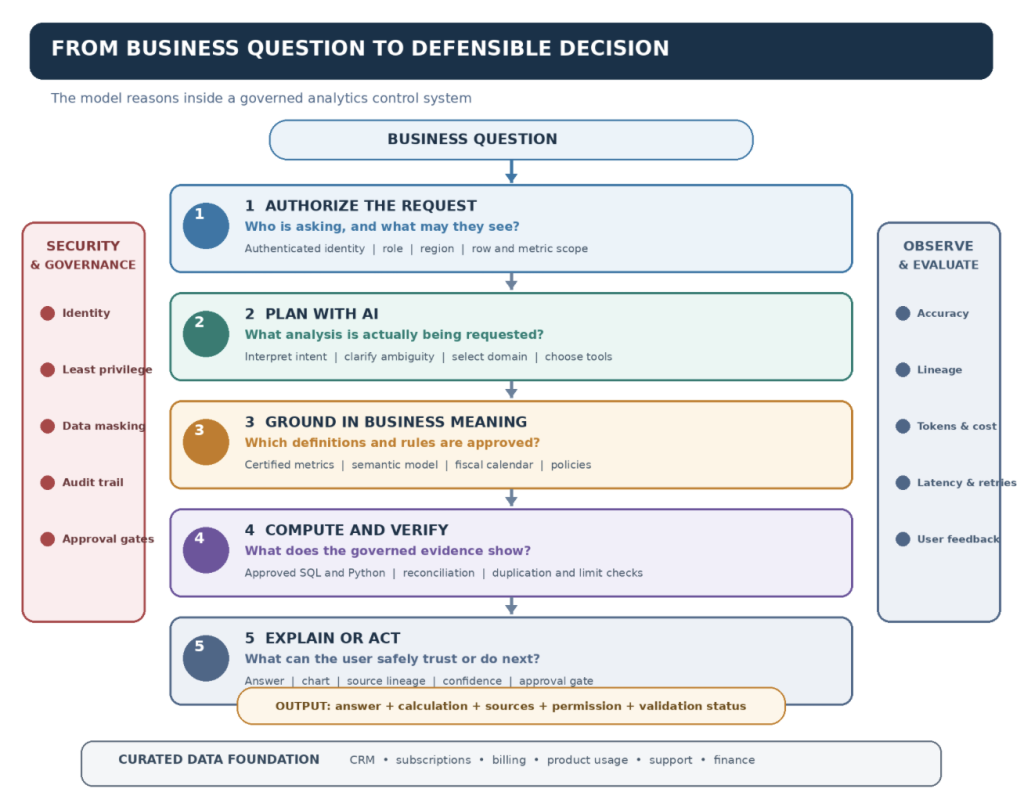 Figure 1. A vendor-neutral architecture for governed SaaS analytics agents. The central flow shows how a question becomes a verified answer; the side rails show the controls that remain active throughout.
1. Experience and access: establish who is asking
The entry point may be a collaboration tool, an analytics portal, a business intelligence report or an API. Before any reasoning begins, the system should establish user identity, role, region and permitted data scope. The same question asked by a chief financial officer and a customer success manager may require different rows, measures and levels of detail. Permission must travel with the request; it cannot be reconstructed from the prompt.
2. Orchestration: plan the work before calling tools
The orchestrator classifies the question, identifies the business domain, chooses tools and determines whether the request is informational, predictive or action-oriented. It should also know when not to proceed. An ambiguous phrase such as “lost customers” may mean cancelled subscriptions, non-renewals, dormant users or closed accounts. A well-designed agent asks for clarification instead of silently selecting a convenient definition.
Specialized agents can help—revenue, product, customer success and finance, for example—but specialization should follow proven need. A swarm of agents adds hand-offs, tokens, latency and failure points. Most organizations should begin with one orchestrator and a small set of controlled tools, adding specialist agents only when domain boundaries and evaluation data justify them.
3. Governed context: give the model business meaning
Retrieval-augmented generation is useful for policies, release notes, metric documentation and playbooks. It is not enough for numerical truth. Analytics requires a semantic contract: approved measures, dimensions, grains, join paths, exclusions, fiscal calendars, owners and freshness expectations. The model may select from these definitions, but it should not invent them at runtime.
For example, net revenue retention should resolve to the organization’s approved beginning-arrival cohort, expansion, contraction and churn rules. “Active customer” should carry a documented time window and status logic. This semantic layer is the bridge between human language and governed computation.
4. Controlled computation: let AI plan, not fabricate
The agent should query curated warehouse objects or a governed semantic model through bounded tools. Approved SQL templates, parameterized query functions and constrained Python routines are safer than unrestricted code generation. The result should include not only a number, but also the time period, filters, grain, sources and calculation version used to produce it.
Verification is a distinct step. Totals can be reconciled against certified measures; result sets can be checked for unexpected duplication; empty or extreme outputs can trigger a retry or human review. The model’s narrative should be generated only after the deterministic evidence package passes these checks.
5. Explain or act: return an evidence package
The output should be more than a polished paragraph. A trustworthy response carries an evidence package: the answer, calculation method, source lineage, permission scope, validation status and any material limits. If the request would update a forecast, create a customer task or change an operational record, the action should pass through a policy and approval gate rather than inheriting authority from the conversation.
The foundation below the agent: curate before it arrives
The underlying platform still needs the disciplines familiar to modern analytics teams: ingestion, transformation, identity resolution, dimensional modeling, tests, lineage and certification. CRM, billing, product telemetry, support and finance data should converge into reusable customer, subscription, product and time structures. An agent does not remove this work. It raises the cost of getting it wrong because one weak join can now influence hundreds of dynamically generated answers.
Two control planes that cannot be optional
Security and governance must span every layer. Identity-aware authorization, least-privilege tools, masking, audit trails and approval gates should be designed as runtime controls. This aligns with the risk-management logic of the NIST AI Risk Management Framework, which organizes responsible AI work around governance, mapping, measurement and management. For analytics, those ideas become concrete questions: Who may ask? Which data may be used? How is an answer tested? Who approves an action?
Observability and evaluation form the second control plane. Traditional monitoring asks whether a service was available. Agent monitoring must also ask whether the answer was correct, grounded, efficient and appropriately scoped. Useful telemetry includes the question class, model, tools called, SQL executed, rows and bytes processed, token use, retries, latency, warehouse cost, validation result, user feedback and cost per correct answer.
These records create a feedback loop for both accuracy and economics. They reveal expensive questions, weak metric coverage, agents that retry too often and models that cost more without improving quality. Observability is therefore not merely an engineering dashboard; it is the operating ledger for AI value.
What happens when a leader asks, “Why did ARR miss?”
A trustworthy answer is produced through a sequence, not a single model call. The critical point is the validation gate: a passing result may be explained and used for a controlled action, while a failing result must stop, return to planning or move to human review.
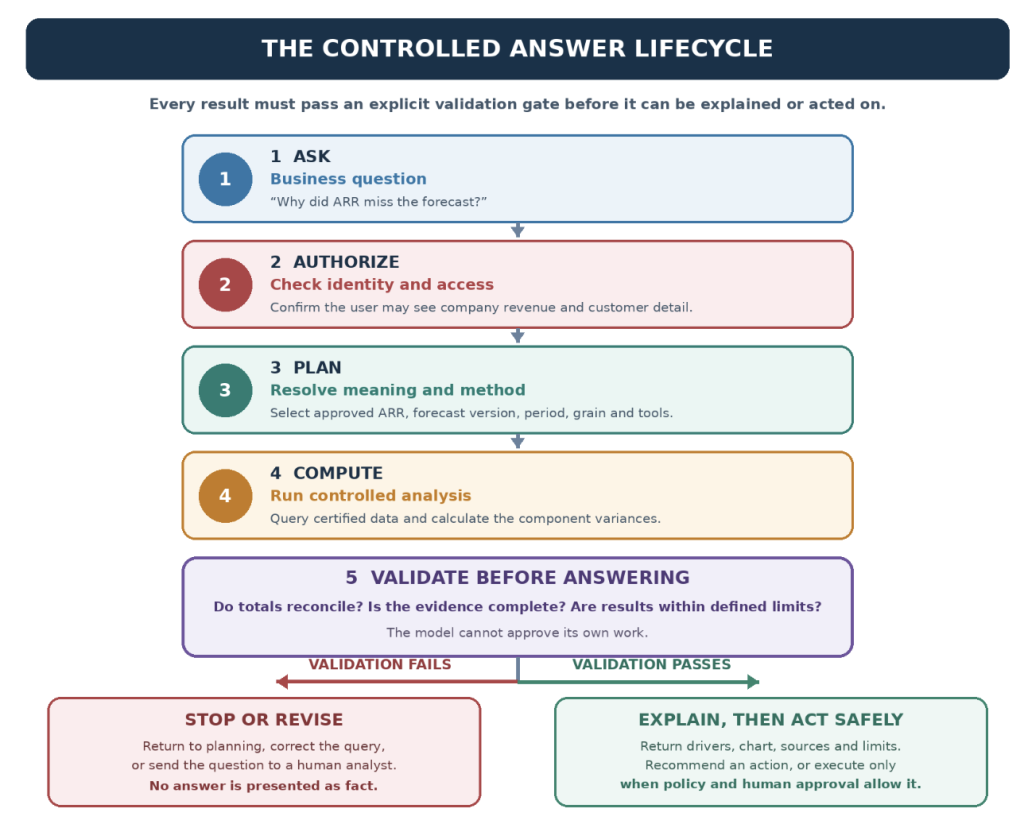 Figure 2. The validation gate separates evidence-backed answers from results that must be stopped, revised or reviewed by a human.
- Authorize. Confirm the user can see company-level revenue and customer details.
- Plan. Resolve ARR, forecast version, fiscal period, currency and comparison grain using governed definitions.
- Compute. Query certified revenue and forecast data, then examine churn, contraction, delayed expansion and new-business variance.
- Verify. Reconcile the total variance, test component sums and attach the query and metric versions.
- Explain. Present the largest drivers, confidence limits and a link to supporting evidence.
- Act. Recommend follow-up analysis or create a task only if the user has authority and the action policy allows it.
The answer might conclude that a forecast miss came primarily from delayed enterprise expansions, followed by contraction in a specific customer cohort and higher-than-expected churn. What makes this valuable is not the polished paragraph. It is the ability to move from every claim to the governed calculation and underlying evidence.
A practical reference implementation
The design is intentionally vendor-neutral, but organizations need a concrete way to assemble it. One implementation using a common Microsoft-and-Snowflake analytics stack could map the layers as follows. The products are replaceable; the architectural responsibilities are not.
| Architecture responsibility | Reference implementation |
| Curated analytical data | Snowflake governed views and data models |
| Transformation and testing | dbt and Snowflake SQL |
| Semantic contract | Power BI or Fabric semantic models plus certified measures |
| Agent orchestration | Azure AI Foundry Agent Service |
| Language models | Azure OpenAI with model routing by task and risk |
| Document retrieval | Azure AI Search for policies, definitions and playbooks |
| Controlled computation | Approved SQL tools and reviewed Python functions |
| Identity and authorization | Microsoft Entra ID with inherited data permissions |
| Telemetry and value reporting | Application Insights and Snowflake event tables surfaced in Power BI |
Table 1. Example technology mapping; equivalent platforms can fulfill the same responsibilities.
A 90-day path from demonstration to dependable capability
Days 0–20: define the decision and its contract
Choose one high-value domain—revenue retention is a strong SaaS candidate—and limit the first release to a small set of recurring leadership questions. Document approved metrics, grains, source objects, permissions, expected evidence and failure conditions. Create an evaluation set containing normal, ambiguous, adversarial and out-of-scope questions before building the interface.
Days 21–50: build a read-only evidence path
Connect the agent only to curated data and approved retrieval sources. Implement identity propagation, bounded query tools, validation rules and complete telemetry. Compare answers with certified business intelligence outputs and require source evidence. At this stage, the system should recommend but not write back to operational systems.
Days 51–90: test in real operating meetings
Introduce the agent into a narrow revenue or customer-health review with analysts present. Track answer accuracy, clarification rate, time saved, cost per verified answer and unresolved failure patterns. Expand questions, users or autonomy only when the evidence shows that the control environment is keeping pace with capability.
The future is an analytics control system, not an answer machine
Generative AI will make enterprise data easier to interrogate. It will also make inconsistent definitions, weak permissions and hidden modeling errors easier to distribute. The strategic choice is therefore not whether to add a chatbot to the analytics estate. It is whether to redesign analytics so that dynamic reasoning can operate inside explicit business contracts.
The organizations that succeed will let models do what they do well: interpret intent, plan analysis, connect context and explain evidence. They will keep identity, metric logic, computation, validation and approval in governed systems that can be inspected and improved.