Over the past year it has become easy to connect Amazon data to an AI assistant. Most tools do it through the Model Context Protocol, the open standard that lets Claude or ChatGPT call an outside data source directly. The promise is consistent everywhere: stop exporting spreadsheets and just ask your data questions in plain language.
That is a genuine improvement. But nearly all of these tools wire up the same dataset, which is your own Seller Central account. Your orders, your ad spend, your fees, your inventory. Reasoning over that with an assistant instead of a pivot table is a real time saver, and I am not dismissing it.
The catch is that your own account is only half of the picture, and usually the less useful half. It can describe what happened to you. It cannot tell you who caused it, or what is heading your way. For that you need the part of the market that sits outside your account, and that is the part I spend my time on.
The competition is a network, not a brand
When I started in this market I pictured competition the way most sellers do, one brand lined up against another on a product page. Whoever else lists something like your item is the rival, so you keep an eye on them.
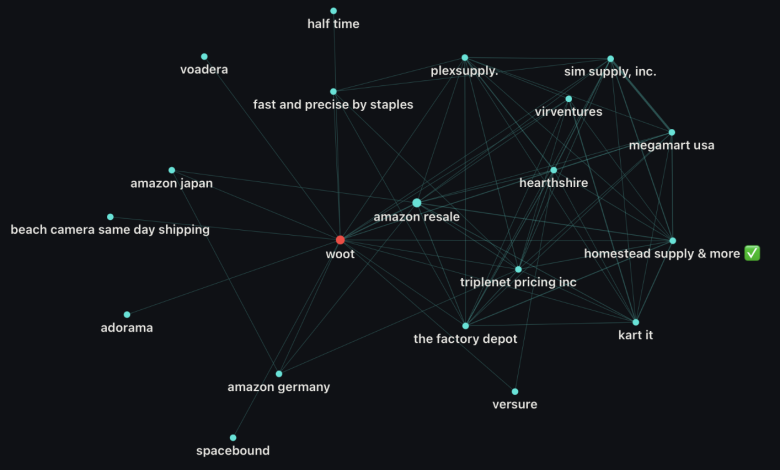
What broke that picture was looking at the marketplace by seller rather than by product. A small set of the same seller names surfaces over and over, never on a single listing but across dozens or hundreds of them, spanning brands with nothing obvious in common.
These are not brands. They are businesses run as portfolios, and there are far more of them than most sellers assume. Your real competition is this layer of professional operators moving across the whole marketplace, and from your own vantage point almost none of it is visible.
That is difficult to act on until you can actually see the layer, so seeing it is what I built toward.
Brands by sellers, sellers by brands
The way I hold it now is from two directions at once. From a brand, I want the full roster of sellers fighting over it: the one holding the buy box, the ones priced just beneath it, and whoever turned up recently.
From a seller, I want the mirror image, the complete set of brands in their catalog ordered by how much volume each appears to carry. Lay those two directions on top of one another and a graph falls out. Brands link to the sellers on them, and sellers link back to the brands they stock.
Follow the connections and you can travel from a single brand, to the sellers competing over it, out to the other brands those same sellers are quietly building a business on. A seller account never surfaces this, because it is scoped to you. It cannot reveal that the competitor squeezing your margin this month runs the identical strategy on dozens of unrelated brands, or which of those they used as their way in.
Comparing two sellers, and reading the gap
Once you treat a seller as a catalog rather than a string of single listings, the natural next step is to set two of them next to each other.
What you are after is not the overlap. It is the difference, the brands present in one catalog and absent from the other. Compare your own catalog against an operator you respect, and that missing column reads like a sourcing shortlist, brands they are earning on that never crossed your radar.
Compare two competitors instead and you can watch which one is pushing into new territory and where that move leaves them thin. It converts the fuzzy worry of “what is my competition doing that I am not” into a list you can work through.
I want to be plain about the numbers, since this is where a lot of products overpromise. Any sales figure here is an estimate, ours included, because actual units sold stay private to each seller’s account. What is genuinely observed, not modeled, is the record of who held the buy box, who appeared on a listing, and which brands a seller carries, and the comparison leans on that observed record.
Putting the network inside Claude and ChatGPT
For a long time all of this sat behind a dashboard. You signed in, navigated, and read the graph by hand, which worked but lived in its own tab far from where decisions actually get made.
What changed things for me was wiring the same data to an assistant over an MCP connector, so the interaction becomes a question instead of a click. You can ask which sellers have owned the buy box on a brand across the last couple of years. You can ask it to diff two sellers and name the brands one stocks that the other ignores. You can ask which operators are circling your brand and what else sits in their catalogs.
You ask in ordinary language, inside the same chat where you already work through decisions, and the reply comes from the data rather than from the model guessing. This is the part that should matter to an AI audience, because an assistant is only as strong as the data it can reach, and most assistants reaching into Amazon can only reach your own corner of it.
Crucially it only reads. It never touches your account or edits a listing; it retrieves the observed market data and explains it, which is the conservative shape you want for research rather than execution.
Your own playbook, on a schedule
This is the point where it stops being a search box and turns into a system.
Because it is a connector, it works anywhere the protocol works, including setups where an assistant runs on a cadence. So you can hand it a standing competition review and stop remembering to log in. Once a week it can report who broke into the buy box on the brands you track, which fresh brands your sharpest competitors picked up, and where the market is undercutting you.
The catch is that a review only earns its place if the logic inside it is yours. You set the competitors worth watching, the price floor, the threshold for what counts as an opening, the categories that matter and the ones to ignore.
Encode your angle once and the assistant keeps rebuilding the review through your eyes. A bare alert tells you a number moved; a review wired to your own reasoning tells you what moved, who moved it, and whether it should change what you do.
Keep the human in the loop
None of this argues that AI should run an Amazon business. It should not, and it cannot. The judgment about your own category stays yours, the data is imperfect, and every answer is a starting point you still have to check.
What I wanted was narrower and more useful: for the assistant I already use to be able to see the whole board, not just my own numbers but the network of sellers I am actually up against, the catalogs they are building, and the openings they leave behind. The tools that win the next phase of AI in commerce will not be the ones with the slickest chat window. They will be the ones that hand the assistant something worth reasoning about.
If you want to see this network view for yourself, it is what I have been building at Webotee, including the connector that puts it inside Claude and ChatGPT. The data is observed market intelligence, it is read-only, and it is the half of Amazon you cannot see from inside your own account.
Bio: Nikola Cosic is the founder of Webotee, an Amazon market intelligence platform, and a software engineer specializing in large scale data systems.