The graphics researcher is pushing past pretty output toward systems creators can steer, iterate on, and trust inside real products.
Yitong Deng loves games for a reason that has nothing to do with winning. He likes the sense of being inside another place. He likes the freedom to wander and choose what happens next. He also hates the moment the illusion breaks.
He remembers the giveaways. Plastic-looking surfaces. Shapes that read as digital. Motion that does not behave like the world.
“I always noticed the seams,” Deng says. “The tiniest artifact can pull you out.”
That annoyance became a direction.
Deng works in computer graphics with an AI focus. He is interested in visual realism, but he is even more interested in controllability. He wants systems that generate compelling images without turning the creator into a passenger.
“A beautiful result is not enough,” he says. “Creators need steering. They need predictability.”
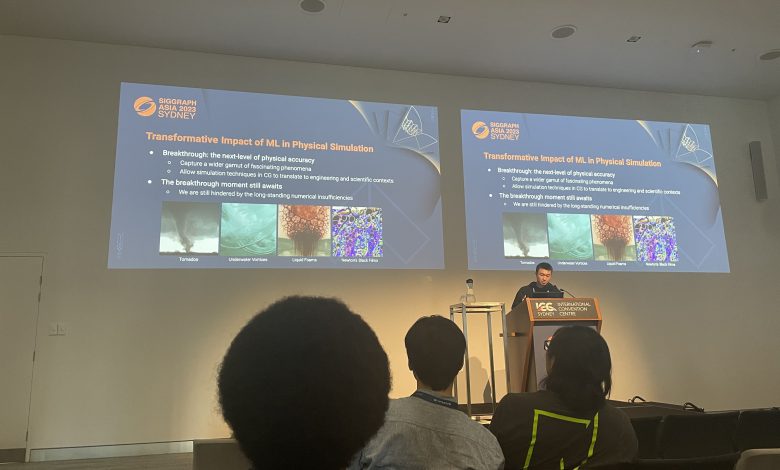
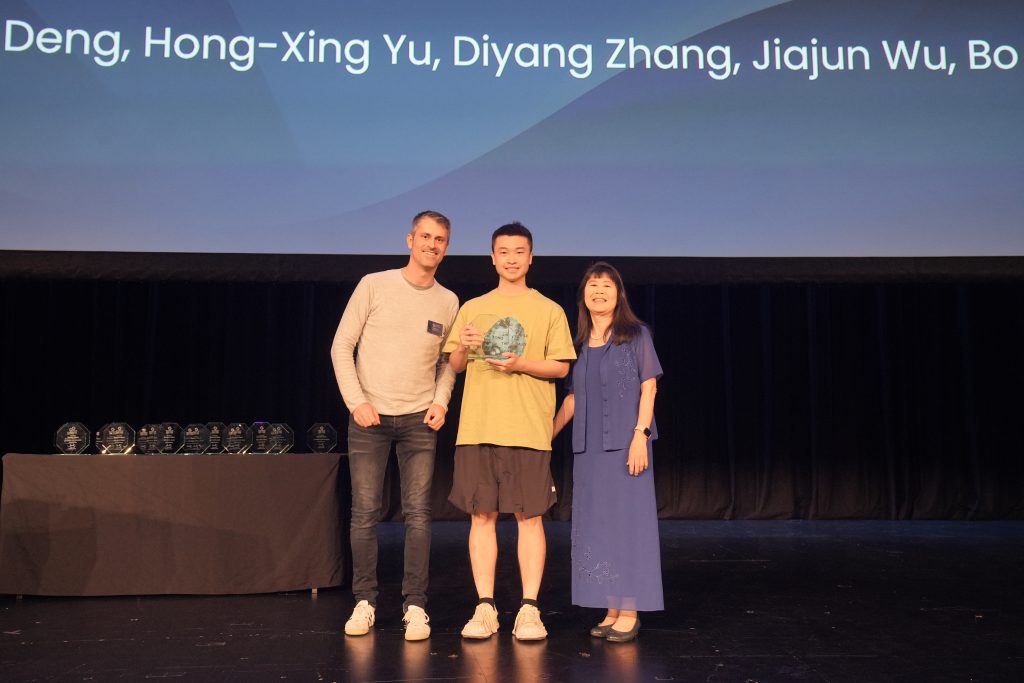
His research aims to make AI-assisted visual content feel grounded in physical rules so that it becomes precise and realistic enough to be usable for games, film, simulation, and interactive media. His work has been published in top venues including SIGGRAPH, SIGGRAPH Asia, ICLR, NeurIPS, and CVPR. His SIGGRAPH Asia 2023 first author paper, Fluid Simulation on Neural Flow Maps, received a Best Paper Award.
“We as humans are extremely good at picking up even the minuscule inconsistencies. So we need to work very carefully to get it 100% right. And this is why we need physical rules,” he says.
His work has influenced downstream academic projects at institutions including Brown University, MIT CSAIL, the University of Southern California, the University of Pennsylvania, McGill University, and Université de Montréal. He sees that impact as proof of relevance, not as a trophy.
“Influence means a lot to me because it shows that more and more researchers are focusing on the importance of controllability, consistency, and structure in generative AI,” he says. “That matters more than the headline.”
Deng entered Stanford’s computer science PhD program because he wanted to train at the center of the field’s history. Stanford Computer Graphics has developed the foundational digital technologies that empowered some of the world’s most popular movies, from Toy Story, Finding Nemo, and Cars, to The Matrix, Spider-Man 2, The Avengers, and Transformers. He also wanted a runway for long-term work. His advisor at Stanford is Ron Fedkiw, a two-time Oscar winner for visual special effects.
Deng is currently on leave from the program. He describes the decision as a change in setting, not a rejection of research.
“Academia rewards controlled, component-by-component progress,” he says. “My next step is to pursue a broader shift in the overall paradigm, and a startup is the right environment for that.”
He believes many AI systems in graphics are being bolted onto pipelines that were designed for a different era. The results look impressive in demos, but the tools break under production constraints. He wants the freedom to redesign the full chain when the hypothesis requires it.
“Patching can only take you so far,” he says. “Sometimes you need to rework the architecture.”
That thinking is part of why he joined Moonlake AI as a Founding Research Scientist. Moonlake is a startup focused on AI gaming and virtual worlds. He also brings industry experience from Netflix and Epic Games. Those environments gave him a clear sense of how systems behave when millions of people touch them.
“You can make something look good in a controlled clip,” he says. “Product reality is different. Product reality demands stability.”
His long-term vision is ambitious, but it is specific. He wants to change how people create and experience digital content. He talks about the blueprint in three layers.
He wants AI-native techniques that make games feel less fake. He wants game visuals to feel indistinguishable from real-world footage, including nuanced details of light interaction, geometry, physics, and animation. He wants richer interaction, so characters behave less like scripted bots and more like entities with memory and personality.
He points to VR headsets as a step toward deeper presence, and he sees room for major improvement in both hardware and software. He wants stronger immersion through hardware and software that evolve together. He also points to audio as an underused lever, especially dynamically rendered spatial sound that updates on-the-fly as a person moves and interacts with the environment, making immersion as responsive in audio as it is in visuals.
He also thinks the next frontier is touch.
“Tactile feedback is missing from most virtual experiences,” Deng says. “That gap limits what the world can feel like.”
He mentions haptic gloves and force feedback devices as part of what he hopes to build toward over time.
“The goal is a fuller sensory contract,” he says. “Sight and sound are not the whole human experience.”
Deng’s work sounds technical, but his motivation is simple. He wants the virtual world to hold up. He wants a person to step into an experience and stay there, without the seams announcing themselves every few seconds. He wants creators to have the level of control that makes those experiences repeatable at scale.
He is not chasing spectacle.
“With AI technology, our notion of multimedia is going to change drastically in the next 3-5 years. AI will not just be making images 10% sharper, but really unlocking brand-new dimensions previously unimaginable. So stay tuned,” he says.