As the global energy sector navigates one of its most complex transformations in history, a critical question continues to surface: how can energy systems become not just cleaner, but also smarter, more adaptive, and inherently resilient?
While much of the discussion has focused on renewables and electrification, the Physical AI Market is increasingly shaping the next phase of energy innovation. The rise of the Physical AI Market reflects a deeper shift toward embedding intelligence directly into infrastructure.
The Intelligence Gap and the Rise of the Physical AI Market
Energy infrastructure today is under unprecedented strain. The integration of renewables, distributed energy systems, and electrification is pushing legacy grids beyond their design limits.
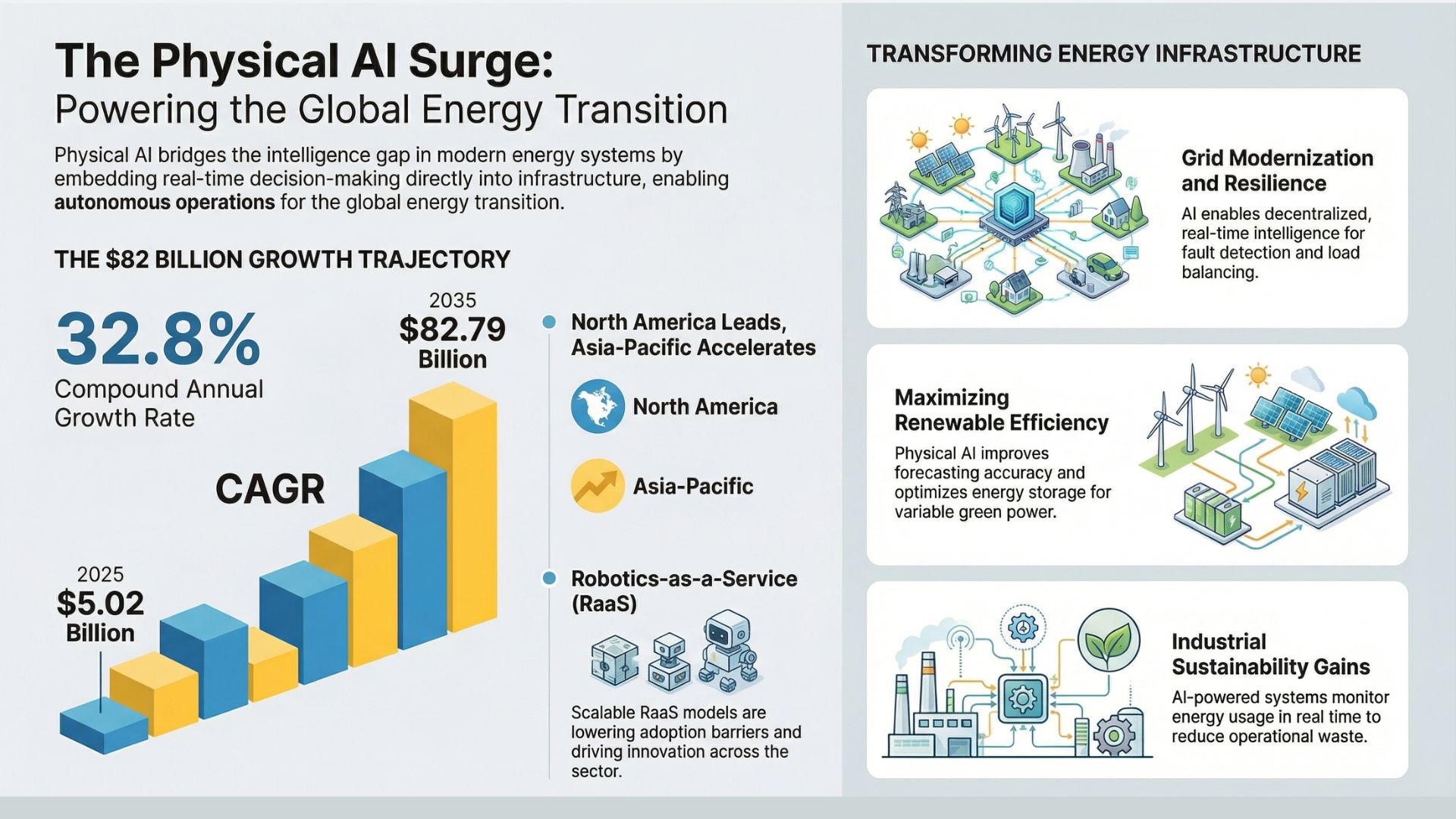
This is where the Physical AI Market becomes highly relevant. The growth of the Physical AI Market is being driven by the need to bridge the intelligence gap in modern energy systems. Acumen Research And Consulting projects that Global Physical AI Market was valued at USD 5,021.2 million in 2025 and is projected to reach approximately USD 82,790.9 million by 2035, expanding at a compound annual growth rate (CAGR) of 32.8% between 2026 and 2035.
As the Physical AI Market expands, it is enabling machines to interact intelligently with the physical environment—bringing real-time decision-making into energy operations.
From Automation to Autonomy: Physical AI Market in Action
Historically, energy automation has been reactive. The evolution of the Physical AI Market is changing this paradigm by introducing autonomy into physical systems.
The Physical AI Market is enabling:
- Real-time perception
- Context-aware decision-making
- Autonomous system responses
Through these capabilities, the Physical AI Market is redefining how energy infrastructure operates in dynamic environments.
Grid Modernization and the Physical AI Market
Smart grids are central to the energy transition, but their effectiveness depends on intelligence at the edge.
The Physical AI Market is accelerating grid modernization by enabling decentralized, real-time intelligence. As the Physical AI Market grows, utilities are adopting AI-driven systems for:
- Fault detection
- Load balancing
- Grid resilience
The expansion of the Physical AI Market is directly tied to the evolution of smarter, more adaptive grids.
Renewable Energy Optimization Through the Physical AI Market
Renewable energy introduces variability that traditional systems struggle to manage.
The Physical AI Market plays a crucial role in addressing this challenge. Innovations within the Physical AI Market are improving:
- Renewable forecasting accuracy
- Energy storage optimization
- Grid integration of renewables
As the Physical AI Market matures, it is becoming essential for maximizing renewable energy efficiency.
Industrial Efficiency Gains from the Physical AI Market
Industrial sectors represent a major opportunity for energy savings.
The Physical AI Market is enabling a new level of industrial intelligence through robotics and automation. Growth in the Physical AI Market is driving adoption of systems that:
- Monitor energy usage in real time
- Optimize production processes
- Reduce operational waste
The continued expansion of the Physical AI Market highlights its importance in achieving industrial sustainability.
The Physical AI Market and the Energy Impact of AI Infrastructure
As AI adoption grows, so does its energy footprint.
The Physical AI Market is uniquely positioned to address this paradox. Solutions emerging from the Physical AI Market are helping optimize data center energy consumption through:
- Intelligent cooling systems
- Automated infrastructure management
- Energy-efficient operations
In this way, the Physical AI Market supports both the growth and sustainability of digital infrastructure.
Robotics-as-a-Service and the Physical AI Market Expansion
The rise of Robotics-as-a-Service is closely tied to the Physical AI Market.
This model is accelerating the Physical AI Market by lowering adoption barriers and enabling scalable deployment of AI-powered systems.
As the Physical AI Market evolves, RaaS is becoming a key driver of accessibility and innovation across the energy sector.
Regional Growth Trends in the Physical AI Market
The Physical AI Market is expanding globally, with strong regional dynamics shaping its growth.
North America leads the Physical AI Market, while Asia-Pacific is emerging as the fastest-growing region. This regional expansion of the Physical AI Market reflects increasing investments in smart infrastructure and energy innovation.
Strategic Importance of the Physical AI Market
The Physical AI Market is no longer just a technology trend—it is a strategic imperative.
Organizations participating in the Physical AI Market must consider:
- Infrastructure readiness
- Integration challenges
- Long-term scalability
As the Physical AI Market continues to evolve, it will redefine competitive dynamics across the energy sector.
The Future Outlook for the Physical AI Market
The Physical AI Market is projected to grow from USD 5.02 billion in 2025 to over USD 82.79 billion by 2035, at a CAGR of 32.8%.
This rapid expansion underscores the transformative potential of the Physical AI Market across energy and industrial domains.
The trajectory of the Physical AI Market indicates a future where intelligent systems are deeply embedded in physical infrastructure.
Physical AI Market as the Foundation of Intelligent Energy Systems
The global energy transition requires more than infrastructure—it requires intelligence.
The Physical AI Market provides the foundation for this transformation by enabling systems that can adapt, optimize, and operate autonomously.
As the Physical AI Market continues to grow, it will play a defining role in shaping energy systems that are not only sustainable, but also intelligent and resilient.
Author Bio:
Digvijay Deshmukh is a technology and market research analyst at Acumen Research and Consulting, where he specializes in tracking emerging innovations across the pharmaceutical, biotechnology, and broader technology ecosystems. His work explores the convergence of digital transformation, artificial intelligence, automation, and advanced manufacturing within life sciences and healthcare industries. Digvijay’s insights help global organizations understand how data-driven technologies and Industry 4.0 trends are reshaping R&D, production efficiency, and market competitiveness. He regularly contributes to analytical studies highlighting how technology is redefining the future of pharma and healthcare.