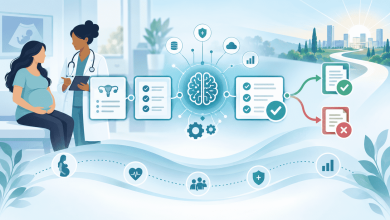

As industries across markets race to capture the advantages of AI-native business models, to-date healthcare has been slower to realize the same operational gains.
That’s not because AI lacks transformative potential in healthcare. In fact, some of its most significant successes have come in highly specialized applications, from detecting cancer biomarkers to accelerating the discovery of new pharmaceutical therapies.
These achievements demonstrate that AI can deliver meaningful value in healthcare. However, its adoption has largely been confined to narrowly defined use cases where models have undergone extensive validation.
An AI-native organization, by contrast, reimagines the business around AI, using agentic systems to redesign workflows and automate decision-making across the enterprise. While this approach has delivered productivity gains in other industries, it also introduces greater variability. AI systems can struggle with complex, multi-step workflows, particularly when faced with incomplete data, ambiguous inputs, or unexpected scenarios.
For the highly regulated healthcare sector, those risks cannot be overlooked. Errors do not simply affect operational efficiency, they can impact patient outcomes.
For many healthcare and life sciences organizations, becoming fully AI-native from the ground up may not be practical or even desirable. Instead, the greater opportunity lies in selectively adopting AI-native tools within well-defined, governed workflows.
By introducing AI where it can be rigorously validated and closely monitored, organizations can capture meaningful improvements without compromising safety and trust.
An AI-native advantage for biopharma
While we may not see a healthcare provider adopt a fully AI-native model, companies in life sciences have much to gain from the approach.
Data from Boston Consulting Group have found that an AI-first mindset applied to biopharma pilots could result in as much as 5% to 15% revenue uplift if applied more broadly.
General-purpose AI can confidently invent facts or misinterpret clinical context. In healthcare, a false negative can be fatal, making it impossible for clinicians to trust a “black box” model without clear accountability and explainability.
While we’re still a long way from having an AI model that is reliable enough to enter clinical workflows and work autonomously, there are other areas of healthcare where it’s more feasible to apply AI.
Patient engagement and stakeholder liaison is one of these places that can be viewed as low-hanging fruit for an AI-first mindset that also promises to significantly improve performance.
The same study from BCG found that an AI-native approach can boost the efficiency of biopharma sales representatives by 20% to 30%. Streamlining the medical communication product process is place to move towards these competitive gains.
Yet even here a cautious, risk averse approach is still paramount. An AI hallucination in a patient brochure could misinform patients about the correct dosage or fail to properly highlight the adverse reactions to watch out for with a new drug. A factual error during an advisory board meeting can also lead to a clinical trial losing its funding.
This is why it’s advisable to focus on AI tools rather than fully native workflows when creating medical communication materials.

Scaling the AI advantage across medical communications
Prezent Vivo 1.0 is an AI-native platform being announced this week that offers an interactive content studio built exclusively for the life sciences industry, and is looking to merge AI alongside human expertise.
Built around the way life sciences teams work, it combines purpose-built AI with expert medical communications services in a single platform, meaning that medical affairs and commercial teams can create and scale communications and take advantage of the AI-first advantage through this targeted tool.
According to a recent statement from the company, Prezent Vivo 1.0 combines AI-native speed with expert scientific oversight to deliver agency-quality medical communications in 24 to 72 hours at almost half the price of traditional agencies.
Combining scientific accuracy with enterprise branding and communication guidelines, the interactive Prezent Vivo 1.0 platform lets teams create content and communication materials in shorter timeframes at a lower cost while preserving the vital guardrails needed for this risk-averse industry.

This ensures that commercial teams can keep up with the fast-moving pace of work and produce brochures, slide decks and reports with clear, convincing messaging and an extremely close attention to detail.
Said Francine Carrick, President of Prezent Vivo, “Prezent Vivo 1.0 gives Life Sciences teams the flexibility to work the way they need, with AI, experts, or a combination of both, helping them reduce costs without compromising scientific quality.”
Scientific congress intelligence translated into content
Scientific congress meetings are another location where life science and biopharma companies can harness the advantage of AI-native tools to boost performance.
Yet pre-congress intelligence is one of the most underleveraged competitive advantages. Teams often invest heavily in post-congress analysis, but far fewer invest in building clarity before the first abstract drops. The organizations that do both consistently come out ahead.
With Prezent Vivo 1.0, teams attending congress events can produce and amend their commercial presentation materials in response to pre-conference intelligence and sessions during the course of the program.
One of the key additions to Prezent Vivo 1.0 is AI-generated scientific posters. Astrid transforms abstracts, publications, clinical study reports, spreadsheets, and other scientific source materials into congress-ready, publication-quality posters in minutes to help teams accelerate congress preparation while maintaining scientific rigor.
Combining AI with human expertise to unlock the native advantage
Prezent Vivo is already trusted by more than 150 Life Sciences companies, including 45 of the world’s top 50 BioPharma organizations. Although the launch of Prezent Vivo 1.0 brings an AI-native platform to the life sciences industry, the company hasn’t removed human oversight from the equation.
Working with hundreds of companies in the sector, it was clear that the fundamental need for accuracy and scientific rigor meant that any AI-native tool would need robust human guardrails.
“Scientific breakthroughs only matter when they’re communicated effectively,” explained Rajat Mishra, CEO and Co-Founder of Prezent.
“Prezent Vivo 1.0 brings AI and human expertise together to help Life Sciences teams move from discovery to better patient outcomes, faster,” added the executive.
One of the new features includes fixed price Projects. with this, users share their objectives and source materials with the platform’s AI assistant to create an initial draft. From here, presentation engineers and medical communications experts refine the narrative, validate the science and quality control standards are in order.
Companies can also opt for an overnight editorial review to check presentations for copy precision and improve clarity, consistency, and scientific accuracy.
A competitive advantage through AI-native tools
While general-purpose AI offers speed, it often lacks the scientific depth required for regulated communications, and traditional agencies can be slower and more costly.
As life sciences teams are under pressure to create effective communications and respond faster to scientific developments, we can look to a next generation of companies to bring an AI advantage to medical communications and patient engagement.