For decades, software development was constrained by a simple reality: humans could only write so much code. That constraint is now disappearing. AI coding assistants, autonomous agents and generative tools are dramatically increasing how much software organisations can produce, compressing work that once took days into hours and automating tasks that once required specialist expertise.
This is often presented as a straightforward productivity story. More code, delivered faster, should mean more innovation and greater business value. But a different reality is emerging.
Software quality activities already account for 50-60% of the time spent building and deploying modern applications. As AI dramatically increases the volume of code being generated, organisations are discovering that verification, not development, is becoming the primary constraint on software delivery.
With 60% of global organisations releasing untested code as AI accelerates development, the challenge is whether they can verify, govern and trust what is being generated. When software underpins everything from payments to customer service, supply chains and internal operations, failure brings real risk for business performance. While enterprises demand speed, they also can’t afford to introduce risk through unsecure or low-quality AI-generated code.
A growing verification gap
Recent debates around AI coding tools have focused heavily on productivity metrics. Organisations are measuring increases in commits, pull requests, lines of code and development velocity. These metrics are easy to quantify, but they only tell part of the story.
Generating code and releasing trusted software are not the same thing. Our latest global Quality Transformation Report found that more than half of organisations are knowingly shipping untested code into production. No longer the result of accidental oversights, it’s the result of top-down pressure to accelerate delivery and the sheer volume of software that teams are expected to validate.
This should give technology leaders pause. Modern software quality already consumes more effort than software creation itself. Its highly interconnected nature means that organisations are rarely testing a single application in isolation; they are validating complex ecosystems of dependencies, integrations and business processes.
As AI significantly increases the amount of code entering delivery pipelines, development capacity is scaling exponentially while verification capacity scales only incrementally. Traditional approaches to quality simply can’t keep up. Without fundamentally rethinking how quality is embedded into the software lifecycle, organisations risk creating a growing gap between the speed at which software is produced and their ability to ensure it is reliable, secure and fit for purpose.
More code, more value? Not necessarily
One of the most important lessons in software engineering is that output and outcomes are rarely the same thing. A development team can produce more code without creating more customer value, increase release frequency without improving reliability, or accelerate delivery while simultaneously increasing technical debt.
AI intensifies this dynamic. As code generation becomes easier, the bottleneck moves elsewhere. The challenge shifts from creating software to understanding it, validating it, integrating it and maintaining it over time. This helps explain why many organisations are finding that development acceleration does not automatically translate into business acceleration. The question is no longer “Can we build this?” but increasingly “Can we trust what we have built?”
Quality systems weren’t designed for AI scale
Most quality assurance processes evolved in an era when software creation was largely constrained by human effort. Testing frameworks, review processes, governance structures and release controls were built around development cycles that operated at a fundamentally different pace.
Today, organisations are trying to apply those same mechanisms to environments where AI can generate code continuously and autonomous agents are beginning to perform increasingly sophisticated development tasks. The result is growing strain across software delivery systems.
Our research found that only 37% of organisations are very confident that their testing strategy adequately addresses the most critical risks to software quality and business performance. Meanwhile, more than half are now managing between six and ten separate AI or automation tools across the software development lifecycle.
What we have created is not just technological complexity, but operational complexity. Every new tool, model, agent and automation layer increases the number of decisions that must be validated before software can be trusted.
The emerging trust problem
Perhaps the most concerning finding from our research is not the volume of untested code. It is the growing gap in confidence between those making strategic decisions and those responsible for day-to-day delivery.
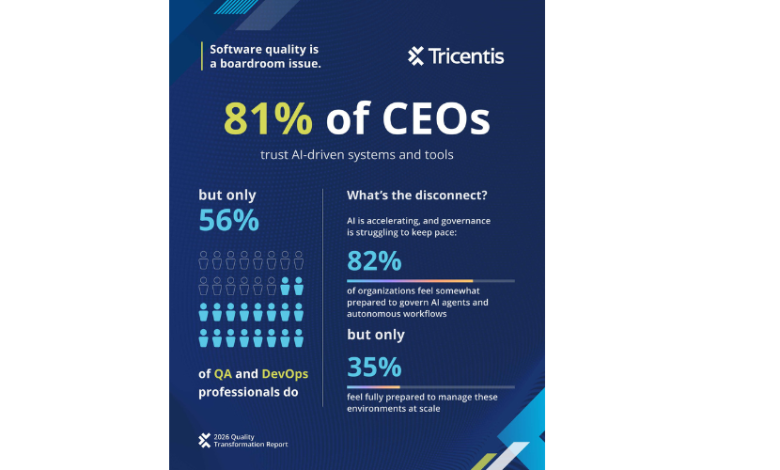
93% of senior executives believe their testing strategies address the most important software risks. Among QA and DevOps practitioners, confidence falls significantly. A similar divide appears when organisations assess trust in AI-driven systems and automation tools. Business leaders consistently express greater confidence than the operational teams responsible for validating and managing software releases.
This is important because software quality is ultimately a trust issue. Customers trust applications with their data, employees trust systems to perform reliably, regulators trust organisations to meet compliance requirements, and boards trust technology teams to manage operational risk. When confidence in delivery systems becomes disconnected from operational reality, organisations create blind spots that become increasingly dangerous as AI adoption grows.
Is governance the new competitive advantage?
Much of the current discussion around AI focuses on capability. Which model is best? Which coding assistant is the fastest? Which agent can automate the most tasks? These are important questions, but they may not be the most important ones.
As autonomous systems become embedded throughout software delivery, governance is likely to become a more significant differentiator than raw AI capability. Successful organisations will be the ones that are capable of maintaining visibility, accountability and control as software creation becomes increasingly automated.
Interestingly, our research found that while most organisations believe they are somewhat prepared to govern AI agents and autonomous workflows, only 35% feel fully prepared to do so at scale. That distinction is critical: Many organisations are prepared for experimentation, but far fewer are prepared for operational dependency.
Why software quality is becoming a boardroom issue
For years, software quality was often viewed as a technical concern. Today, it has become a business issue, mirroring the evolution of cybersecurity. What was once treated as a specialist IT function became recognised as an enterprise-wide risk requiring board-level attention.
Poor software quality increasingly manifests as financial loss, operational disruption, compliance failures and reputational damage. One in five organisations in our research reported annual losses of between $1 million and $5 million as a result of software quality issues.
As AI expands the scale and speed of software delivery, these consequences become more visible. The question facing leaders is no longer whether quality matters; it is whether existing approaches to quality are sufficient for an AI-driven future.
Moving beyond “verify later”
The software industry has spent years optimising for speed, and AI is accelerating that trend. But speed without verification and governance creates fragility and risk. Moreover, speed without trust ultimately undermines the very outcomes that organisations are trying to achieve.
The answer is not to slow AI adoption or reject automation. The opportunity lies in modernising verification at the same pace as organisations modernise development.
That means embedding quality throughout the software lifecycle rather than treating it as a final checkpoint. It means creating governance models that can operate at machine speed. And it means recognising that trust is becoming as important as productivity in measuring software delivery success.
The next generation of software leaders will not be defined by how quickly they can generate code but by how confidently they can verify it. Because in the age of AI, the most valuable capability may not be artificial intelligence itself, but the ability to trust it.