Across industries, AI is transforming how the world works: manufacturers use predictive models to optimise production; logistics firms automate real-time routing; and financial services rely on AI for risk management. Yet marketing – despite being one of the most data-rich disciplines – has been slower to adapt.
The sector has the same opportunity, but it faces a practical challenge. Much of what matters in marketing happens away from screens – it occurs when people try a product at home, form an opinion and decide whether they would buy it again. These moments can be hard to measure, and even harder to connect back to the activity that generated them – this problem is demonstrated clearly within the world of sampling. Products are often handed out with the hope that they will spark interest, but teams get very little certainty about who received them, what they thought, or whether anything changed afterwards.
This gap between activity and evidence is where AI becomes useful. It gives marketing teams firmer ways to identify the right people, check that each interaction is genuine and turn unstructured comments and behaviour into something actionable. Instead of relying on broad targeting or large send-outs, trial can become more focused, more measurable and easier to connect to real outcomes.
Smarter targeting through data-driven matching
Sampling has traditionally relied on simple assumptions about where the “right” consumer might be – on the street, in stores, or flicking through a magazine. This can be an incredibly wasteful endeavour. Many samples go to people with little interest, and the feedback that returns is often too weak to guide decisions.
AI is changing this model. Data-driven matching analyses customer insights – such as profile information, past activity, and interests – to identify and target audiences most likely to engage. By ensuring each sample reaches a genuinely interested individual, brands can increase participation rates and improve data quality.
For example, Ole Henrikensen partnered with Sampl with the goal of driving online review generation and increasing sales conversion. Together, we used an existing CRM database to identify ideal target customers – millennials with proven interest in luxury skincare – weaving in automation to cut down manual processes of selection. The result was a consumer journey that not only encouraged trial but also fostered behaviour understanding and purchase intent, and a 96% increase in new-to-brand customers.
Scaling insight with AI-driven analysis
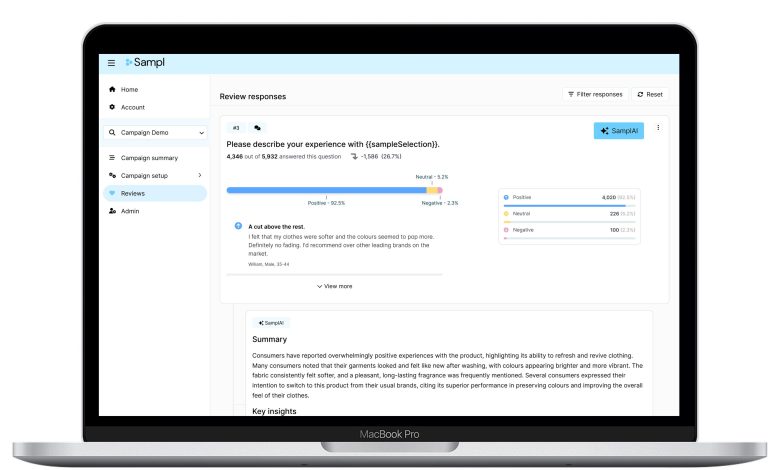
When a campaign ends, the real work starts. Thousands of reviews and survey responses can overwhelm even the best marketing teams. Manually analysing such feedback is slow and inconsistent. AI changes this by instantly summarising feedback, identify recurring themes, and highlight sentiment trends that might otherwise be missed.
When running large scale sampling campaigns, reviews can jump to the hundreds and thousands. Natural-language models make it possible to process unstructured comments – revealing what customers truly think. Analysing this volume of qualitive feedback through AI-assisted tools surfaces patterns – like preferred textures, scents, packaging – that manual processes could overlook.
AI doesn’t replace human interpretation – it accelerates it. With richer, faster insights, marketers can focus on decision-making rather than data cleaning. Real-time dashboards and automated summaries make results accessible across departments, and help product, sales and leadership teams act on feedback more quickly.
Our work with Weleda’s Skin Food produced a 4000% increase in reviews and 95% “would recommend” sentiment. Analysing such volumes through AI-assisted tools makes it possible to pinpoint detailed preferences. The outcome isn’t automation for its own sake – its clarity that informs decision making.
Building sustainability and efficiency into marketing operations
Every sample has a cost, most of which is paid before the consumer even touches the product. Producing, filling and shipping units require resources. When targeting is broad, a significant share of those units end up unused or given to the wrong audience.
AI supports a more responsible approach. By narrowing the audience to people who are more likely to be relevant, brands can run smaller campaigns without losing the value of trial. This reduces waste across production, packaging and delivery. It also creates clearer reporting, so teams can show how changes in targeting have reduced unnecessary activity over time.
Efficiency and sustainability become the by-products of better audience decisions, not separate initiatives that need extra attention.
Bridging data, creativity, and consumer research
The most useful change AI offers is the ability to link each stage of a sampling campaign. It enables teams to see who received the product, how they engaged with it and what they said about it in one connected view. This turns trial into a continuous feedback loop rather than a one-off activity.
Creative teams can gain a clearer sense of how people react to different messages or formats. Product teams can see where their expectations match consumer reality. Retail teams get solid evidence of early traction for launches or underperforming SKUs. AI helps businesses organise these signals so each team can focus on context and interpretation, not data sorting.
Trial remains a human moment. AI simply makes it easier to learn from it.
The path forward
Product sampling is one of the clearest examples of how AI can bring more certainty to marketing. It improves how teams find the right people, helps them check that interactions are authentic and turns open-ended feedback into structured insight. These changes make trial more measurable and less wasteful.
For marketers, the benefit is simple. They can plan activity with more confidence, make stronger cases for budget and bring clearer evidence into conversations with retailers and leadership. As AI becomes an embedded part of marketing workflows, activities like trial will feel less like guesswork and more like reliable tools for understanding demand and shaping growth.