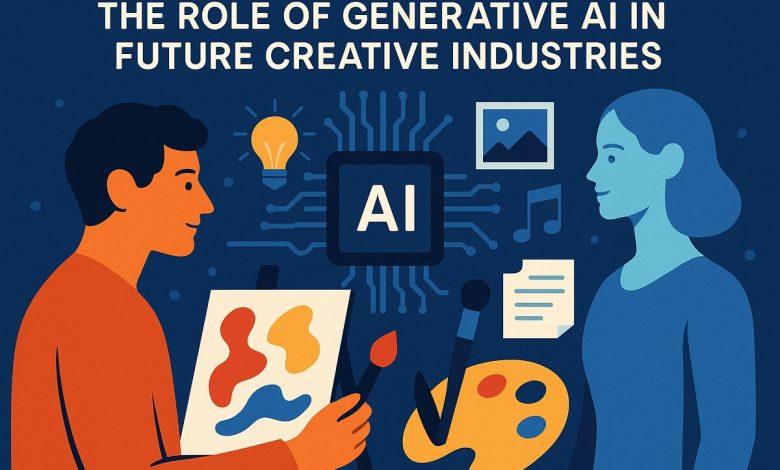
Generative AI is a groundbreaking force that is reshaping the creative sector. The technology uses huge datasets and sophisticated algorithms to produce unique content across various domains, including writing, art, visual, film and music. Far from being a threat to human creativity, it acts as a collaborator, augmenting the capabilities of creators and artists.
Generative AI assists with everything from brainstorming initial concepts to speeding up the production process, allowing professionals to focus on more important strategic, nuanced aspects of their work.
By providing access to more powerful creative tools and smooth workflows, generative AI is not only boosting efficiency but also pushing boundaries of what’s possible in this new era of artistic expression and innovation.
What is Generative AI for Future Creative Industries?
Generative AI is an artificial intelligence that helps in creating unique and orginial content, from text and images to videos and music. It is becoming an important tool in the creative industries, not as a replacement for human talent, but as a collaborative partner. Automating daily repetitive tasks and suggesting new ideas helps artists, writers, and designers work faster and explore new creative possibilities. This technology is changing how content is made, making it more efficient, accessible, and innovative for everyone involved.
How Generative AI Boosts Operational Efficiency
Generative AI provides significant operational benefits by reducing costs and streamlining workflows.
Benefits of Generative AI for the Creative Sector
Improved Creativity and Collaboration
Generative AI acts as a creative partner by helping artists, musicians, and writers broaden their ideation and explore new avenues of creativity. By generating a first draft, visual content, or concept, AI helps artists focus more on personalization and innovative strategic work.
Wide Access to AI Tools
The barriers to entry are lowered by generative AI’s wide variety of tools, which allow artists to create high-quality content without needing extensive traditional skills. Generative AI also improves content creation by optimizing outputs for search engines, helping it reach the target audience.
Increased Content Quality
AI-powered tools create content, keeping in mind the brand voice and maintaining a high-quality output across various content types. By using Machine Learning (ML) and Natural Language Processing (NLP), these tools make sure the content is engaging and optimized for search engines.
AI Prompt Engineering in Creativity
In creativity, AI prompt engineering has came as an important skill for using generative AI’s full potential. By crafting effective prompts, artists, writers and designers can guide AI models to deliver tailored, high-quality outputs for specific creative goals. This allows users to higher uniqueness and creative control, making prompt engineering an important part of modern content creation workflows.
Addressing Key Concerns with Generative AI
Generative AI helps in addressing copyright and ownership issues, as there is a huge debate going on about the intellectual property rights of AI-generated work, as models are trained on existing human-created content. And for that, a clear legal frameworks are needed to define the ownership and make sure fair compensation.
Also, there is always a risk that AI, by synthesizing training data, could lead to homogenization of creative styles or perpetuate biases, make sure ethical and unique outputs. AI also has an impact on junior-level roles, as it automates their tasks, raising concerns about how future creatives will gain fundamental experience, necessitating a focus on higher-level, strategic “AI-guiding” skills.
Application of Generative AI in the Creative Industry
Generative AI is rapidly being integrated across all major creative domains.
Music and Sound Production
AI models like Claude and Gemini (or other modern large language models) can be used to compose music in various genres by analyzing patterns from vast datasets of existing songs. This technology allows musicians, singers, and even non-musicians to compose everything from jingles to soundtracks with ease.
Creative and Copywriting
Tools like GPT-4 and other modern large language models have the power to generate articles, blogs, and novels that mimic human writing. The AI systems can create compelling, creative stories or highly effective content drafts. By using AI for the first draft, writers can focus on polishing and refining the content, saving a lot of time.
Visual Arts and Graphic Design
In visual art, generative AI has already proven its capability of creating stunning paintings, digital artwork, and even whole design concepts. AI tools allow artists to create pieces of art that would be unimaginable just a few years back. Artificial intelligence, trained on vast datasets, can mix different artistic styles and genres, creating new aesthetic outcomes and pushing boundaries.
Film and Animation
Generative AI is transforming the animation and film industry by enhancing visuals and automating animation sequences. AI is speeding up the labor-intensive process of creating frames by generating new content as per the pre-defined style. It also benefits entertainment software by helping screenwriters suggest plot twists, character development, and write dialogue as per the present narratives.
Gaming and Interactive Media
The gaming sector has adopted generative AI for making dynamic content that adapts to player behavior. Artificial intelligence can design entire level based on skill sets, players’ preferences and even non-player character dialogue. This technology allows developers to craft more personalized experience while reducing the resources and time needed for manual content creation. AI-powered narrative systems can branch storylines in real-time, creating unique gaming experience for each player.
Final Thoughts
The collaboration of generative AI in the creative industries represents an important shift, not a replacement of human ingenuity. This technology helps creators by offering new ways for collaboration and speeding up workflows.
While the debates will still play their role in ethical implications, there is no denying their potential to foster unparalleled efficiency and innovation. As artificial intelligence models become more intuitive and advanced, they will likely become an indispensable part of the creative toolkit, allowing artists, writers and designers to achieve more with greater ease and speed.
The generative AI in creative industries looks like a symbiotic relationship between machine and human, where AI serves as an example of new ideas and a partner in bringing them to life, making sure that the creative sector remains dynamic and forward-thinking.
FAQs for the Transformation of Generative AI in Creative Industries
1. How to hire AI developers for creative projects?
When businesses consider creative AI adoption, one main challenge is figuring out how to hire AI developers with the right combination of creative and technical expertise. The right developers should have experience in generative AI frameworks, machine learning models, and tools like text generation, image synthesis or music composition.
2. What is Generative AI, and how does it apply to creative industries?
Generative AI is an AI that creates oringinal content such as images, music, text and video by learning patterns from huge datasets. It applies to creative industries by serving as a powerful tool to assist with ideation, drafting and production across domains like visual art, writing and film.
3. How is Generative AI changing content creation?
It is transforming content creation by speeding up the production process, improving efficiency through the automation of day-to-day tasks, and lowering the barrier to entry for creators. This acceleration allows creators to maintain a consistent content stream and focus on the more nuanced, strategic aspects of their work.
4. Can Generative AI replace human creativity?
No, generative AI can’t replace human creativity; rather, it acts as a collaborator and an augmentative tool. It can handle initial drafts and concepts, allowing human writers, artists and designers to focus on persoanalization, strategic direction and innovative final refinement.
5. What industries are benefiting most from Generative AI?
Industries benefiting most include music and sound production, where AI composes original tracks; visual arts and graphic design, for creating stunning digital artwork and concepts; and film, animation, and gaming, for automating labor-intensive processes and creating personalized interactive media.
6. What are the probable challenges of using Generative AI in creative work?
The probable challenges includes addressing ethical implications, such as intellectual property rights and copyright, related to the training data. And making sure that the content generated maintains a high levels of uniqueness and aligns with specific brand voice or artistic vision.