A global company launches a major strategic initiative supported by real-time dashboards, predictive analytics, automated workflows, and AI-powered reporting systems.
Marketing interprets the market one way.
Sales responds differently.
Operations follows another direction entirely.
Everyone has access to the same information.
Yet the organization behaves as if multiple realities coexist simultaneously.
This phenomenon has become increasingly common in modern organizations.
Over the last decade, companies have dramatically expanded their investments in automation, artificial intelligence, data infrastructure, and operational optimization. Execution has become faster, systems more integrated, and workflows more scalable.
Yet despite these advances, many organizations continue to experience inconsistent decisions, unstable execution, strategic fragmentation, and constant operational realignment.
At first glance, this appears to be an execution problem.
It usually isn’t.
In many complex environments, the deeper limitation lies in how decisions themselves are formed, interpreted, and validated before execution even begins.
The Invisible Gap Between Data and Decision
One of the most underestimated problems in modern organizations is the assumption that better information naturally leads to better decisions.
For years, companies have invested heavily in dashboards, business intelligence platforms, predictive analytics, and AI-driven insights under the expectation that greater visibility would automatically improve organizational performance.
In many cases, it did improve visibility.
But visibility and decision coherence are not the same thing.
A leadership team may review the same reports, the same metrics, and the same market signals — yet still arrive at conflicting interpretations about priorities, risks, and next actions.
This happens because data alone does not determine:
· which signals are truly relevant
· how context should influence interpretation
· which criteria should guide action
· or how decisions should remain consistent as environments change
As organizational complexity increases, this gap becomes more visible.
Different departments begin operating from different assumptions. Teams react to local priorities instead of shared interpretation. Strategic alignment weakens, even when operational efficiency improves.
According to organizational theorist Karl Weick, organizations do not respond to information directly — they respond to the meaning constructed around that information.
That distinction matters.
Because what many organizations call a “performance issue” is often a decision coherence issue operating beneath the surface.
The result is a pattern that has become increasingly common across industries:
· faster execution, but unstable outcomes
· more information, but fragmented interpretation
· greater efficiency, but lower organizational coherence
In practice, many organizations are not struggling because they lack technology.
They are struggling because the structure connecting information, interpretation, and decision-making remains largely implicit.
When Execution Improves but Outcomes Don’t
One of the clearest signs that organizations are facing a structural decision problem is the growing disconnect between execution capacity and outcome consistency.
Over the last decade, companies have become exceptionally good at execution.
Workflows are automated.
Communication is instantaneous.
Performance metrics are monitored in real time.
Artificial intelligence accelerates analysis, forecasting, and operational responsiveness.
Yet many organizations continue experiencing:
· unstable strategic direction
· recurring operational realignment
· duplicated efforts across teams
· constant revisions of priorities and initiatives
This creates a paradox that is becoming increasingly difficult to ignore:
organizations are operating faster, but not necessarily moving more coherently. In many environments, the response to this inconsistency is predictable:
increase optimization.
More dashboards.
More automation.
More process control.
More operational acceleration.
But execution improvements cannot resolve inconsistencies that originate before execution itself.
When decision structures remain fragmented, operational efficiency tends to amplify variability rather than reduce it.
A misaligned decision executed efficiently does not become more coherent because it moves faster.
It simply scales the inconsistency more rapidly across the organization.
This is one of the reasons many organizations experience cycles of intense activity without proportional strategic clarity.
The issue is rarely a lack of effort or capability.
More often, it is the absence of an explicit structure connecting interpretation, decision criteria, and execution consistency over time.
Decision-Making as a System
A growing number of organizations are beginning to recognize that execution alone cannot sustain coherence in increasingly complex environments.
The deeper challenge is not simply operational performance.
It is the absence of a structured way to transform information into consistent, adaptive decisions over time.
This requires a shift in perspective.
Instead of treating decision-making as an isolated managerial act — often dependent on experience, urgency, or fragmented interpretation — organizations may need to begin treating decision-making itself as a continuous system.
Not a moment.
Not an intuition.
Not a reaction.
But an organizational structure capable of integrating information, contextual interpretation, validation, and adaptation continuously across operational environments.
This changes the role of decision-making entirely.
Rather than functioning as a secondary consequence of operations, decision-making becomes part of the infrastructure that sustains organizational coherence itself.
Management scholar Herbert Simon argued decades ago that organizations are fundamentally systems of decisions.
What is changing now is the scale and complexity at which those decisions must operate.In highly dynamic environments, intuition and isolated expertise become increasingly insufficient to sustain alignment across distributed teams, rapidly changing conditions, and adaptive operational demands.
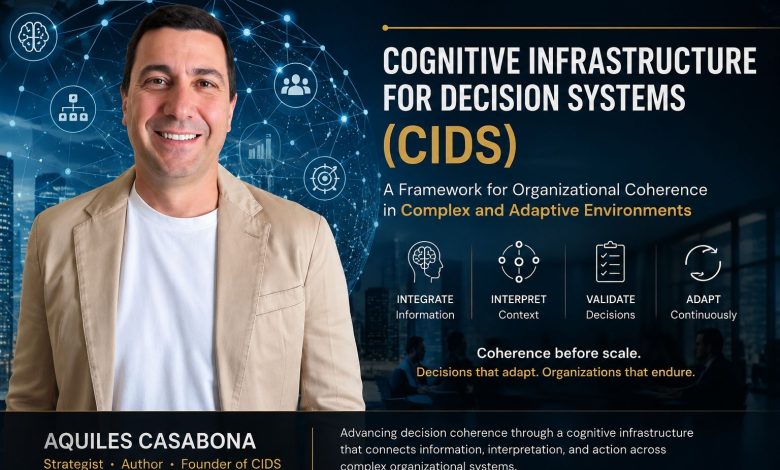
According to Aquiles Casabona, whose work on Cognitive Infrastructure for Decision Systems (CIDS) explores decision architecture in complex organizational environments, the missing layer in many organizations is not technological capability, but structural continuity in how decisions are formed and validated over time.
This perspective reframes organizational performance itself.
The issue is no longer only how efficiently organizations execute.
It is whether the logic guiding execution remains coherent as complexity increases.
Why This Matters in Complex Environments
In relatively stable environments, informal decision-making can often remain functional for long periods of time.
Experience compensates for structural gaps.
Patterns repeat.
Context changes slowly enough for intuition and operational memory to remain effective.
But complexity changes that equation.
As organizations become more distributed, adaptive, and context-dependent, the limitations of fragmented decision-making become increasingly visible.
Small inconsistencies scale faster.
Misalignment compounds across teams.
Local interpretations begin competing with organizational coherence.
In these environments, organizations are no longer dealing only with operational complexity.
They are dealing with interpretative complexity.
This distinction matters because complex environments rarely fail in obvious ways.
Most organizations do not collapse because of a single catastrophic decision.
Instead, they gradually lose coherence through hundreds of fragmented interpretations, reactive adjustments, and locally optimized actions that no longer align structurally.
The result is an increasingly common organizational condition:
· teams moving quickly, but in different directions
· constant operational adaptation without strategic stability
· increased activity with diminishing clarity
· execution intensity replacing decision coherence
Researcher Dave Snowden, known for his work on complexity and adaptive systems, has argued that complex environments require different forms of sense-making than stable operational systems.
What many organizations are beginning to realize is that scaling execution is far easier than scaling coherent interpretation.
And as artificial intelligence accelerates operational responsiveness, this distinction becomes even more critical.
Without structures capable of sustaining coherent decision formation, organizations risk amplifying fragmentation at the same speed they amplify execution.
From Optimization to Coherence
For decades, organizational performance has been largely defined by optimization.
The dominant assumption was straightforward:
better systems, faster execution, improved processes, and greater efficiency would naturally produce better outcomes.
In many contexts, they did.
But as complexity increases, optimization alone becomes insufficient to sustain organizational coherence.
Organizations may continue improving execution while simultaneously losing alignment between interpretation, decision-making, and action.
This is why many companies today experience a strange contradiction:
they operate with extraordinary efficiency, yet struggle to maintain strategic consistency over time.
The limitation is no longer simply operational.
It is structural.
What increasingly differentiates organizations in complex environments is not only their ability to execute efficiently, but their ability to maintain coherent decision structures while conditions continuously change.
Coherence becomes a strategic capability.
Not rigidity.
Not excessive control.
But continuity in how decisions are interpreted, validated, and adapted across different contexts.
This represents an important shift in organizational thinking.
The question is no longer only:
“How can we optimize execution?”
It is increasingly:
“How do we sustain coherent decisions as complexity scales?”
A Structural Shift Already Underway
As artificial intelligence continues evolving, its role is often framed primarily in terms of automation, acceleration, and productivity.
But a quieter transformation may already be emerging beneath the surface.
Organizations are beginning to recognize that operational efficiency alone does not guarantee organizational coherence.
The challenge is becoming less about executing faster and more about sustaining alignment across increasingly complex and adaptive environments.
This is why discussions around contextual intelligence, decision frameworks, adaptive systems, and organizational coherence are becoming more visible across industries.
Although these movements are not always connected explicitly, they point toward the same underlying transition:
a shift from execution-centered systems toward structures capable of sustaining coherent decision formation over time.
This transition is still early.
In many organizations, decision-making remains highly dependent on fragmented interpretation, implicit assumptions, and localized operational pressures.
Yet the pressure created by complexity itself is making these limitations increasingly difficult to ignore.
According to Aquiles Casabona, whose work has focused on decision system architecture, the next stage of organizational evolution may depend less on isolated technological capability and more on the ability to structure how decisions continuously adapt under changing conditions.
This does not eliminate the importance of execution.
It repositions execution within a broader organizational architecture where coherence precedes scale.
Final Thought
The challenge facing modern organizations is no longer a lack of information, technology, or execution capability.
In many cases, those capacities already exist at extraordinary levels.
What remains structurally unresolved is how organizations transform information into coherent, adaptive, and continuously validated decisions.
Until this layer becomes explicit, improvements in execution will continue producing fragmented outcomes, recurring realignment, and operational inconsistency at scale.
The next stage of organizational performance may not come from doing more.
It may come from building the structures that allow organizations to decide coherently in environments where complexity never stops evolving.