Every major social platform now runs on short-form video. TikTok, Instagram Reels, YouTube Shorts. The feeds your customers scroll through every day are dominated by 15-to-60-second clips. And the algorithms behind those feeds are actively suppressing static content in favour of video.
Most small businesses know this. The awareness gap closed years ago. What remains is a production gap. Filming, editing, captioning, and publishing video takes hours per piece. For a team of one or two people, that time does not exist. AI has closed that gap faster than most business owners realise.
Short-Form Video Owns the Discovery Feed on Every Major Platform
Short-form video is now the primary content format on TikTok, Instagram, and YouTube. Businesses that do not produce it are invisible on the fastest-growing discovery surfaces in digital marketing.
YouTube CEO Neal Mohan confirmed in his 2025 letter that Shorts surpassed 70 billion daily views. By early 2026, that figure had reached 200 billion. TikTok has over 2 billion monthly active users globally. Meta reported that Reels now account for roughly 50% of the time users spend on Instagram. These are not projections. They are current usage figures from the platforms themselves.
For small businesses, this matters because short-form video is where organic discovery still works. Facebook page reach has declined steadily for a decade. Instagram feed posts reach a fraction of followers. But a well-made 30-second video can reach thousands of non-followers through algorithmic distribution on any of these three platforms, with zero ad spend.
The Real Reason Small Businesses Are Not Posting Video
- Time, not awareness, is the bottleneck. A single short-form video takes 2 to 4 hours to produce manually: scripting, recording or sourcing visuals, editing, adding captions, writing metadata, and uploading to each platform.
- On-camera content creates a second barrier. Many business owners are not comfortable on camera, and hiring a presenter or video editor starts at £1,500 to £3,000 per month for consistent output.
- One-off videos do not move the needle. Platform algorithms reward accounts that post 3 to 5 times per week. A single video per fortnight gets almost no algorithmic distribution.
The result is a cycle most small business owners recognise: they post a video, see modest results, cannot sustain the effort, stop for weeks, then try again. Algorithms treat that inconsistency as a signal to reduce reach. The problem is not motivation. It is operational capacity.
What an AI Video Pipeline Looks Like in Practice
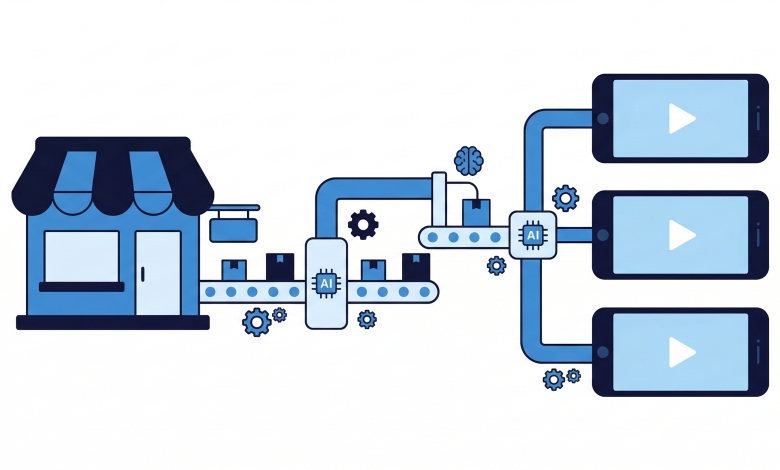
An AI video pipeline replaces the manual steps of video production with automated stages, from topic selection through to published content. The entire process takes minutes per video instead of hours.
At SyncStudio, the company I founded, we built a four-stage pipeline that reflects how this works at a practical level. First, an AI topic generator suggests content ideas based on your niche and audience. Second, a script engine writes scene-by-scene scripts with hooks, transitions, and calls to action. Third, a rendering engine produces the finished video with voiceover, captions, and music in one of several faceless formats: motion graphics, text stories, or interactive quizzes. Fourth, the video publishes directly to TikTok, Instagram Reels, and YouTube Shorts with platform-specific metadata.
This is not unique to us. The broader category of AI video generation tools has matured rapidly. What matters is the shift from “AI helps you edit” to “AI handles the full workflow.” That distinction is what makes daily publishing realistic for a one-person business.
The Numbers Behind AI-Produced Video vs Manual Production
- Manual production costs 2 to 4 hours per video. At a freelancer rate of £25 to £50 per hour, that is £50 to £200 per finished video before ad spend.
- AI pipeline tools produce a video in under 5 minutes. At subscription costs between £15 and £80 per month, the effective cost per video drops below £1 at moderate volume.
- The time difference compounds. Publishing 5 videos per week manually requires 10 to 20 hours. With an AI pipeline, the same output takes under an hour, including review and scheduling.
| Metric | Manual Production | AI Video Pipeline |
| Time per video | 2–4 hours | Under 5 minutes |
| Cost per video (at 20/month) | £50–£200 | Under £1 |
| Weekly time for 5 videos | 10–20 hours | Under 1 hour |
| On-camera requirement | Yes (or hire presenter) | No (faceless formats) |
| Multi-platform publishing | Manual upload to each | One-click to all three |
The economics shift at scale. A business posting 20 videos per month manually is spending 40 to 80 hours and £1,000 to £4,000 on production. The same output through an AI pipeline costs a fraction of that in both time and money. For small businesses, this is not an incremental improvement. It changes whether video is operationally viable at all.
Platform Algorithms Now Reward Exactly What AI Delivers
Every major platform’s algorithm in 2026 rewards two things above all else: posting frequency and watch-time completion. AI video pipelines are built to deliver both.
TikTok’s 2025 update shifted distribution to a follower-first model. New videos are now shown to your followers before being pushed to non-followers on the For You Page. This means accounts that post regularly build a feedback loop: more posts reach followers, which generates the engagement signals that trigger wider distribution. Accounts that post once a week or less never build enough signal to break through. We covered the full mechanics of this shift in our breakdown of TikTok’s 2026 algorithm changes.
Instagram’s Reels algorithm now prioritises original content and penalises recycled clips with visible watermarks from other platforms. The platform also introduced Trial Reels, which let creators test content with non-followers before committing to a full publish. Both features favour accounts that produce fresh content frequently.
YouTube Shorts has a completion rate threshold that influences whether a Short gets recommended beyond its initial audience. Videos under 60 seconds that hold viewers to the end perform disproportionately well. AI-scripted videos, with structured hooks and tight pacing, are engineered for this metric.
What Early Movers Get That Latecomers Will Not
- Algorithmic incumbency. Accounts that build a posting history and engagement baseline now will have a structural advantage when their competitors start posting later. Algorithms favour established accounts with consistent track records.
- Audience compounding. A follower gained today sees every future video. An account with 5,000 followers built over six months of consistent posting has a distribution floor that a brand-new account cannot match.
- Category ownership in local and niche markets. Most local businesses and niche service providers have zero short-form video presence. The first accountant in your city posting weekly finance tips on Shorts, the first personal trainer in your area posting daily workout clips on Reels: they will own that category in the algorithm’s local and topical rankings.
Short-form video under 60 seconds generates 2.5x more engagement than static image posts on Instagram, based on 2024 data from Socialinsider. This holds across accounts with fewer than 10,000 followers. The format advantage is real, and it compounds for those who start early. Tools like SyncStudio’s multi-platform publishing pipeline make it possible to maintain that consistency across TikTok, Reels, and Shorts simultaneously without tripling the workload.
The Window Is Open, But It Will Not Stay Open
AI video tools are dropping the barrier to entry for short-form video production to near zero. That means the competitive advantage of using them is temporary. The businesses that benefit most will be those that start while their competitors are still deliberating.
The pattern here mirrors what happened with search engine optimisation in the early 2010s, and with social media marketing in the mid-2010s. Early adopters built audiences and domain authority that later entrants spent years and significant budgets trying to match. Short-form video, powered by AI production tools, is at that same inflection point right now.
The practical next step is small. Pick one platform. Use an AI video tool to produce five videos this week. Publish them. Measure what happens. The data will tell you more than any article can.
For most small businesses, short-form video is not a content experiment. It is the primary discovery channel they are leaving empty. AI has made it possible to fill it.
About the Author
Justin Ashurst is the founder of SyncStudio, an AI-powered platform that generates and publishes short-form video for TikTok, Instagram Reels, and YouTube Shorts. Based in the UK, SyncStudio serves coaches, agencies, and small businesses producing faceless video content at scale.