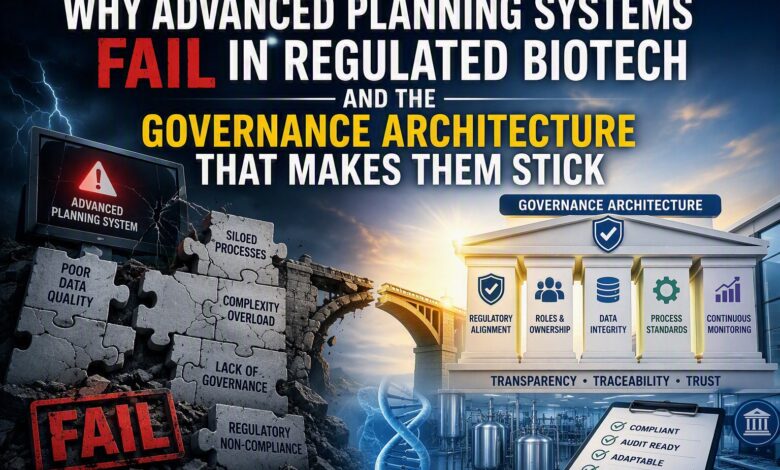
Biotech organisations are pouring capital into advanced planning systems, drawn by the promise of demand, supply, inventory, and production finally working from one synchronised plan. Yet a surprising number of those programmes quietly underdeliver once the implementation partner has gone.
McKinsey puts the failure rate of major transformations at around 70%, and the causes it identifies are rarely about the software. They are about people, process, and the discipline required to sustain a new way of working.
I have spent my career leading planning transformations in regulated biotech, both as an implementation consultant responsible for designing and deploying new planning environments and as an in-house leader accountable for making those environments work after the project team leaves. I have sat on both sides of that handoff, and the pattern is remarkably consistent.
When the numbers disappoint, the instinct is to blame the platform. That instinct is almost always wrong.
A planning failure in this industry is rarely a system-capability gap. It is a process, governance, and change-management gap, and no amount of additional configuration will close it. The distinction matters because it changes what leaders are actually buying. A platform is a tool. Durable planning is a governance transition. Treating the second as though it were the first is the most common reason advanced planning value erodes.
The Failure Is Structural, Not Technical
Strip away the vendor logos, and failed deployments tend to share the same structural conditions. A system cannot resolve any of them on its own.
The first is the absence of a consensus planning process. Demand, supply, inventory, and production each produce their own numbers, but nothing forces those numbers to reconcile into one agreed plan. The single version of the truth everyone refers to in meetings often lives on a presentation slide, not in anyone’s daily work.
The second is unclear data ownership. When no function is accountable for the master data that planning depends on, a new platform inherits the same disconnected, hand-maintained inputs it was bought to replace.
The third is the lack of an enforced cadence across functions. Without a standing rhythm that survives a difficult quarter, planning drifts back to private spreadsheets the moment people get busy.
I have watched this play out inside biotech organisations moving from clinical trials into commercial supply. Demand sits in one analyst’s workbook, supply in another, inventory in a third, and the production schedule somewhere else entirely. Each file may be competent in isolation. Together, they never fully agree.
Every monthly review then begins with an argument over whose numbers are correct. A planning platform placed on top of that environment does not settle the argument. It automates it.
This is why technology-first programmes stall. Gartner found that only 17% of supply chain organisations are pursuing genuine redesign of their processes and workflows. The master-data foundations these systems depend on are an organisational problem long before they are a technical one.
People First, Then Process, Then Tool
Durable transformation follows a deliberate order. It starts with people, moves to process, and reaches the tool last.
People come first because behaviour determines whether a new way of planning survives. Software does not change behaviour on its own. Structured change management, train-the-trainer programmes, and a genuine period of hypercare after go-live are what turn reluctant users into confident ones.
In practice, hypercare is not simply a support desk remaining available for several weeks. It often means planners initially running their trusted spreadsheets in parallel with the new system, comparing outputs, investigating differences, and gradually building confidence in the governed plan. That parallel period must be actively managed and time-bound. Otherwise, the temporary safety net becomes the permanent operating model.
Resistance is also worth listening to. The planners pushing back are often the people who understand the edge cases the project plan missed. Their objections can reveal genuine operational risks, including product allocation constraints, clinical demand uncertainty, manufacturing dependencies, and inventory rules that are not visible in standard process maps.
Process comes second. A formal sales and operations planning cadence, consensus demand governance, and workflows mapped to clear roles describe how the organisation will plan, independently of any system. Those decisions must be made with the business, not discovered on a configuration screen.
For example, a consensus demand review should not simply be a recurring meeting. It should be a governed workflow in which assumptions are submitted, exceptions are reviewed, changes are approved, and a locked snapshot is created before supply planning begins. Without that control, teams can continue editing demand after downstream decisions have already been made, creating an unstable plan and an unclear record of accountability.
The tool comes last, and its job is specific. It should enforce the agreed process, not merely permit it.
That word, enforce, is where many programmes fall short. A system that still allows unrestricted overrides, undocumented changes, or unofficial planning outside the governed workflow will see old workarounds return within a quarter.
Most struggling deployments invert the order entirely. They configure the platform first and hope process discipline and adoption will follow. In my experience, they do not.
In one anonymised transformation, forecast reliability began improving within two planning cycles after the organisation introduced a fixed consensus cadence, assigned ownership for planning inputs, and locked approved demand snapshots before supply review. The technology had already been available. The improvement came when the organisation changed how decisions were governed.
In Regulated Biotech, Governance Is Compliance
In life sciences, this architecture pays for itself twice.
A governed source of truth, with version control and an auditable record of how data moves from one system to the next, is exactly what operational efficiency requires. It is also closely aligned with what regulators expect.
The FDA’s guidance on data integrity and current good manufacturing practice, together with 21 CFR Part 11, places significant emphasis on records that are attributable, traceable, controlled, and supported by a complete history of changes. The qualities that make a plan trustworthy to an operations team are the same qualities that make it defensible during an inspection.
On the audit floor, inspectors may ask teams to show which planning record informed a decision, who changed it, when the change occurred, what the previous value was, why the adjustment was made, and whether the approval followed the defined procedure. If that history is distributed across email, spreadsheets, meeting notes, and individual memory, producing a reliable answer becomes difficult.
Seen this way, planning run across disconnected spreadsheets is not merely inefficient. It is a data-integrity exposure waiting to surface.
The governed environment that shortens the planning cycle and improves forecast reliability is also the environment that produces the version history, approvals, traceability, and documented rationale an inspector expects.
In a regulated setting, the familiar trade-off therefore falls away. Leaders do not have to choose between operational performance and inspection readiness. A well-designed planning foundation delivers both through the same governance architecture. That makes the investment far more than an efficiency initiative.
Deployment-Ready Is Not the Same as Sustain-Ready
One of the most useful distinctions a planning leader can make is between an organisation that is ready to complete an advanced planning deployment and one that is structurally ready to sustain it.
They are not the same thing, and confusing them is how expensive systems end up only partially used.
Deployment readiness is largely logistical. It involves funded scope, migrated data, a configured system, completed testing, trained users, and a defined go-live plan. With sufficient budget and a capable implementation partner, many organisations can clear that bar.
Sustain readiness is organisational, and it is far rarer.
It depends on whether someone owns the planning process itself rather than only the system that hosts it. It depends on whether the cross-functional cadence continues when the quarter becomes difficult and whether there is a real mechanism for resolving demand-versus-supply disputes before they harden into stalemate.
Most importantly, it depends on whether planning literacy stays inside the organisation or leaves with the consultants.
I have sat on both sides of that handoff. As a consultant, the responsibility is to build the process, configure the environment, transfer knowledge, and prepare the organisation for ownership. As an in-house leader, the responsibility is different. You must keep the cadence alive, develop internal capability, challenge weak assumptions, manage exceptions, and stop teams from quietly returning to familiar workarounds.
A transformation is not sustainable when only the implementation partner understands the model logic, integration dependencies, workflow controls, or exception rules. Internal teams must be able to explain not only how the system works, but why the process was designed that way and how it should evolve.
An organisation that can answer those questions will keep extracting value for years. One that cannot will watch a costly new platform decay back into the spreadsheets it was meant to retire.
This is the readiness I now look for before anything is configured. The go-live was never the hardest part. Keeping the discipline alive after the project team disbands is.
The 2026 Imperative
As agentic and AI-assisted capabilities move deeper into planning, the case for getting this foundation right becomes even stronger.
AI demand-sensing capabilities can identify changes in customer behaviour, market conditions, order patterns, and external signals faster than traditional planning cycles. Autonomous replenishment engines can generate recommendations based on inventory positions, lead times, service targets, and supply constraints. Exception-based planning can help teams focus attention on the relatively small number of issues that require human judgement rather than manually reviewing every item in the plan.
Agentic planning can take this further by monitoring conditions continuously, identifying emerging constraints, recommending corrective actions, and coordinating decisions across planning functions. It can help planners evaluate scenarios faster, surface risks earlier, and reduce the time spent collecting and reconciling information.
However, these capabilities do not remove the need for governance. They increase it.
An automated recommendation is only as reliable as the data, rules, accountability, and approval process beneath it. If master data is inconsistent, ownership is unclear, or functions operate from competing versions of the plan, AI will not resolve the problem. It will produce poor decisions faster and at greater scale.
Organisations will therefore need to define where an AI-generated recommendation can be accepted automatically, where human review is mandatory, which data sources are authorised, how overrides are documented, and who remains accountable for the final decision.
Gartner’s assessment that supply chain data governance is foundational to digital transformation is especially relevant here. Governance is not a benefit that appears after digital transformation succeeds. It is the precondition that allows digital and AI-enabled planning to operate safely and consistently.
The advice I give planning leaders is simple.
Build the governance transition first: the people, the process, the ownership model, the enforced cadence, and the single governed record. Then let the platform hold that discipline in place.
Done in that order, an advanced planning system stops being an expensive experiment. It becomes what it was always meant to be: the operating system of a regulated supply chain.