The difference between an all-hands meeting that builds trust and one that becomes the office joke usually comes down to who is sitting at the encoder.
Internal communications have changed more in the last five years than in the previous twenty. Hybrid workforces, distributed leadership, and the rise of employee experience as a strategic function have pushed comms teams into territory that used to belong to broadcast networks.
If you run internal comms or employee experience at a 500 to 5,000-person company, your quarterly all-hands is no longer a room meeting with a recording. It is a livestream. A CEO town hall is simulcast to fifteen offices and a Zoom audience that is larger than the in-room crowd. An executive interview is cut into clips for LinkedIn and recirculated through the careers page for the rest of the quarter. The live audience has become the smallest of the three audiences you are producing for.
The production teams hired to support that work are often the same vendors a company has been using since the days of fluorescent ballrooms and tripod camcorders. The gap between what a modern livestream actually requires and what most AV vendors deliver is where careers get made and lost.
A botched all-hands livestream does not just embarrass the team that planned it. It becomes the talking point of every coffee chat for the next two weeks. The CEO who froze mid-sentence. The stream that buffered through the Q and A. The audio arrived two seconds out of sync with the speaker. The recording was unusable for the recap video. None of these is a content failure. They are production failures, and they are entirely preventable when an experienced corporate livestream production company is in the room.
Here is what to look for.
Put senior people on site
Not a sales lead who shows up at kickoff and disappears. Not a project manager who has to text three different specialists to answer a basic question. The engineer in charge of the stream needs to have run hundreds of shows like yours and needs to be physically present from load-in to load-out.
If your vendor cannot tell you the name of the person sitting at the switcher and the person managing the encoder two weeks before the event, that is a warning sign.
Demand a real technical plan
The plan should be written down before the event. It should include camera positions, audio inputs, signal flow, encoder configuration, bitrate ladders, streaming destinations, redundancy paths, recording formats, and a clear answer to the question of what happens when something fails.
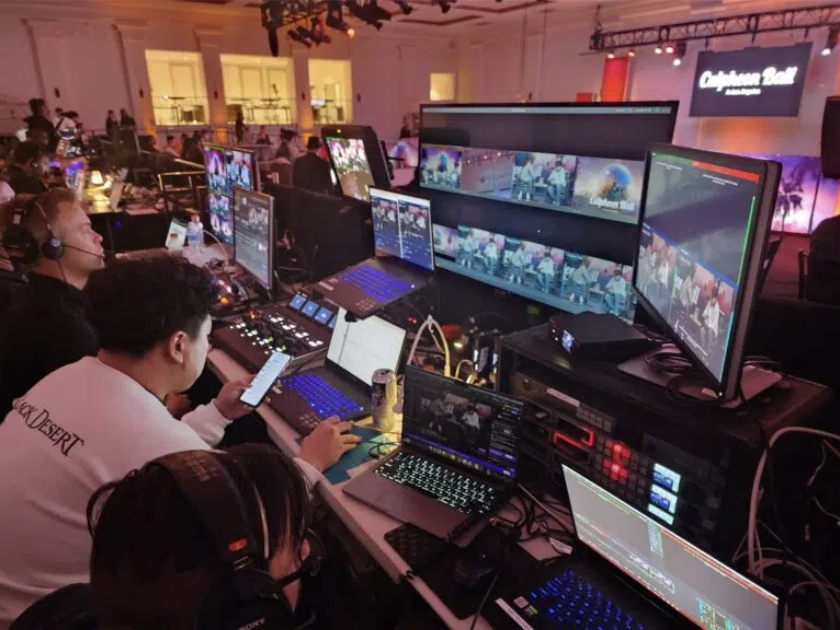
Every livestream has at least one thing that fails. The internet connection drops. An encoder crashes. A platform throttles. The question is whether your partner has rehearsed the recovery and built the redundancy before show day, not after.
A partner who treats the run of show as a living document, updated through every rehearsal, is a partner who is going to save you when the unexpected happens. A partner who shows up with a single laminated card is going to make excuses.
Treat streaming infrastructure as part of the show
This is where livestream production separates itself from corporate AV, and where most vendors are weakest. Your partner should be running redundant encoders, bonded cellular as a backup to venue internet, and a separate path for any platform that matters, whether that is YouTube, Vimeo, Zoom, Teams, or a custom RTMP destination.
They should be testing the bandwidth at the venue days before the event, not the morning of. They should be able to tell you the exact bitrate ladder they are pushing, why they chose it, and what happens to your viewers if the primary connection degrades. If they cannot explain their failover plan in plain language, find someone else.
Treat audio as mission-critical
This is the single area where corporate livestreams most often fall short. Bad audio destroys a town hall faster than bad video, and on a stream, it is more punishing than in a room because remote viewers have no visual cues to compensate. Your partner should be running redundant lavaliers on every speaker, monitoring levels live, providing IFB to anyone who needs it, and delivering a clean program mix to the encoder that is separate from the room PA.
They should be asking about the room acoustics days before the event, not the morning of. If they cannot tell you which microphone model they recommend for your CEO and why, find someone else.
Plan for live, remote, and recorded from the first meeting
Most all-hands livestreams have a live audience in the room, a remote audience on a streaming platform, and a long tail of recorded content that gets cut up and redistributed for weeks afterward. The production partner has to plan for all three from the first planning conversation.
The cameras have to frame for the in-room screens and the remote viewers, which are not the same shot. The audio has to be clean enough to survive compression and platform processing. The recording masters have to be captured at a higher quality than the stream, organized, and labeled so the post team is not hunting through unmarked files three days later. Backup recordings need to exist on a separate device in case the primary fails.
Welcome the pushback
The best production partners are not order takers. They will tell you when your timing is unrealistic, when the venue’s internet is wrong, when the speaker order will cause a transition problem, when the platform you picked is going to throttle, and when the lighting plot will make the CFO look exhausted on camera.
This pushback is uncomfortable in the moment and invaluable in the aftermath. The vendors who say yes to everything are the vendors whose work ends up on the highlight reel of mistakes.
Silence on comms is a sign of readiness
There is a tell that separates senior production teams from junior ones. The senior teams are nearly silent on comms during the show itself. Everything has been planned, rehearsed, and resolved. The director calls the cameras. The encoder operator confirms green across all destinations. That is most of what you hear.
The junior teams are calling out instructions, asking for clarification, and panicking through countdowns. If your partner’s comms feed sounds like a control room in a movie, they are not ready.
The post-event handoff matters as much as the stream
Master files delivered on a clear schedule. Stream archives pulled from every destination, not just the primary. Recording labels that match your content plan. Backup copies. A debrief call within a week. The relationship does not end when the stream ends. The next event starts where the last one left off.
Think beyond the stream itself
The best partners understand that the live stream is not the deliverable. The stream is the moment. The deliverable is everything that gets cut from it afterward and distributed across channels for the next quarter.
A senior production team is thinking about the highlight reel, the recap video, the executive sound bites for social, and the long-form recording for the careers page from the first planning meeting. They are framing shots and capturing B-roll with all of those uses in mind. They are recording isolated camera feeds, not just the program output, so the post team has real options. A junior team is producing a live stream and treating the post-event content as someone else’s problem.
The psychological dimension
Internal comms leaders bear the stress of an event for weeks before show day. The production partner becomes either a major contributor to that stress or a major source of relief from it.
Partners who communicate proactively, anticipate problems, and project calm under pressure make the entire pre-event experience easier for the comms team. Partners who require constant follow-up, miss small commitments, and panic about logistics make the experience harder. This is not a soft factor. Over the course of a year of major events, the psychological cost of the wrong production partner is significant, and it shows up in the quality of every other part of the comms team’s work.
The bottom line
The internal comms function has earned a seat at the executive table by treating its work as a strategic discipline rather than a logistics function. The production partner standing behind that work has to operate at the same level.
A corporate livestream production company that operates at that level does not just show up with cameras and an encoder. It shows up with experience, judgment, redundancy, and the calm presence that lets a comms leader focus on the message instead of the machinery. That is the bar. Anything below it is a vendor. Anything that is a partner.