Most people outside of the supply chain have never heard of EDI. Most people inside it wish they had a better version of it.
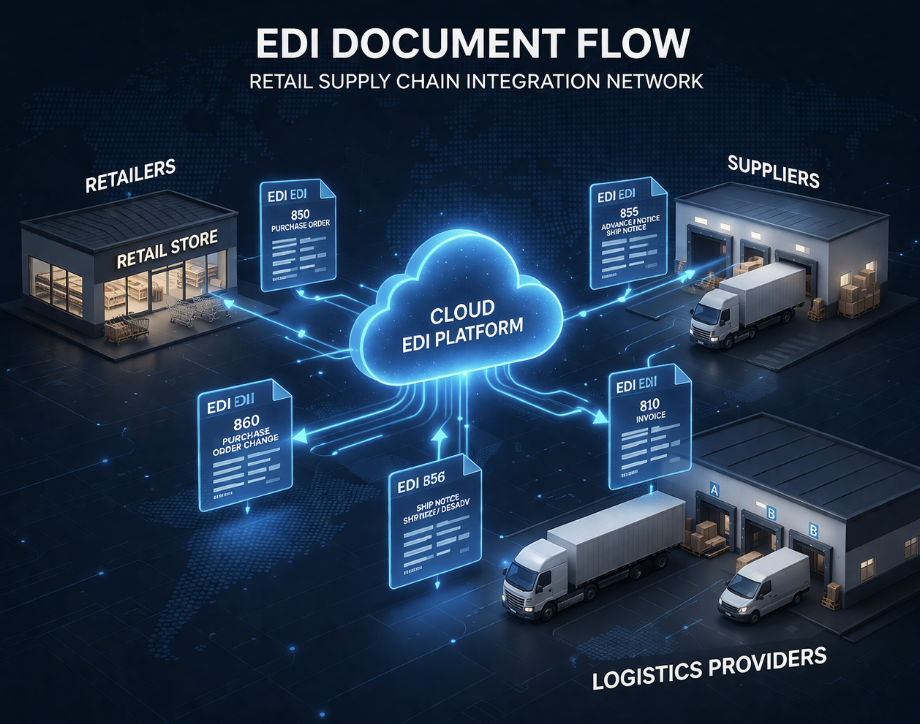
Electronic Data Interchange is how businesses exchange documents with trading partners. Purchase orders, invoices, ship notices, inventory updates: all of it moves through EDI pipelines. In many organizations, those pipelines have been running on the same infrastructure for two decades.
It is not glamorous. But pull it out from under a retail or manufacturing operation, and the whole thing stops.
The problem is that EDI was designed for a slower world. Batch processing overnight was fine when nobody expected real-time anything. Custom per-partner mapping was manageable with a handful of suppliers. Weeks-long onboarding was just accepted.
None of that flies today.
Why EDI Is Trickier Than It Sounds
Two businesses agree to exchange structured data. Simple enough in theory.
In practice, every trading partner has its own requirements. One retailer mandates a specific version of the X12 850 purchase order standard. A logistics partner uses EDIFACT. A supplier you are trying to onboard is running an AS2 connection nobody has touched in years.
Multiply that across dozens of relationships and you have a compliance problem that quietly becomes a full-time job.
Then there is the error issue. EDI errors are notoriously silent. A malformed segment, a missing qualifier, a value outside an expected range these fail without much fanfare. A delayed shipment, a payment hold, a chargeback; by the time the impact shows up downstream, the root cause is hours behind you.
Legacy middleware was not built to catch this in real time. It processed batches and logged results. Which means your team finds out about problems after the damage is already done.
What Good EDI Actually Looks Like Now
The cloud era has changed expectations across every layer of the tech stack. EDI is no different.
A modern platform should onboard new partners in days, not months. Validate transactions as they happen, not after a batch runs. Give you visibility across every partner connection from one place. And connect to the rest of your stack through clean APIs, not bespoke middleware.
It should also handle compliance across partners automatically. Different versions, different protocols, different acknowledgment rules: a good platform manages all of that so your team is not manually tracking fifty sets of partner-specific requirements.
That is the bar. Here is who is clearing it.
The 5 Best EDI Platforms Right Now
1. Orderful
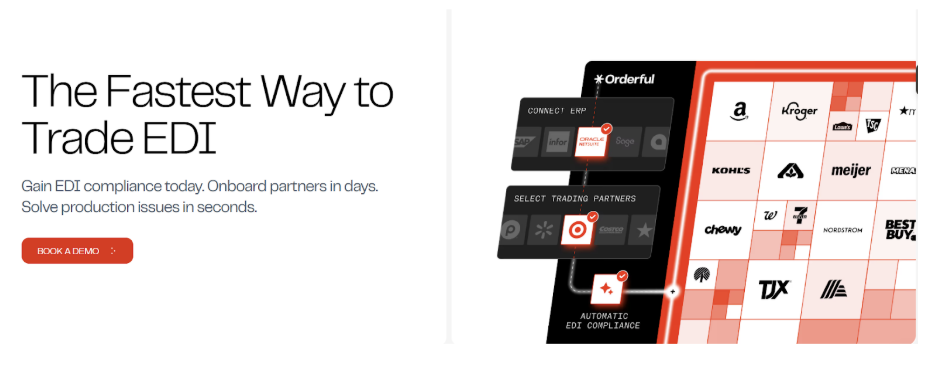
Orderful has rebuilt EDI from scratch for the cloud era, and the difference is immediately obvious.
Most platforms treat every new partner like a fresh project. Scope it, map it, test it, wait. Orderful runs as a shared network instead. Partners already on it can be activated fast, without starting from zero each time.
The architecture is fully cloud-native and API-first. Real-time validation flags errors before they reach downstream systems. Transaction visibility is clear and queryable. And compliance across multiple partners with different document standards is handled automatically, not manually.
For businesses tired of slow, expensive EDI setups, Orderful is the reset worth starting with.
- Pricing: Available on request
- Key features: Cloud-native, API-first, network-based onboarding, real-time validation, automated compliance
- Best for: Mid-market to enterprise teams that want fast onboarding and a genuinely modern EDI setup
2. Boomi
Boomi is best known as an integration platform, and its EDI capabilities sit inside that wider toolset.
If your business is already managing multiple integrations across cloud apps, ERPs, and databases, having EDI in the same environment is genuinely convenient. The drag-and-drop interface is approachable, and pre-built connectors for major ERP systems cut down setup time considerably.
Where it gets complicated is cost and complexity. For teams that only need EDI, Boomi may be more platform than the situation calls for.
- Pricing: Subscription-based; tiered by usage
- Key features: EDI within a broader iPaaS environment, pre-built connectors, ERP integrations, low-code interface
- Best for: Businesses already using Boomi for broader integration who want EDI in the same environment
3. IBM Sterling B2B Integrator
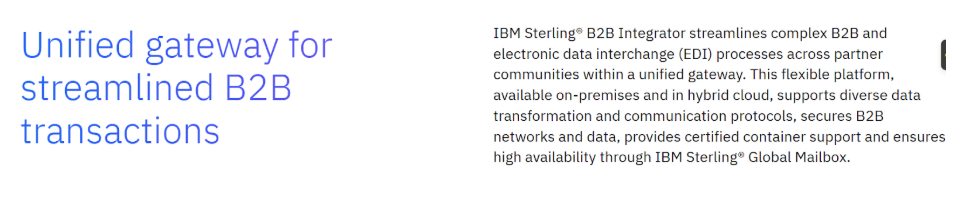
IBM Sterling has been in B2B integration for a long time, and the depth of its capabilities reflects that.
It supports a comprehensive library of EDI standards and transmission protocols. Visibility, auditing, and compliance tooling are robust. For large enterprises managing complex partner networks with strict regulatory requirements, that depth is a real advantage.
The trade-off is what you would expect from an enterprise platform of this age. Implementation is heavy. The learning curve is steep. And the cost structure is firmly enterprise-tier. Not the right choice for teams earlier in their modernization journey.
- Pricing: Enterprise-tier; available on request
- Key features: Multi-standard EDI support, advanced compliance and audit tooling, high-volume processing
- Best for: Large enterprises with complex regulatory requirements and high transaction volumes
![A supply chain operations team reviewing EDI transaction logs and partner compliance status on a modern cloud dashboard. Alt text: supply chain team EDI transaction monitoring cloud dashboard]
4. Jitterbit
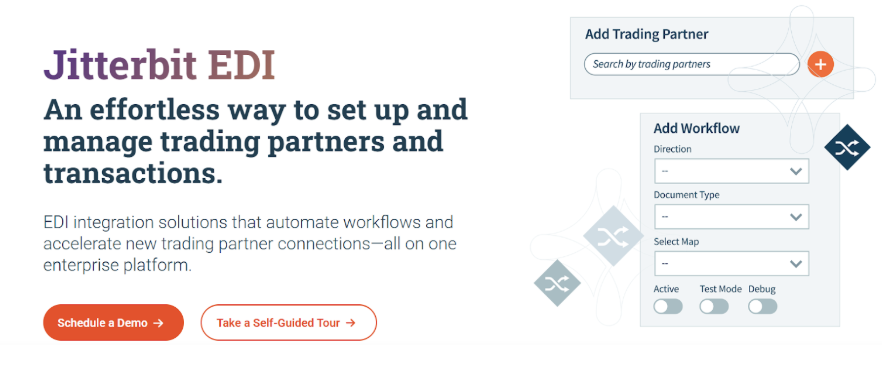
Jitterbit sits in a similar space to Boomi; an integration platform that handles EDI as part of a broader toolset. Where it stands out is accessibility.
The interface is genuinely approachable for teams without deep integration expertise. Pre-built templates speed up common EDI workflows, and the API management layer means you can handle both EDI and modern API-based partner connections in one place.
It is not a pure-play EDI tool, so businesses with very specific or complex EDI requirements may hit limitations. But for mid-market teams that need practical, manageable integration across both EDI and APIs, it works well.
- Pricing: Quote-based
- Key features: EDI and API integration, pre-built templates, accessible interface, cloud and on-premise support
- Best for: Mid-market teams needing EDI alongside API and application integration in one platform
5. DiCentral
DiCentral takes a managed service approach that suits businesses that do not have in-house EDI expertise.
Setup, mapping, partner onboarding, and compliance management can all be handled by their team rather than yours. For smaller businesses dipping into EDI for the first time, that hands-on support removes a lot of the initial friction.
The managed model also means less direct control. Businesses that need deep customization or want to manage integrations internally will likely find it limiting. But as an entry point into EDI without needing to build internal expertise from scratch, it is a practical starting option.
- Pricing: Subscription and managed service options available
- Key features: Managed EDI services, partner onboarding support, compliance management, web-based portal
- Best for: Smaller businesses or first-time EDI adopters who want a managed, low-lift setup
What to Think About Before You Choose
Onboarding speed is the one that catches most teams off guard. Ask any vendor exactly how long it takes to go from signed contract to first live transaction with a new partner. The gap between platforms on this question is often measured in months, not days.
Real-time validation is non-negotiable. Batch processing with after-the-fact error reporting is a legacy pattern that has no place in a modern supply chain. If a platform cannot tell you something went wrong before it affects a downstream system, that is a structural problem.
Cloud-native and cloud-compatible are not the same thing. A legacy platform with a new interface layered on top is still a legacy platform underneath. The architecture matters, especially if you are trying to integrate EDI cleanly with the rest of your stack.
And network size compounds over time. Platforms with large pre-connected partner networks make every new onboarding faster than the last. That advantage only grows.
If you are exploring how cloud infrastructure is reshaping enterprise operations more broadly, this overview of cloud integration trends is worth a read alongside your platform research.
EDI is not exciting. But when it works well, it is invisible and that is exactly what a good supply chain should feel like.