

Ticketing AI Was Built for Fans, Not Organizers — Vivenu’s Bold Bet Flips the Script

Somewhere right now, a person running a $20 million festival with a staff of fifteen is pulling CSV files at midnight, trying to figure out why Friday isn’t selling. The industry that employs her has spent the past two years—and millions of dollars—trying to integrate AI everywhere a fan might touch. The buying side of ticketing has never been smarter, yet the selling side still runs on exports.
Simon Hennes was waiting for the industry to notice this. It hasn’t, so his company decided to build for the other side of the transaction.
“The organizer is where the real opportunity is,” the vivenu co-founder and CEO tells me. “We’ve spent years helping organizers own their own customer relationships and first-party data. Recent innovations in AI finally give them the ability to actually use that data.”
Vivenu has built its business around white-label ticketing software that lets venues, sports teams, universities and live entertainment brands sell tickets under their own brand while retaining ownership of customer relationships and first-party data. The company has raised more than $65 million, and now powers ticketing for more than 1,000 organizations in roughly 60 countries, from the Grammy Awards and the Golden Globes to Stanford Athletics and concerts for artists including Bad Bunny.
Hennes doesn’t dismiss what larger competitors have built. Ticketmaster’s AI already combats scalpers through Verified Fan, alongside investments in dynamic pricing and conversational discovery through ChatGPT and Google’s AI search. SeatGeek has expanded similar capabilities, while Eventbrite offers AI-generated marketing copy for organizers.
“Our competitors can absolutely launch AI capabilities,” Hennes explained. “The difference is they don’t necessarily want to empower organizers, promoters and venues with the same level of data and platform-integrated granularity because they’re marketplace businesses. We’re AI-integrated, API-first and built around first-party data. They’re largely closed ecosystems.”
Who Owns the Fan? The Business Model Behind vivenu AI
For Hennes, AI only creates value if the platform’s incentives stay aligned with the organizer’s — and that, he believes, is where vivenu parts ways with marketplaces that sit between organizers and fans rather than connecting them. His philosophy starts from one question: who owns the fan?
“There’s this incredibly deep connection between fans and organizers—fans and venues,” Hennes says. “That relationship doesn’t belong to the ticketing platform.” Fans identify with Taylor Swift, the New York Yankees or the Grammy Awards — not with the company processing their payment. Yet the platform usually keeps the checkout, the customer data and everything that happens after the sale. “Why shouldn’t the organizer own that relationship, own the checkout experience, own the data and reap all of the benefits?”
AI, he argues, raises the stakes on that question. “If an AI agent tells me exactly what I should do this weekend based on my preferences, it becomes far more valuable for organizers to own the checkout, own the data and personalize that experience themselves.”
Hennes points to festival organizers doing roughly $20 million in ticket sales with 10 to 20 employees — years of customer data, no bandwidth to act on it. “Five or ten years ago, they struggled to use all the data we provided them with — the depth of the platform, the retargeting and upselling motions,” he says. “With AI, there’s no excuse anymore. Small teams can hyper-personalize, retarget better and make every form of communication way more relevant.”
None of this works, Hennes adds, without infrastructure that AI-native startups tend to underestimate. Vivenu recently ran ticketing for Bad Bunny’s Puerto Rico residency — millions of requests per minute, 400,000 tickets sold in 30 minutes, no downtime. Lightweight AI ticketing tools may find a market among small events; a stadium on-sale is a different physics problem, and surviving one depends on years of investment in payments, security and compliance.
That layered build is also why Engage—the native CRM and marketing platform vivenu shipped just weeks before vivenu AI assistant—wasn’t the coincidence it looked like. The tool gives organizers a single place to manage first-party customer data, build audience segments, automate campaigns and track fan engagement.
“Fan engagement should translate into higher revenues and bigger relevance. We built Engage so our customers can not only access more data in a more granular way, but can also act on it within the platform,” Hennes says.
Enterprise AI’s Real Moat Is the Architecture
For Jens Teichert, vivenu’s co-founder and chief technology officer, the biggest challenge in enterprise AI is providing models with enough context to produce an answer an organization can actually trust. “If your platform wasn’t designed for machine-to-machine communication—if APIs weren’t fundamental from the beginning—it becomes extremely difficult, sometimes impossible, to connect agents in a scalable and secure way,” Teichert tells me.
Vivenu, he says, had to rethink parts of its own platform first. “We had to overcome challenges just to make our APIs more accessible and scalable for the world of agents. Even if we’re able to teach the agent how to access all the data that lives inside a business, it ultimately needs to reason about the industry,” he says.
To bridge that gap, vivenu built what Teichert describes as a GraphRAG architecture that combines product knowledge, ticketing terminology, business rules, and live enterprise data into a shared reasoning layer. A seemingly simple request—”How many season-ticket holders haven’t renewed this year?”—illustrates the challenge. Before generating a query, the AI must understand what qualifies as a season ticket for that organization, where renewal records reside and which business rules govern the calculation.
“The agent constructs a query that’s sent to our analytics engine,” Teichert explains. “That outputs the data back, and the agent is then able to answer your question—and combine that with other data queries as well.”
The reasoning layer doesn’t stop at search. A question about slowing ticket sales can automatically become an audience segment in Engage, which can then evolve into a draft marketing campaign or pricing recommendation without an employee having to export data between systems.
MCP Servers, AI Agents and the Security Lines
One of the more unusual pieces of the launch is vivenu’s support for the Model Context Protocol, or MCP, which allows external AI assistants to interact directly with enterprise software. Teichert acknowledges that doing so expands the potential attack surface.
“When we implemented our MCP server, we purposely waited for the industry — and especially the OAuth protocol — to catch up, so that we could ensure there was a proper standard backed by the industry,” he says. “With the current standard, you can implement it in a way that you can actually trust the client connecting to your platform and fetching a token.”
Not everything inside the platform becomes available, however. Teichert says the discipline lies in choosing which tools the MCP server exposes at all: vivenu wants to hand AI agents as much power as possible, but personally identifiable information and payment data are walled off entirely. What agents can reach is the platform’s full reporting and configuration surface — a risk, in his assessment, that’s relatively easy to contain.
Neither founder pretends AI model hallucinations have disappeared. Teichert is matter-of-fact about it: grounding the model in enterprise data and tuning inference pushes errors toward a minimum, but nobody in the industry has gotten to zero, and he isn’t going to claim vivenu has.
“Will an embedded assistant still make mistakes from time to time? Yeah, 100 percent,” he says. What’s changed, in his telling, is that customer conversations and vivenu’s own data now point the same direction — the models have crossed the good-enough threshold, even for an industry as full of edge cases as ticketing.
Instead of promising perfection, vivenu limits the blast radius. Company policy draws a hard line at anything commercial: no price change goes live and no message reaches a customer without a human signing off first. The industry, Teichert argues, hasn’t yet worked out which agent workflows deserve full autonomy and which still need a review step — and until it does, vivenu isn’t deciding on its customers’ behalf.
“Right now, we still want to give our customers the power and the ultimate say about what they actually want to ship.”
Can Ticketmaster Catch Up on Organizer-Facing AI?
Perhaps the most provocative argument Hennes makes is his belief that the largest incumbents may struggle not because they lack engineering talent but because they lack aligned incentives. Ticketmaster’s marketplace model, he argues, depends on owning the fan relationship; vivenu’s business depends on giving that relationship back to organizers.
“There are conflicting business models. Ticketmaster makes most of its money through their marketplace, and that’s where they want to keep the fans,” Hennes says. “It should be a Ticketmaster URL, website user account and cross-sale. Will they launch something on back-end operations and administration? For sure,” he says. “But in terms of the whole revenue engine, I don’t think they would want to, because of the conflicting business model in place.”
Whether that prediction proves accurate remains to be seen.
Control Layer Verdict
The ticketing industry’s biggest opportunity sits behind the scenes, where organizers still spend hours stitching together customer segments, marketing campaigns, pricing decisions and analytics across disconnected systems. The company’s architecture-first approach—combining first-party data ownership, API-native infrastructure, domain-specific knowledge, zero-trust security and human approval—suggests it understands that enterprise AI succeeds long before a language model generates its first sentence. Contemporaries can license the same frontier models. They can’t modernize decades of architecture, or realign decades of business incentives—overnight.

Victor Dey is a tech analyst and writer who covers AI, data science, startups, and cybersecurity. A former AI editor at VentureBeat, his work also appears in New York Observer, Fast Company, Entrepreneur Magazine, HackerNoon, and more. Victor has mentored student founders at accelerator programs at leading universities including the University of Oxford and the University of Southern California, and holds a Master's degree in data science and analytics.
More from Victor Dey
See all Future of AI
Cysic CEO Says Paying for an AI Model Doesn’t Prove Your Host Ran It
 Future of AI
Inside Indeed’s AI Hunt For Fake Employers Before Anyone Applies
 Future of AI
Databricks Co-Founder Explains How Genie Tackles the Blind Spot In Always-On AI
 Enterprise AI
What Happens to Enterprise Software When AI Does the Work?
Recommended for you
More stories Future of AI
The future of AI in financial crime is here: how can banks fight back to regain trust and use AI for good
 Future of AI
PuppyGraph Raises $10M to Tackle the SQL Problem Stalling AI Agents in Production
 AI Leadership & Perspective
AI Is Creating a New Kind of Technical Debt and Most Companies Don’t See It Coming
 Future of AI
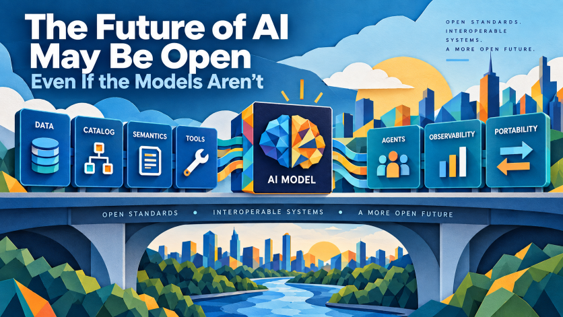
The Future of AI May Be Open Even If the Models Aren’t
 Future of AI
Zendesk CEO Forecasts $400M in AI ARR With Outcome-Based Pricing
 Future of AI