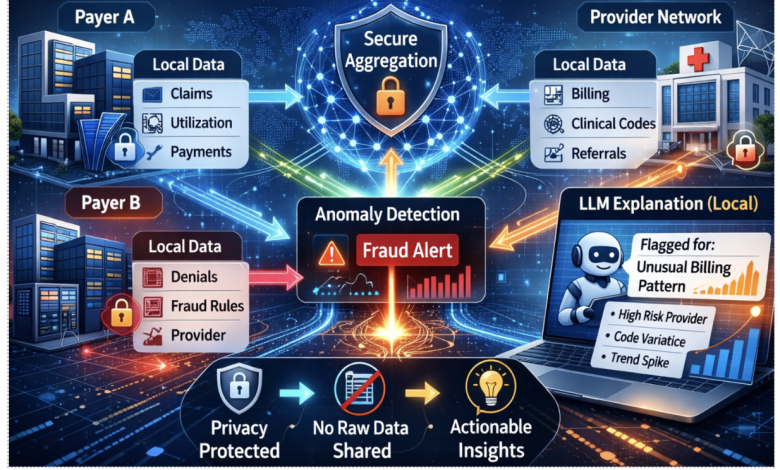
Payment integrity has a fragmentation problem: each payer sees only part of the pattern, while the most sophisticated abuse often spreads across organizational boundaries. Vertical federated learning offers a more realistic path to collaboration by letting competing payers learn from complementary data without pooling raw PHI into one central system.
Healthcare payment integrity is often framed as a claims analytics problem, but in practice it is also a visibility problem. One payer may see a provider whose billing behavior looks mildly unusual. Another may see referral relationships that seem slightly off. A third may detect a utilization pattern that looks explainable on its own but becomes suspicious when viewed in a broader context. Fraud, waste, abuse, and collusive billing frequently thrive in this fragmented environment because no single organization has a complete picture. That is why many of the most expensive anomalies are not hidden in one bad claim. They are hidden in patterns that only emerge when multiple slices of the ecosystem are viewed together.
For years, the standard answer was centralization. If the data is fragmented, the thinking goes, then bring it all into one place. On paper, that sounds efficient. In reality, centralized data lakes for competing payers are difficult to justify politically, operationally, and legally. They raise hard questions about data ownership, competitive sensitivity, identity resolution, minimum necessary use, and the security risk that comes with concentrating large volumes of sensitive healthcare information. Even when a centralized model is technically possible, it can become so complicated from a governance perspective that the collaboration never gets beyond the planning stage.
This is where vertical federated learning becomes interesting. Federated learning is already familiar to many technical readers as a way to train models across distributed data without moving all of the raw records into one location. Vertical federated learning, or VFL, is especially relevant when participating organizations hold different features about overlapping entities. In payment integrity, that means two or more parties may each know something important about the same provider, facility, billing entity, procedure pattern, or episode of care, but none of them wants to share raw underlying data. VFL allows those parties to learn jointly from their complementary feature spaces while keeping source data local.
That change in architecture also changes the collaboration model. Instead of asking competitors to contribute raw claims, notes, or sensitive operational datasets to a shared repository, VFL asks them to contribute local computation. Each participant keeps its own feature engineering, storage, and governance inside its own environment. A training workflow coordinates the learning process so that the shared model benefits from the combined signal without requiring the underlying records to leave their home systems. In a sector as sensitive as healthcare, that is more than an architectural nuance. It is often the only collaboration pattern that stakeholders can seriously consider.
A practical payment integrity VFL system does not need to begin with the most sensitive data elements. In fact, the better design often starts with stable operational entities such as providers, provider–procedure combinations, facility-level patterns, or provider-month behavioral summaries. One payer may contribute features related to prior denials, edit hits, or recovery outcomes. Another may contribute features related to specialty peer deviation, utilization spikes, or modifier behavior. A provider-side participant might contribute network context, operational metadata, or referral intensity. Each organization sees a different side of the same reality. VFL turns that fragmented view into a trainable system without forcing a centralized data-sharing model.
Of course, privacy-preserving does not mean risk-free. That point is worth making clearly because federated learning is sometimes described too casually, as though “not sharing raw data” automatically solves the privacy problem. It does not. A federated design reduces exposure by keeping source records local, but it still requires careful attention to what is exchanged during training. Intermediate representations, gradients, or model updates can themselves become attack surfaces if the system is poorly designed. That is why secure aggregation matters. It helps ensure that a coordinating layer sees only combined contributions rather than every participant’s update in isolation. Differential privacy can further reduce exposure by limiting how much any one example influences what the shared system learns. But these protections come with tradeoffs. Stronger privacy generally means some reduction in model utility, and the right balance has to be tested rather than assumed.
That privacy–utility tradeoff is especially important in payment integrity, where false positives carry real operational cost. If a model flags too aggressively, investigators waste time chasing noise. If privacy protections are applied without measuring their effect on detection quality, the collaboration can become technically elegant but operationally disappointing. The goal is not simply to prove that a privacy mechanism exists. The goal is to build a system that remains useful under realistic constraints. That means evaluation needs to be cross-silo, business-relevant, and grounded in how the alerts will actually be consumed. Another design choice matters just as much as the detector itself: explanation. A payment integrity model rarely succeeds in production by emitting a score alone. Analysts, auditors, and SIU teams need a reasoned narrative that helps them decide where to look first and why the case deserves review. This is where a hybrid pattern becomes powerful. The VFL model acts as the detector, surfacing entities or patterns that merit attention. A local LLM then generates a grounded explanation using only the evidence available inside each organization’s own environment.
That explanation boundary is crucial. The shared VFL system should contribute risk signal, not raw narrative exchange between competitors. Once an alert is triggered, each payer can retrieve its own local evidence such as coding drift, peer comparisons, modifier concentration, history of policy mismatches, or temporal changes in utilization. A locally hosted LLM can turn that evidence into an auditor-friendly summary: why the pattern appears unusual, what changed over time, and which supporting signals were strongest. The explanation stays local, the source evidence stays local, and the narrative can be reviewed against internal governance standards before it ever reaches a human investigator. This local-LLM layer also solves a practical trust problem. Investigators are more likely to use AI when they can see that the explanation is tied to real, reviewable evidence rather than a vague statement that something was “high risk.” In healthcare, that trust has to be earned. A model that sounds confident but cannot point to concrete supporting signals creates more governance burden, not less. A grounded local explanation model helps bridge the gap between technical output and operational decision-making.
But once that LLM enters the design, systems engineering becomes impossible to ignore. In many enterprises, the biggest constraint is not model weights but inference memory. Payment integrity explanations often involve long prompts that include retrieved policy snippets, historical summaries, benchmark context, feature highlights, graph-derived indicators, and investigation notes. That means the key-value cache becomes a first-class systems concern. Without efficient KV-cache management, on-prem deployment costs rise quickly, and the very teams that most need affordable explanations may find the design too expensive to run at scale.
This is why quantized KV caches and paged cache management deserve more attention in healthcare AI architecture discussions. Quantization reduces the memory footprint of the cache, making it easier to serve longer contexts on limited hardware. Paged cache management improves memory utilization and helps reduce fragmentation, which becomes important when handling mixed workloads and variable sequence lengths. Together, these techniques make local explanation infrastructure more realistic for payer environments that need predictable cost, strong control boundaries, and the ability to operate outside a hyperscale cloud footprint.
That matters because many healthcare organizations are not trying to build flashy general-purpose AI assistants. They are trying to build focused, governable systems that help specialists investigate high-value anomalies with speed and consistency. A local LLM that produces grounded explanations within tight memory budgets is often more valuable than a larger, more expensive model that cannot be deployed where the data and governance controls live. In other words, memory efficiency is not just a technical optimization. It is part of the adoption strategy.
Security and adversarial robustness also deserve explicit treatment. A cross-silo learning system introduces new failure modes that centralized analytics teams may not be used to thinking about. A participant could contribute noisy or manipulated updates. A poorly aligned collaboration target could produce misleading signals. An explanation model could overstate certainty or summarize weak evidence too confidently. These are not reasons to avoid the architecture, but they are reasons to design the controls early. Validation should include adversarial thinking, drift monitoring, alert quality review, and human-in-the-loop checkpoints. Payment integrity is too operationally sensitive for a black-box rollout.
Governance is where all of these threads come together. A serious deployment needs clear boundaries around identity resolution, local evidence retrieval, secure aggregation, model ownership, explanation logging, auditability, and privacy budget management when differential privacy is used. It should also define what the system is allowed to do. In most settings, the right role for this architecture is decision support, not autonomous adjudication. The system can prioritize cases, summarize local evidence, and surface cross-silo risk patterns. Final judgment should remain with trained reviewers who understand both the business context and the limitations of the model.
That is why vertical federated learning is so promising for payment integrity. It does not pretend that collaboration is easy. It simply offers a more realistic version of collaboration – one that acknowledges competitive boundaries, privacy constraints, and operational budgets. Instead of forcing everyone into one data lake, it allows each participant to keep control of its own data while still learning from a broader pattern space. Instead of asking analysts to trust a raw score, it supports a local explanation layer that can turn model output into something reviewable and actionable. And instead of assuming infinite infrastructure, it points toward memory-efficient LLM serving techniques that make the whole system more deployable.
The deeper lesson is that payment integrity is not just about finding bad claims. It is about recognizing patterns that no one organization can fully see alone. The future will likely belong to architectures that support collaboration without centralization, explanation without data sprawl, and stronger detection without weakening governance. Vertical federated learning, paired with local LLM explanations and efficient inference engineering, is one of the clearest paths in that direction.
Author bio
Jimmy Joseph is an AI/ML engineer specializing in healthcare payment integrity, applied machine learning, and scalable enterprise AI systems. His work focuses on building practical, audit-aware solutions that help healthcare organizations detect anomalous payment behavior, improve explainability, and deploy advanced AI under real-world privacy and operational constraints.