Large language models (LLMs) are extraordinary at generating fluent, human-like text, yet they remain constrained by the tendency to hallucinate information. Once trained, they’re frozen in time, unable to access new facts, recall proprietary data or reason about evolving information.
Retrieval-Augmented Generation (RAG) is a powerful architecture that can improve the factual grounding of LLMs and reduce the problem of hallucination. RAG connects the generative AI model with an external knowledge base that provides more domain specific context and keeps the responses grounded and factual. This is often cheaper than expensive finetuning approaches which involve retraining on domain specific data. RAGs show the promise that they can improve model performance without involving expensive fine-tuning step.
However, traditional RAG based approaches have a limitation that it is still a static pipeline: one query in, one retrieval step, one answer out. It doesn’t reason about what’s missing, it can’t refine its searches, and it doesn’t decide which tools or sources to use. RAGs don’t have access to dynamic real world data where information may be changing constantly and the tasks may require planning.
Agentic RAG improves on this limitation of traditional RAG based approaches. It reimagines the retrieval process entirely: instead of a passive lookup system, we get an active reasoning agent which is capable of planning, tool use, multi-step retrieval and getting dynamic data from APIs.
In this article, we will deep dive into Traditional RAGs and Agentic RAG. Using industry case studies, we will delineate the key distinctions between these two approaches, establishing guidelines on which one to use for which scenario.
Traditional RAG
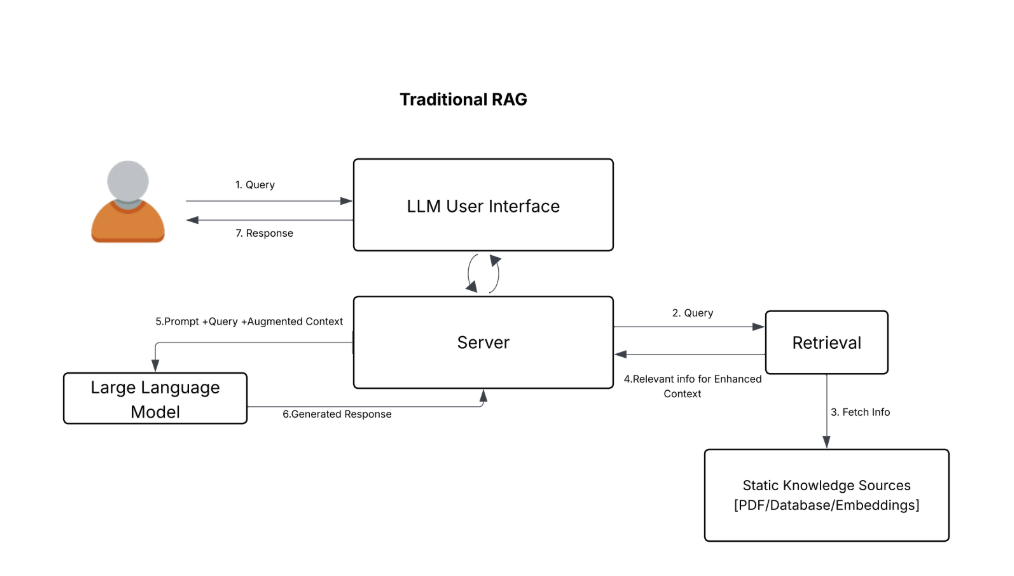
Traditional RAG follows a clear static pattern:
- A user or system issues a query.
- [Retrieval] The system retrieves relevant information from a knowledge base (often via vector search).
- [Augmentated] The retrieved information is appended to the prompt for the LLM.
- [Generation] The LLM generates an answer with the additional information retrieved
This “retrieve → augment → generate” loop enhances factual accuracy by letting the model use real-world context rather than relying solely on its pretrained weights.
Strengths
- Fact grounding: Minimizes hallucination by referencing retrieved evidence.
- Simplicity: Linear, transparent flow which is easy to deploy and maintain.
- Performance efficiency: Fast and inexpensive for well-defined domains.
- Reliability: Works well for static or slowly changing corpus.
Limitations
- Single-pass retrieval: If initial results are incomplete, there’s no self-correction.
- No reasoning or planning: The system doesn’t decide what else to look for or which sources to query next.
- Limited flexibility: Tied to one knowledge base and unsuitable for dynamic or multi-source data.
Industry Use cases
- Internal knowledge assistants: HR or IT chatbots referencing static internal documents.
- Policy and compliance lookups: Legal or regulatory queries from controlled datasets.
- Research summarization: Pulling key information from academic or technical papers.
Traditional RAG is highly effective for use cases where questions are specific and context is contained, but it’s less effective when data is fluid or the task requires multi-step reasoning.
Agentic RAG
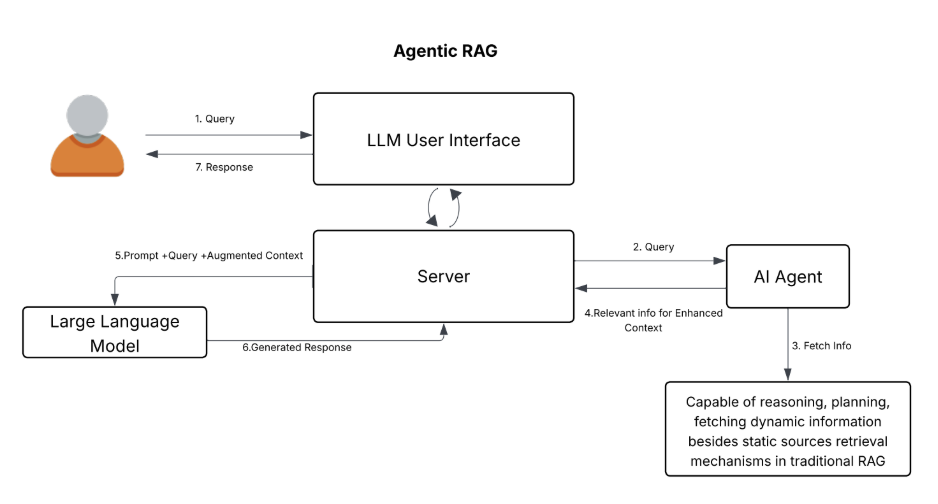
Agentic RAG builds upon the same retrieval-generation principle but adds autonomy and decision-making through intelligent agents. Instead of a one step retrieval process, it becomes an iterative and goal driven process.
An agent can reason about what information it needs, reformulate queries, call different tools or APIs, and even maintain memory across interactions. In short, it uses RAG as one of several capabilities in a broader planning loop. Here are the core characteristics of an Agentic RAG system :
- Iterative retrieval: The agent refines queries until sufficient information is found.
- Dynamic source selection: It can pull from multiple knowledge stores, APIs and live data feeds.
- Tool-use and orchestration: The agent can invoke specialized tools (for example, databases, summarizers, or search engines) as needed.
- Context management: Maintains working memory and long-term state to handle multi-turn or multi-step tasks. Memory allows agents to refer to previous tasks and use that data for future workflows.
- Planning : They are capable of query routing, step-by-step planning and decision-making.
Advantages
- Higher flexibility: Capable of handling real-time, evolving data environments.
- Multi-step reasoning: Solves complex tasks that require planning and synthesis.
- Reduced hallucinations: Validation loops help ensure factual consistency.
Challenges
- Increased complexity: Requires orchestration between agents, tools, and memory.
- Higher cost and latency: Multi-stage reasoning introduces additional computational load per query.
- Validation: Greater autonomy demands careful monitoring and validation.
Industry Use Cases
- Customer service orchestration: Intelligent agents retrieve policy data, check CRMs, verify orders, and escalate tickets automatically.
- Real-time analytics assistants: Systems that integrate with databases, dashboards, and APIs to surface insights and act on triggers.
- Healthcare and diagnostics: AI systems combining clinical databases, patient data, and recent literature to assist in decision support.
- Supply chain optimization: Agents pulling from logistics, inventory, and weather APIs to adapt shipping plans dynamically.
These domains demand multi-step reasoning, real-time updates, and flexible handling of data which fits into the Agentic RAG’s use case.
Multi-agent Workflows
Agentic RAG systems naturally evolve into multi-agent workflows as they can contain one or more types of AI Agents. Example AI Agents that can be invoked :
-
- Routing Agent : Routing agents chose which external data sources to invoke to address an incoming user query. Not all queries may need the same set of external calls and routing agents can make the responses smarter by routing to the correct external sources at query time.
- Query Planning Agent : Query planning agents break down a complex query to subqueries and submit the queries to the right agents for resolution
- ReAct Agent : Reason and Acting agents can break down a complex task into step by step tasks, delegate it to subagents and then manage the workflow based on the responses of the agents
Traditional vs Agentic RAG Comparison
| Dimension | No RAG | Traditional RAG | Agentic RAG |
| Retrieval Flow | Single query → generate | Single query → retrieve → generate | Iterative, multi-step retrieval with refinement |
| Reasoning | No | Minimal; retrieval is reactive | Agent plans, evaluates, and adapts |
| Knowledge Sources | Only LLM | LLM and One or few static KBs | LLM and Multiple dynamic, multimodal sources |
| Hallucinations | Ungrounded | Grounded on static data from other sources | Grounded on more real time sources |
| Flexibility | No | Low; fixed pipeline | High; real-time and context-aware |
| Tool Use | None | None | Integrated; agents can call tools/APIs |
| Computational Complexity | Lower | Low | Higher |
| Latency | Lower | Low | Higher |
| Resource Intensivity | Lower | Low | Higher |
| Industry Applications | Niche areas with specific expert LLM | Direct Q&A, knowledge lookup | Dynamic workflows, decision support, analytics |