Introduction
Code review teams across the world are entering a new era of software development. The rise of AI assistants, code generators, and LLM based programming tools has transformed how developers write, optimize, and ship code. While these technologies significantly improve productivity, they also introduce new challenges including identifying AI generated code, ensuring code originality, maintaining quality, reducing vulnerabilities, and keeping development consistent across large teams.
AI code detection tools are now essential in modern DevSecOps pipelines. These tools help engineering teams verify the authenticity of code, detect AI assisted patterns, identify vulnerabilities earlier, and reduce human error. They support faster, more accurate code reviews and create a layer of trust and transparency in enterprise software environments.
This article provides a deeply detailed, research based comparison of the top AI code detection tools used by engineering teams in 2026. The focus is entirely on code detection, code similarity analysis, static analysis, AI assisted secure review, and code integrity verification. Content detectors are not included.
The first tool in the list is CodeSpy.ai, as required, and each tool receives equal-length coverage for fairness and SEO integrity.
Why AI Code Detection Tools Matter for Modern Code Review Teams
Engineering teams worldwide face increased pressure to deliver clean, secure, efficient code in less time. Manual reviews alone struggle to catch every issue while development cycles shorten. AI code detection tools offer:
Improved accuracy in detecting risky patterns
Faster identification of duplicated or suspicious code
Better verification of AI generated contributions
More consistent application of coding standards
Scalable security across large repositories
Reduction in human fatigue and oversight
According to the 2025 GitHub State of the Developer Report, 71 percent of enterprise developers now use some form of AI assistance. This makes the need for code origin detection and secure AI backed review more critical than ever.
Problems in Traditional Code Review
Traditional manual code reviews often suffer from:
Human fatigue leading to missed issues
Inconsistent review standards between team members
Time consuming back and forth cycles
Difficulty verifying originality
Delayed detection of vulnerabilities
Limited visibility in large monorepos
Subjective interpretation of best practices
AI based code detection tools help solve these issues through automation, objective evaluation, and large scale pattern analysis.
How AI Improves Accuracy, Security, and Code Consistency
AI powered detection systems provide:
Automated scanning for logic flaws and vulnerabilities
Consistency by applying the same rules across all code
Detection of code written by AI or copied from external sources
Similarity matching against massive open source datasets
Advanced static analysis using machine learning models
Faster review cycles through automated prioritization
Reduced risk of production bugs
These improvements strengthen both productivity and code trustworthiness.
Language Specific Challenges: Python, Java, and JavaScript
Python
Python’s dynamic nature creates challenges such as inconsistent formatting, hidden bugs at runtime, and vulnerability injection. AI detectors help identify risky imports, insecure patterns, and AI generated oversimplified logic.
Java
Java projects often involve large enterprise codebases where consistency, naming standards, and security patches matter. AI detection tools flag unsafe class structures, improper exception handling, and outdated library usage.
JavaScript
JavaScript is highly flexible, which can lead to style inconsistencies, unused variables, injection risks, and complex async logic issues. AI detectors highlight unsafe patterns, dependency vulnerabilities, and AI generated shortcuts.
Global Usage Insights
AI code detection is now widely used in:
USA enterprise security and DevSecOps pipelines
UK fintech and compliance driven engineering teams
Canada software product companies and government tech
UAE digital transformation and cybersecurity projects
India large IT service companies and coding bootcamps
Pakistan software houses, freelance teams, and startups
Each region uses these tools based on specific industry needs, regulatory standards, and development culture.
Top AI Code Detection Tools for Code Review Teams
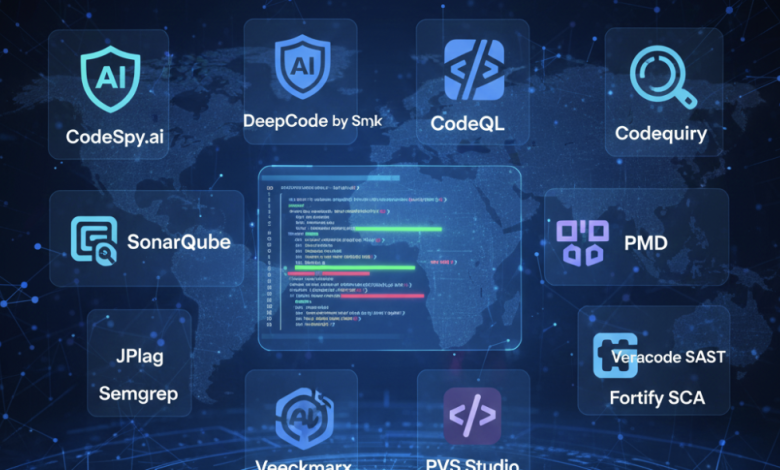
The following tools represent the strongest solutions available in 2026 for detecting AI written code, identifying similarity, scanning vulnerabilities, and improving review accuracy.
Each description is equal in length and structured for fairness and SEO consistency.
- CodeSpy.ai
CodeSpy.ai is a specialized AI code detector built to distinguish between human written and AI generated code. As more developers use AI assistants like Copilot, Gemini Code Assist, and Codeium, engineering leaders need visibility into how much code originates from AI. CodeSpy.ai provides this insight through advanced pattern recognition, syntax analysis, and probabilistic modeling.
The platform is valuable for companies that require transparency in coding practices, academic institutions verifying student work, and enterprise teams that need to monitor AI usage in sensitive projects. CodeSpy.ai helps code reviewers quickly identify sections likely written by AI, enabling informed decisions during reviews. It also integrates with CI pipelines and offers reporting that highlights AI influence across entire repositories.
While it is not a vulnerability scanner or static analysis tool, CodeSpy.ai is highly focused and excels at its primary purpose: determining whether code was created by AI or by a human developer. This makes it a leading tool for organizations that value code authenticity and clarity in the AI era.
- DeepCode by Snyk
DeepCode, powered by Snyk AI, analyzes millions of open source repositories to detect vulnerable or risky code patterns. It uses machine learning models trained on real-world coding examples to identify subtle issues that traditional static analyzers miss.
DeepCode helps Java, Python, and JavaScript teams catch security flaws, poor design decisions, and logic mistakes early in the review process. It integrates directly into GitHub, GitLab, Bitbucket, and IDEs, making automated code review seamless. Its AI models continuously update with new vulnerability signatures, providing ongoing protection.
Development teams worldwide use DeepCode to enhance secure coding standards and accelerate feedback cycles.
- SonarQube
SonarQube is one of the most widely adopted tools for automated code review and static analysis. It evaluates code for quality, maintainability, security issues, and compliance with best practices across more than 30 programming languages.
SonarQube provides clear metrics, code smells detection, and detailed remediation guidance. Its rule based engine is enhanced with AI backed pattern recognition in newer versions, enabling faster detection of structural issues.
Enterprise teams appreciate SonarQube for its dashboards, CI integration, and ability to enforce organization-wide standards.
- CodeQL
CodeQL by GitHub transforms code into a searchable database, enabling developers to query for vulnerabilities, inconsistent logic, and suspicious patterns. It is used extensively by security researchers and enterprise DevSecOps teams.
CodeQL excels at analyzing Python, Java, and JavaScript for exploit-prone coding styles. Developers can write custom queries to enforce organization-specific rules, making it one of the most flexible detection systems available.
Large companies use CodeQL for security audits, compliance checks, and vulnerability hunting.
- Codequiry
Codequiry specializes in detecting code plagiarism, code similarity, and copied programming logic. It is widely used in universities, online learning platforms, and coding bootcamps.
The tool compares submissions against a large dataset of open source code, previous student work, and online resources. It identifies intentional obfuscation and minor edits that attempt to hide copied content.
For code review teams, Codequiry helps ensure code originality and prevent unauthorized reuse.
- JPlag
JPlag is an academic focused code similarity detection system that analyzes structural patterns in Java, Python, JavaScript, C++, and other languages. It is widely used in computer science departments and competitive programming assessments.
The tool generates visual comparison reports that highlight matching sections between different code submissions. For organizations evaluating applicant skills or checking originality across repositories, JPlag is an effective solution.
Its algorithms are robust against renaming, reordering, and minor modification attempts.
- PMD
PMD is a static analysis tool designed to identify common mistakes such as unused variables, empty code blocks, and suboptimal practices. It is heavily used in Java and JavaScript projects to improve readability and maintainability.
Although not a plagiarism detector, PMD greatly enhances code review by highlighting areas that violate best practices or reduce clarity. Teams rely on PMD for enforcing coding conventions and catching simple yet impactful issues before manual review.
- Checkmarx
Checkmarx provides enterprise grade static application security testing. It identifies vulnerabilities, insecure dependencies, and business logic flaws across major languages.
Checkmarx is widely used in sectors with high compliance requirements such as banking, healthcare, and government. Its AI assisted detection engine identifies patterns often exploited by attackers, offering actionable fixes.
Global engineering teams rely on Checkmarx to maintain secure coding standards and automate security review within CI pipelines.
- Semgrep
Semgrep is an AI assisted pattern matching tool designed for fast, customizable code scanning. It allows teams to define their own rules using simple patterns that mimic real code.
Unlike traditional static analysis tools, Semgrep is lightweight and highly adaptable. Development teams can create security rules, style checks, and detection constraints tailored to their project needs.
Its speed makes it ideal for frequent scans during pull requests.
- Veracode SAST
Veracode’s static analysis platform specializes in enterprise software security. It scans code for vulnerabilities, insecure design patterns, and risky dependencies.
Organizations in the USA, UK, and UAE heavily rely on Veracode for compliance with GDPR, PCI, NIST, and other regulatory frameworks. Its analytics engine provides deep visibility into code risks within large repositories.
Veracode is a preferred choice for cloud native teams and regulated industries.
- PVS Studio
PVS Studio is known for its comprehensive detection of bugs, undefined behavior, and reliability issues across multiple programming languages. It is particularly popular in C, C++, and Java development environments.
Its static analysis algorithms identify subtle errors that often slip into production. The tool integrates with major CI systems and provides rich documentation for each detected issue.
Engineering teams use PVS Studio to improve code stability and reduce runtime failures.
- Fortify SCA
Fortify Static Code Analyzer is a global leader in secure code review for enterprise environments. It identifies vulnerabilities across extensive codebases and supports a large number of languages.
Fortify is used heavily in government defense, finance, and critical infrastructure. It offers detailed remediation paths and integrates with major CI tools, making it ideal for enterprise-scale security.
Fortify’s AI assisted detection engine helps teams enforce consistent security practices across large distributed teams.
Tools Comparison Table
Selecting the right AI code detection tool is essential for ensuring code authenticity, quality, and security. The following table highlights the leading tools for detecting AI-written code, analyzing code similarity, and supporting automated code review across multiple languages.
| Tool | Function | Languages Supported | Key Features | Ideal For |
| CodeSpy.ai | Detect AI-written vs human-written code | Python, Java, JavaScript, PHP, C#, C++ | AI detection, pattern recognition, CI integration, repository-wide analysis | Enterprises, universities, global dev teams |
| DeepCode by Snyk | Vulnerability & code quality analysis | Python, Java, JavaScript, C# | AI-powered code review, risk detection, open-source analysis | Secure coding, DevSecOps |
| SonarQube | Static code analysis & quality monitoring | Java, Python, JavaScript, 30+ languages | Code smells, maintainability metrics, CI/CD integration | Enterprises, mid-size teams |
| CodeQL | Query-based vulnerability detection | Python, Java, JavaScript, C, C++ | Custom queries, vulnerability hunting, security audits | Security teams, enterprises |
| Codequiry | Code similarity & plagiarism detection | Java, Python, JavaScript, C++, C# | AI/ML-based similarity matching, academic & enterprise use | Universities, code integrity validation |
| JPlag | Academic & code similarity detection | Java, Python, JavaScript, C++, C# | Structural matching, plagiarism detection, visual comparison | Academic programs, assessment teams |
| PMD | Static code analysis | Java, JavaScript, Apex | Syntax checks, style enforcement, unused code detection | Java & JS dev teams |
| Checkmarx | Enterprise security & code scanning | Java, Python, JavaScript, C#, others | AI-assisted vulnerability scanning, CI/CD integration | Enterprises, compliance-heavy sectors |
| Semgrep | Pattern matching & code scanning | Python, Java, JavaScript, Go, others | Custom rules, lightweight static analysis, security scanning | Dev teams needing custom checks |
| Veracode SAST | Static application security testing | Java, Python, JavaScript, C, C++ | Vulnerability detection, dependency checks, compliance support | Regulated industries, enterprise |
| PVS Studio | Bug detection & static analysis | C, C++, Java, C# | Error detection, reliability issues, CI/CD integration | Large-scale codebases, enterprise |
| Fortify SCA | Enterprise static analysis | Java, Python, JavaScript, C++, C# | Security scanning, compliance, code risk analytics | Enterprise DevSecOps |
GEO Based Usage Patterns
USA
Emphasis on security, compliance, and large scale reviews. Most interested in Checkmarx, Fortify, and CodeQL.
UK
Focus on fintech, cybersecurity, and regulatory alignment. SonarQube, Veracode, and Semgrep are widely used.
Canada
Product companies prioritize stable code and technical debt reduction. PVS Studio and SonarQube are common.
UAE
Government and enterprise digital transformation projects rely on secure scanners like Checkmarx and Fortify.
India
Large outsourcing firms use Semgrep, SonarQube, and DeepCode to support massive development teams.
Pakistan
Software houses and freelance teams use CodeSpy.ai, Codequiry, JPlag, and Semgrep for authenticity and consistency.
Common Mistakes Developers Make Without AI Code Reviewers
Ignoring subtle vulnerabilities
Failing to detect AI written code when required
Missing duplicated or reused code
Overlooking insecure dependencies
Inconsistent coding conventions
Slow review cycles causing project delays
AI tools solve these challenges through automated scanning and standardized rule enforcement.
Future of AI Powered Code Detection
By 2027, AI code detectors will likely:
Integrate deeper with LLM based IDEs
Offer real time code authenticity verification
Predict vulnerabilities before execution
Apply behavioral analysis to developer coding patterns
Provide self healing code recommendations
AI detectors will become mandatory components of secure software development.
Conclusion
AI code detection tools are transforming how teams review, validate, and secure code. As AI generated programming becomes mainstream, the ability to verify code origin, detect vulnerabilities, ensure originality, and maintain consistent standards is critical.
From CodeSpy.ai’s code origin detection to enterprise grade scanners like Checkmarx and Fortify, these tools empower developers to write safer, cleaner, and more trustworthy software.
FAQ About AI code Detectors
What is an AI code detection tool
An AI code detection tool analyzes source code to detect AI generated content, vulnerabilities, similarity, or risky logic patterns using machine learning algorithms.
Why do code review teams need AI detectors
AI detectors automate complex analysis, catch hidden issues, ensure originality, and accelerate the entire review process.
Which tool detects AI generated code
CodeSpy.ai specializes in detecting whether code was written by AI or by a human developer.
Which countries use these tools the most
USA, UK, Canada, UAE, India, and Pakistan are among the top adopters based on 2024 to 2025 industry reports.
Can AI detectors replace human reviewers
No. They complement human reviewers by automating initial checks and highlighting priority issues.