Startups in 2026 move fast. Markets change in weeks, not years. If you slow down, someone else wins.
That is why AI tools are no longer optional. They help small teams do more work without hiring large teams.
AI gives startups three big advantages. First, speed. You can launch products faster and test ideas without long delays. Second, efficiency. AI reduces manual work like writing reports, tracking tasks, and answering common customer questions. Third, insights. AI tools analyze data and show patterns that help founders make better decisions.
This list focuses on real use cases that matter to startups: productivity, marketing, development, operations, and customer support. Each tool is explained in simple terms with clear features, pros, and cons.
By the end, you will understand which tools fit your startup and how they can support growth without adding stress.
Let’s get started!
Top 13 AI Tools for Startups in 2026
Choosing the right AI tools can shape how a startup grows. The tools below focus on solving daily problems that founders face, from managing tasks to creating content and improving workflows.
Each one supports faster execution, better teamwork, and smarter decisions.
1. Nifty: AI-Powered Project Management with Built-In Collaboration
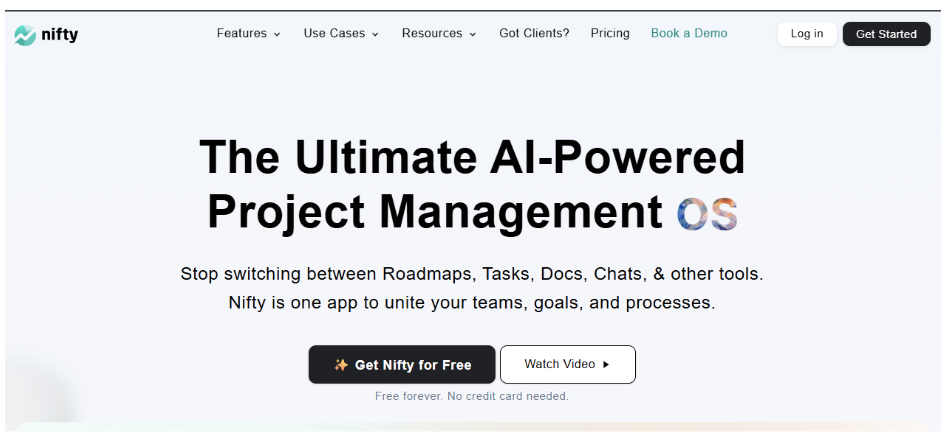
Nifty is a project management platform that combines tasks, milestones, docs, and discussions into a unified workspace.
It helps startups manage projects from kickoff to completion without switching between different tools. For lean teams, this means less time managing software and more time building the product.
Startups often lose momentum when project details live across email threads, Slack channels, and disconnected tools.
Nifty solves this by centralizing everything—roadmaps, tasks, files, and team conversations—in one place.
Its AI assistant can automatically generate project updates, summarize discussions, create task lists from meeting notes, and identify blockers across projects. This keeps everyone aligned without manual status updates.
Founders can track project progress through visual timelines, set milestones, assign ownership, and monitor team capacity. The built-in docs and discussions mean context stays attached to the work itself, not buried in separate apps.
Key Features:
- AI project assistant – Generates progress reports, summaries, and task breakdowns automatically.
- Milestone tracking – Visual timelines show project health and deadlines at a glance.
- Built-in docs and discussions – Context lives with the work, not in separate apps.
- Workflow automation – Automates repetitive task updates and notifications.
- Portfolio view – Manage multiple projects and track team capacity across initiatives.
Pricing:
- Free
- Starter – $39/ month
- Business – $124/ month
- Unlimited – $399/ month
2. Typeface: For End-to-End Campaign Orchestration
Startups often lose time and consistency when content creation is scattered, briefs are in one place, approvals are in another, and assets are in a third.
Typeface solves this by centralizing the entire content workflow. It can generate copy, create images, build campaign assets, and automatically apply brand guidelines across every output.
For lean founding teams, this means professional marketing output without the overhead of agencies or multiple disconnected tools.
Teams can use Typeface’s AI agents to automate end-to-end marketing workflows, from generating content briefs and SEO drafts to producing visuals and social posts in one run.
The Brand Hub stores logos, fonts, tone-of-voice guidelines, and visual references so every piece of content stays on-brand by default. As the startup grows, the platform scales with it, supporting multiple brands, team roles, and enterprise-grade governance without needing a rebuild.
Key Features:
- Marketing Agents: Purpose-built AI agents manage the full marketing lifecycle — from generating campaign ideas and content briefs to running channel-specific workflows (email, social, ads).
- Brand Hub: Centralizes brand assets, guidelines, tone-of-voice references, and visual elements in one place.
- Spaces: A unified workspace where teams can orchestrate the full content lifecycle, from briefing and creation to review and publishing.
- Multimodal AI: Creates both written and visual content from a single workflow.
- Integrations: Integrates with tools teams already use—like Google, Salesforce, and Microsoft—so Typeface’s capabilities fit seamlessly into existing marketing and business workflows.
Pricing: NA
3. ClickUp: AI-Powered Project Management for Startups
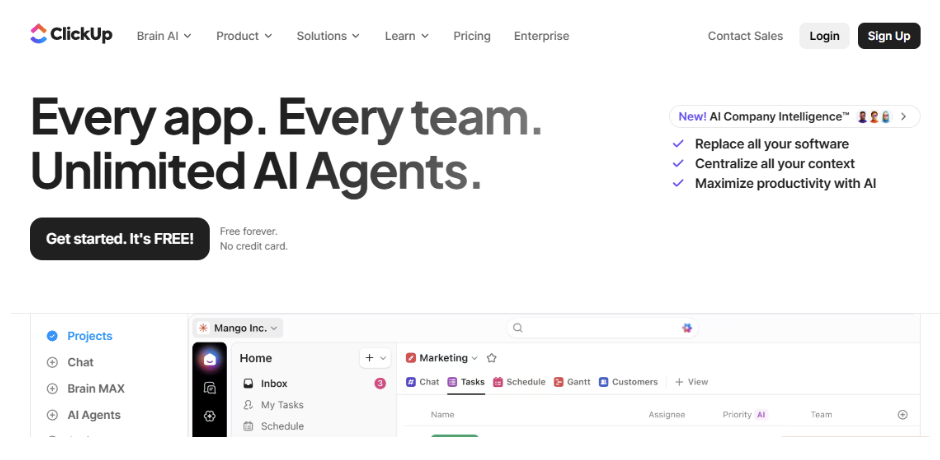
ClickUp is a project management platform that helps startups plan, track, and complete work in one place. It combines task management, documents, goal tracking, and AI support inside a single system. For small teams, this removes the need to juggle many separate tools.
Startups often struggle with scattered communication and missed deadlines. ClickUp solves this by giving teams clear visibility over tasks and responsibilities.
Its AI assistant can generate summaries, write task descriptions, create action steps from meeting notes, and suggest improvements in workflows. This reduces time spent on planning and documentation.
Founders can track goals, manage sprints, assign tasks, and monitor progress through dashboards. As the team grows, ClickUp scales with it. Instead of switching systems later, startups can build structured processes from the start.
ClickUp works well for early-stage teams that need structure without adding complexity. It keeps work organized and helps teams stay aligned.
Key Features:
- AI writing assistant – Drafts task descriptions, summaries, and updates to save time.
- Task automation – Automates status changes and repetitive workflows.
- Goal tracking – Connects tasks to company objectives for clear progress tracking.
- Custom dashboards – Visualize performance and workload in real time.
- Collaboration tools – Comments, docs, whiteboards, and chat in one workspace.
Pricing:
- Free forever
- Unlimited – $7/per user/ month
- Business – $12/ per user/ month
- Enterprise – Custom quote
4. Deevid AI: AI Video Creation for Startup Marketing

Deevid AI helps startups create marketing videos without a full production team. Video content drives traffic and builds trust, but producing videos often requires editing skills and time. Deevid AI simplifies this process by turning text or ideas into ready-to-publish videos.
Startups can use Deevid AI to create product demos, explainer videos, social media clips, and video ads. You enter your script or topic, choose a format, and the tool generates visuals, transitions, subtitles, and voiceovers. This reduces production time from days to minutes.
For startups with limited budgets, this tool cuts costs tied to videographers and editors. It also supports fast testing. Founders can create different versions of a video and see which one performs better. This makes marketing experiments easier.
Deevid AI works best for startups that rely on content marketing and social media growth. It supports fast campaign launches and consistent branding.
Key Features:
- Text-to-video generation – Converts scripts into full videos.
- AI voiceovers – Creates natural-sounding narration in multiple languages.
- Auto subtitles – Adds captions for better engagement.
- Template library – Pre-built formats for ads, reels, and explainers.
- Quick editing tools – Adjust visuals, scenes, and timing with simple controls.
Pricing:
- Lite – $10/ month
- Pro – $25/ month
- Premium – $119/ month
5. GrammarlyGO: AI Writing Support for Business Communication
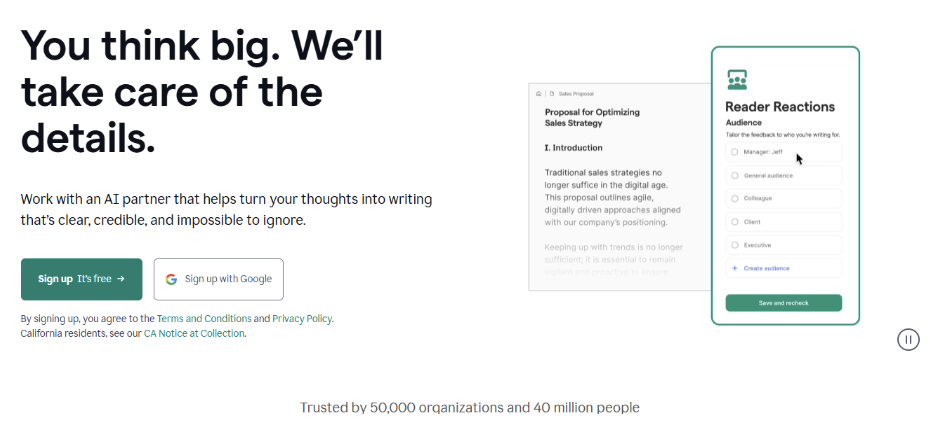
GrammarlyGO helps startups improve written communication. Clear writing builds trust with customers, investors, and partners.
Many startups move fast, which can lead to unclear emails or rushed content. GrammarlyGO supports better clarity and tone.
The tool checks grammar, spelling, and sentence structure in real time. It also suggests rewrites based on your goal, such as making a message shorter or more direct.
Startups can also run important communications through an online proofreading tool to catch overlooked errors and ensure a polished, professional tone before sending. This helps founders communicate with confidence.
Startups use GrammarlyGO for emails, proposals, blog posts, and social media content. It works inside browsers and common writing tools, which reduces workflow disruption. Instead of rewriting entire messages, teams can refine drafts quickly.
For early-stage teams, strong communication can improve sales, partnerships, and investor relations. GrammarlyGO acts as a quality control layer for written content.
Key Features:
- Real-time grammar correction – Fixes errors instantly.
- Tone suggestions – Adjusts writing style based on intent.
- Rewrite assistance – Shortens or restructures sentences.
- Browser integration – Works across platforms.
- Plagiarism detection – Checks the originality.
Pricing:
- Free
- $12 per month
6. Zovoro AI: All-in-One AI Platform for Everything
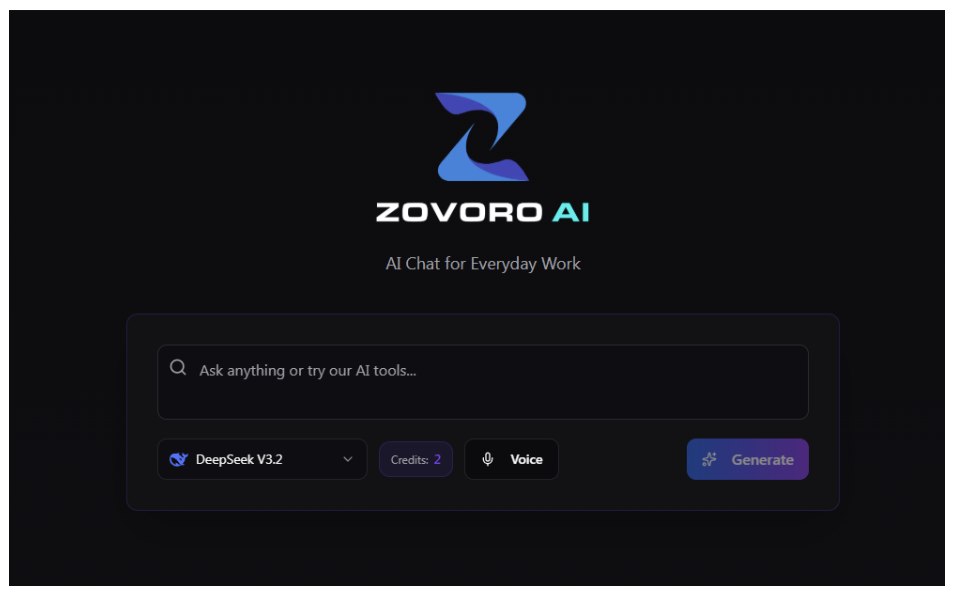
Zovoro AI helps startups replace dozens of disconnected tools with one unified AI system focused on growth, content, creativity, and multimedia.
Early-stage teams often juggle marketing, branding, social media, design, and outreach with limited time and budget — Zovoro AI brings these workflows together in a single platform.
Startups can use Zovoro AI to generate written content like blog posts, landing page copy, ads, and product descriptions. It also creates visuals with AI image generation, produces short videos with AI video tools, and even generates music for content and branding.
Instead of switching between separate design tools, editors, and AI writers, teams get everything inside one workspace — saving costs and execution time.
Beyond content creation, Zovoro AI supports structured marketing workflows. Founders can plan campaigns, generate variations for different platforms, repurpose long-form content into social posts, and optimize messaging for blogs, ads, and emails. This makes it especially valuable for lean teams without dedicated designers or content specialists.
Key Features:
- Multimedia creation – AI image generation, AI video production, and AI-generated music
• Content generation – Blogs, landing pages, ads, social posts, product descriptions
• Campaign workflows – Structured marketing execution and planning
• Content repurposing – Turn long form into short posts and formats
• Brand consistency – Unified tone and style across outputs
• Cost efficiency – Replaces multiple tools with one platform
Pricing:
- Free
- Lite – $9/ month
- Pro – $19/ month
- Business – $39/ month
7. Tagshop AI
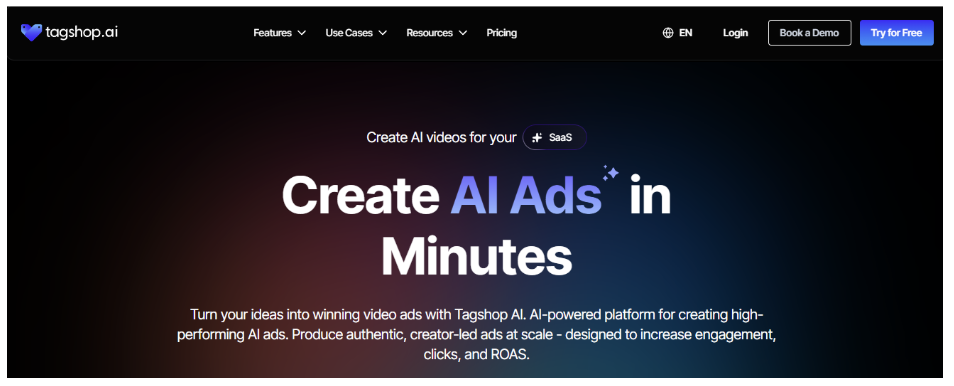
Tagshop AI helps brands and startups create high-performing AI ads without relying on agencies or large creative teams. Video advertising is critical for driving conversions and scaling campaigns, but producing ads usually requires time, coordination, and high costs.
Tagshop AI simplifies this process by turning product details, scripts, or ideas into ready-to-publish AI video ads.
Businesses can use Tagshop AI to create product-focused ads, talking-style videos, short-form social ads, and promotional creatives for platforms like Meta, TikTok, and YouTube.
You enter your script or product context, choose a creator style or format, and the platform generates complete video ads with visuals, captions, and pacing designed for performance. This reduces ad production time from days to minutes.
For teams working with limited budgets, Tagshop AI significantly cuts costs related to filming, creators, and video editors.
It also supports rapid testing. Marketers can generate multiple versions of the same ad using different creators, hooks, or layouts and quickly identify which version performs best. This makes scaling ad campaigns faster and more efficient.
Key Features:
- AI video ad generation – Converts scripts or product inputs into complete video ads.
- AI Twin – Turns a single photo into a speaking digital twin for video content and promotions.
- AI Avatar – Create and test multiple versions of the same video using different avatars, scripts, or styles quickly.
- AI Product Shot – Generates high-quality product visuals and scenes without a physical photoshoot.
- AI Script Generator – Creates ready-to-use video ad scripts based on your product, offer, or goal.
- Image to Video – Converts static images into engaging videos with motion, transitions, and timing.
Pricing:
- Free
- $29/ month
- $99/ month
- $249/ month
8. Canva Magic Studio: AI Design Tool for Startup Branding
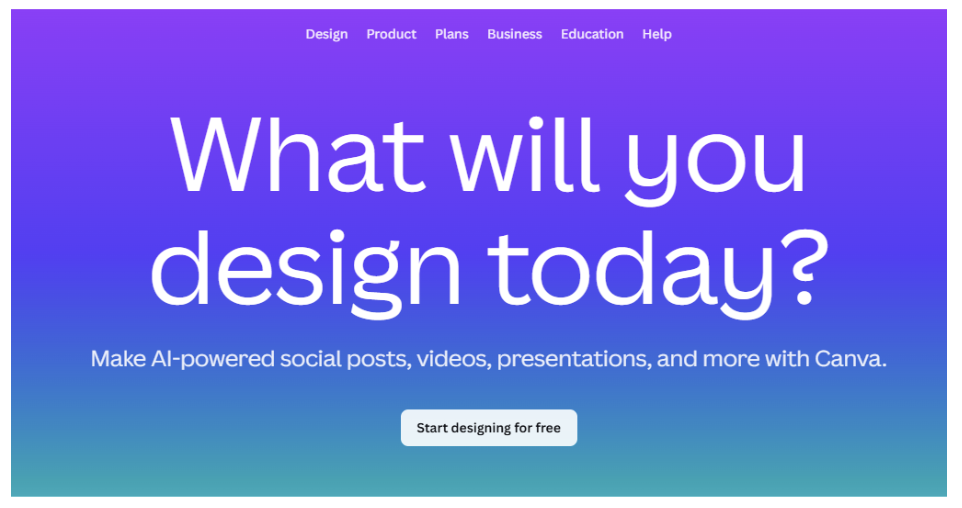
Canva Magic Studio helps startups create visual content without hiring a full design team. Branding, ads, presentations, and social media posts require strong visuals.
Many startups lack in-house designers. Canva solves this problem with AI-driven design tools.
Magic Studio includes tools like text-to-image generation, background removal, and instant design suggestions.
Founders can create pitch decks, social posts, banners, and product mockups with simple drag-and-drop controls.
Startups benefit from speed and consistency. Instead of waiting for a designer, teams can produce marketing materials on demand. Templates ensure brand alignment, while AI suggestions improve layout and color balance.
Key Features:
- Text-to-image generator – Creates visuals from written prompts.
- Magic resize – Adapts designs to multiple formats instantly.
- Background remover – Cleans up product images quickly.
- Template library – Ready-made layouts for marketing and sales.
- Brand kit – Stores logos, fonts, and color palettes.
Pricing:
- Free
- Pro – $12.99/ month
- Teams – $14.99/ month
9. GitHub Copilot: AI Coding Assistant for Faster Development
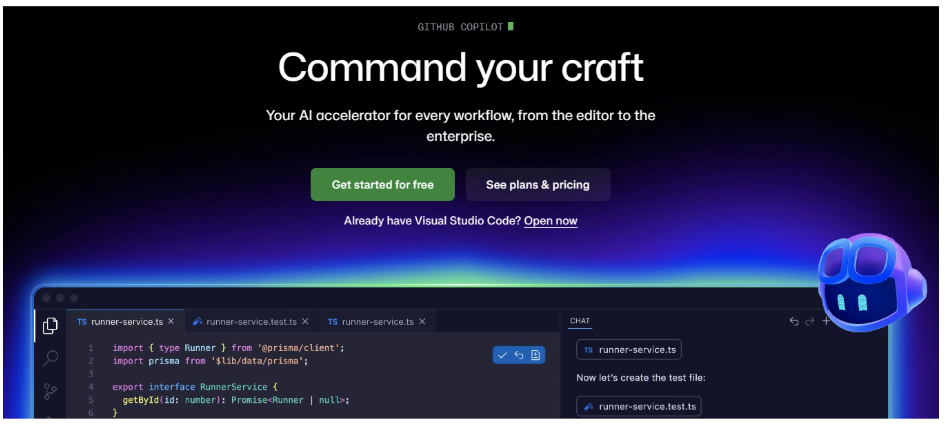
GitHub Copilot helps startups write code faster. Early-stage teams often work with small engineering groups. Deadlines are tight. Product releases cannot wait. Copilot supports developers by suggesting code in real time inside the editor.
As a developer types, Copilot predicts the next lines of code. It can generate functions, suggest logic, and even create boilerplate code based on comments.
This reduces time spent on repetitive tasks. Developers stay focused on solving real problems instead of rewriting common patterns.
For startups building MVPs, speed matters. Copilot helps teams move from idea to working product with fewer delays, and if you need more complex custom solutions, AI app development services can take those prototypes to full-scale apps.
It also supports learning. Junior developers can see suggested solutions and understand different coding approaches.
Key Features
- Real-time code suggestions – Predicts and completes code lines.
- Comment-to-code generation – Turns written instructions into code blocks.
- Multi-language support – Works with popular programming languages.
- IDE integration – Supports common development environments.
- Context awareness – Adapts suggestions based on project files.
Pricing:
- Free
- Pro – $10/ month
- Pro+ – $39/ month
10. Make: AI Automation for Startup Workflows
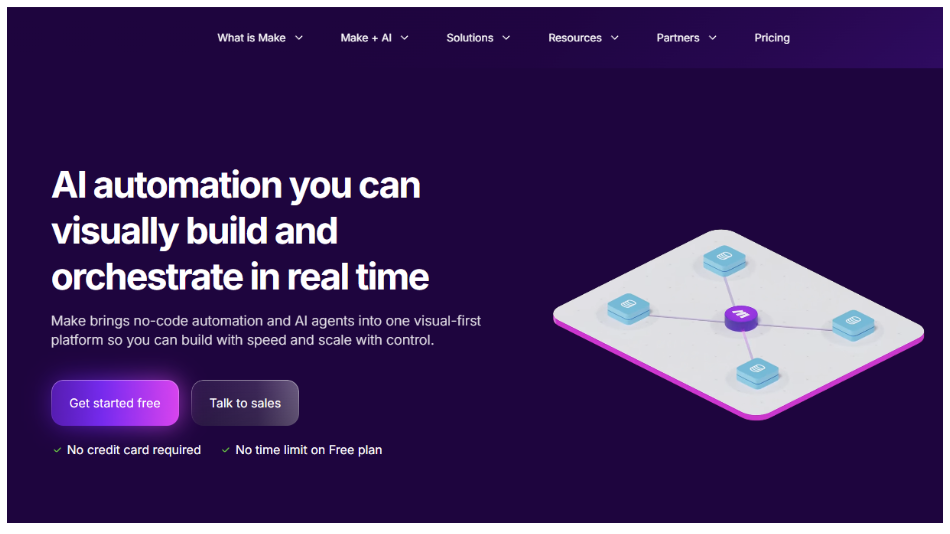
Make is an automation platform that connects apps and moves data between them. Startups use many tools every day—CRM, email, payment systems, marketing platforms, and project management tools. When these tools do not talk to each other, teams waste time copying data from one place to another. Make fixes to this problem.
With Make, you can build automated workflows using a visual editor. For example, when someone fills out a form on your website, Make can add the contact to your CRM, send a welcome email, notify your sales team, and create a task in your project tool. All of this runs in the background.
For startups, automation means fewer manual tasks and fewer errors. Instead of hiring someone to manage repetitive processes, founders can design workflows once and let them run.
Make works well for teams that want control over their systems. It supports advanced logic and filters, which help startups build custom workflows without writing code.
It’s crucial to prioritize server security, as all data is stored and accessed in the cloud, where potential risks can be significant if not properly managed.
Key Features:
- Visual workflow builder – Drag-and-drop automation design.
- Multi-app integrations – Connects with hundreds of business tools.
- Conditional logic – Creates smart workflows based on triggers.
- Real-time data sync – Keeps systems updated automatically.
- Error handling tools – Monitors and fixes failed automations.
Pricing:
- Free
- Make plan – $9/ month
11. Jobma: AI Video Interviewing for Faster, Smarter Hiring

Hiring is one of the biggest bottlenecks for startups. Founders spend hours screening resumes, scheduling interviews, and repeating the same questions to multiple candidates. This slows down growth, especially when building early teams.
Jobma is an AI-powered video interviewing platform that helps startups hire faster without expanding HR teams.
Instead of scheduling multiple first-round calls, startups can send one-way video interview requests. Candidates record responses on their own time. Hiring managers review answers when convenient. This removes scheduling delays and speeds up shortlisting.
For technical or specialized roles, Jobma also supports live interviews and skill assessments. This helps startups evaluate both communication skills and technical ability in one system.
As teams grow, hiring becomes more complex. Jobma integrates with popular ATS platforms, keeping candidate data organized and reducing manual tracking.
Jobma works best for startups that are actively hiring and need structured, repeatable hiring processes without building a large HR department.
Key Features:
- AI-powered video interviews – Screen candidates asynchronously to reduce scheduling delays.
- Live interview support – Conduct real-time interviews inside the platform.
- Skill and coding assessments – Evaluate technical talent beyond resumes.
- ATS integrations – Sync candidate data with existing hiring systems.
- Automated workflows – Streamline interview stages and candidate communication.
Pricing:
- On request
12. Testlify: AI-Powered Talent Assessments for Skills-First Hiring
Hiring the right talent is one of the biggest challenges for growing companies. Recruiters often rely heavily on resumes, conduct repetitive screening calls, and struggle to objectively evaluate candidate skills. This slows down hiring and increases the risk of poor hiring decisions.
Testlify is an AI-powered talent assessment and video interviewing platform that helps companies hire faster using structured, skills-based evaluation.
Instead of manually screening every resume, recruiters can send role-specific assessments to candidates at the pre-screening stage. Candidates complete skill tests, cognitive assessments, and behavioral evaluations online. Hiring teams receive detailed performance analytics and automated scoring, making it easier to shortlist the most qualified applicants.
For deeper evaluation, Testlify also supports one-way video interviews, allowing candidates to record responses at their convenience. Hiring managers can review submissions on their own schedule, reducing coordination delays and improving consistency in evaluation.
As hiring scales, Testlify integrates with popular ATS platforms to streamline workflows and maintain organized candidate records. This enables companies to implement repeatable, structured hiring processes without increasing HR workload.
Key Features
- AI-powered talent assessments – Evaluate technical, cognitive, and role-specific skills using structured tests.
- One-way video interviews – Screen communication and behavioral competencies asynchronously.
- Custom test creation – Build assessments tailored to specific roles and competencies.
- Automated scoring & analytics – Rank candidates based on standardized performance metrics.
- ATS integrations – Sync candidate data with existing recruitment systems.
Anti-cheating & proctoring tools – Ensure test integrity and reliable evaluation.
Pricing:
- $69/ month
13. ReferralCandy: AI-Powered Referral & Affiliate Programs
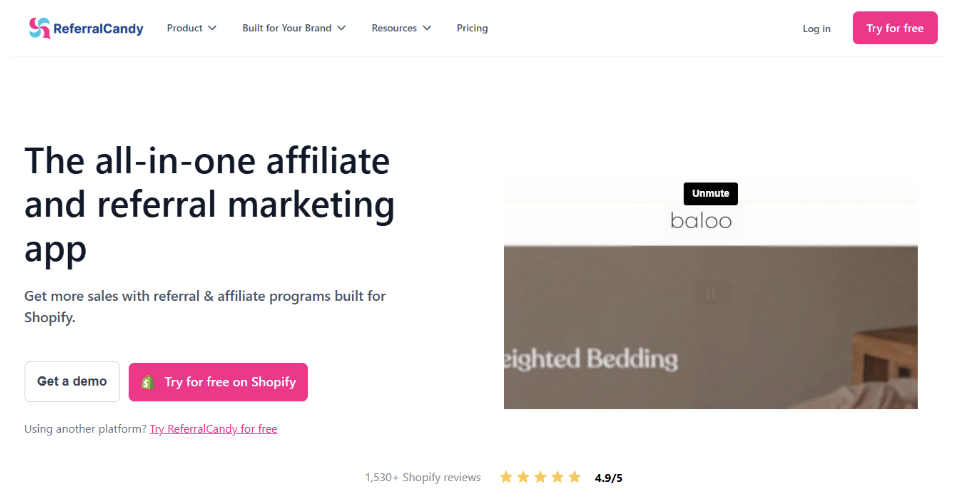
ReferralCandy helps startups turn happy customers into a growth channel. Instead of manually building and managing a referral system, you can generate and launch one quickly—even from a simple prompt. For example, you could type: “Create me a referral program with three tiers offering 10%, 20%, and 30% rewards,” and configure the structure in minutes.
It integrates directly with your eCommerce platform, tracks referrals automatically, and rewards customers when their friends make purchases. This makes it easy for startups to scale word-of-mouth marketing without building custom systems from scratch.
Key Features:
- Automated referral tracking – Tracks shares, clicks, and conversions automatically.
- Custom reward structures – Create percentage discounts, cash rewards, store credit, or tiered programs.
- Branded referral pages – Customize pages and emails to match your brand.
- Fraud detection tools – Identify suspicious or fake referrals.
- eCommerce integrations – Works with platforms like Shopify and WooCommerce.
Pricing:
- Basic – $39/ month
- Grow – $79/ month
- Scale – $249/ month
- Enterprise – $799/ month
How to Pick the Right Tools
Choosing AI tools is not about picking the most popular ones. It is about picking tools that match your startup’s current stage and goals.
Match Tools to Your Startup Stage
Early-stage startups need speed and validation. Focus on tools that help you launch fast and test ideas. Tools like ChatGPT, Canva Magic Studio, and Copilot help build and market products quickly.
Growth-stage startups need systems. Automation tools like Make and CRM-focused tools like Apollo.io are more useful. At this stage, structure matters more than experimentation.
Team Size and Skill Level
Small teams should choose tools that are easy to use. If your team lacks technical skills, avoid tools that require complex setup. For developer-heavy teams, tools like Copilot and Make can unlock more value.
Budget and ROI Priorities
Startups must track spending closely. Ask one question: Will this tool save time or increase revenue? If the answer is unclear, reconsider. Start with core tools that support sales, product, or customer support.
Integration with Existing Stack
Check whether a tool connects with your current systems. Poor integration creates data silos. Strong integration reduces friction and manual work.
The right tool stack feels simple, not crowded. Each tool should solve a clear problem.
Apollo feeds the pipeline. Tidio captures inbound interest. Notion AI keeps sales scripts and training material structured. Claude helps refine messaging and proposals.
This combination works well for B2B startups that depend on outbound sales and structured follow-ups.
Conclusion
AI tools are now part of how startups operate. They reduce manual work, improve speed, and support better decisions. In 2026, the advantage does not come from having AI. It comes from using it well.
Start small. Pick tools that solve clear problems. Measure results. Remove tools that add noise. Keep systems simple.
The goal is not automation for its own sake. The goal is focus. When AI handles repetitive tasks, founders and teams can focus on strategy, product, and customers.
Choose wisely, test often, and build a stack that supports growth without adding stress.
FAQs
- Are AI tools expensive for startups?
Many tools offer free or starter plans. Costs increase as usage grows. Start with core tools that directly impact revenue or productivity. - Can AI replace team members in a startup?
AI supports teams but does not replace human judgment. It reduces repetitive work and speeds up tasks. - How many AI tools should a startup use?
Use only what you need. Too many tools create confusion. Focus on tools that integrate well and solve real problems. - Is coding knowledge required to use AI tools?
Most tools are no-code or low-code. Developer-focused tools like Copilot require coding knowledge, but many others do not. - What is the biggest mistake startups make with AI tools?
Using too many tools without a clear plan. Each tool should have a defined purpose and measurable impact.
Author bio:
Jyoti Ray is the founder of OneMinuteSEO, where he helps startups, creators, and SaaS brands grow through smart link building and search-driven strategies. With deep experience in SEO, outreach, and digital growth, he focuses on practical tactics that deliver measurable results. Connect with him on LinkedIn.