Organizations are deploying AI at an unprecedented pace. But there’s a growing disconnect between what AI systems can do and what people actually trust them to do. Fewer than half of user’s report trusting AI-generated outputs — even when they use AI tools regularly. The technology isn’t the bottleneck anymore. Trust is. For instance, in first deployment of AI model I worked on, a platform that reduced analysis time by 80% was actively used by only 25% of the target audience three months after launch that’s when I learnt the primary reason was not the accuracy but the trust and adoption itself.
The Paradox of AI Adoption
Enterprise AI has a strange problem. The systems work. The models are accurate. The infrastructure is solid. And yet adoption stalls.
In most organizations, the pattern looks the same. Leadership invests in an AI-powered platform. Engineering builds it. A pilot group uses it enthusiastically. Then adoption plateaus at 20–30% of the target audience. The remaining 70% quietly reverts to spreadsheets, manual processes, and the tools they already know.
This isn’t a technology failure. It’s a trust failure. And it follows a predictable pattern: users don’t understand how the AI reached its answer, so they don’t trust the answer, so they don’t use the system. No amount of accuracy improvement fixes this. You can build a system that’s 99% accurate, but if users can’t see why it produced a particular result, they’ll verify every output manually — which defeats the entire purpose of automation.
Where the Trust Gap Lives
The trust gap manifests differently depending on who’s using the system and what’s at stake.
Finance teams are particularly cautious — and for good reason. When an AI system generates a budget variance analysis or validates an investment proposal, the stakes are real. A wrong number in a financial report doesn’t just cause embarrassment; it can trigger compliance issues, misallocate resources, or derail strategic decisions. Finance professionals have spent years building intuition about their data. Asking them to trust a black-box system that produces answers without showing its work is asking them to abandon that intuition entirely.
Engineering teams face a different version of the same problem. When an AI system recommends infrastructure changes — scaling down compute resources, migrating workloads across regions, or flagging cost anomalies — engineers need to understand the reasoning before acting. A recommendation without context is just noise.
Leadership encounters the trust gap at the strategic level. When AI-generated insights inform headcount planning, budget allocation, or operational strategy, decision-makers need confidence that the underlying analysis is sound. “The AI recommended it” is not a sufficient justification in any boardroom.
Why Accuracy Alone Doesn’t Build Trust
The instinct in most engineering organizations is to solve the trust problem by improving accuracy. If the model is 90% accurate, make it 95%. If it’s 95%, push for 98%. The assumption is that at some threshold, users will simply start trusting the output.
This assumption is wrong.
Trust in AI systems follows a different logic than trust in traditional software. When a calculator gives you an answer, you trust it because you understand the operation. When a database query returns results, you trust it because you can read the SQL. When an AI model generates an insight, the reasoning is opaque — and opacity breeds skepticism, regardless of accuracy.
Research consistently shows that users trust AI systems more when they can see the reasoning process, even if the system occasionally makes mistakes. A system that shows its work and is right 90% of the time earns more trust than a system that hides its work and is right 95% of the time.
This has profound implications for how we design enterprise AI systems.
Designing for Transparency: Five Patterns That Work
Building trust into AI systems isn’t about adding an “explain” button after the fact. It requires designing transparency into the architecture from the beginning.
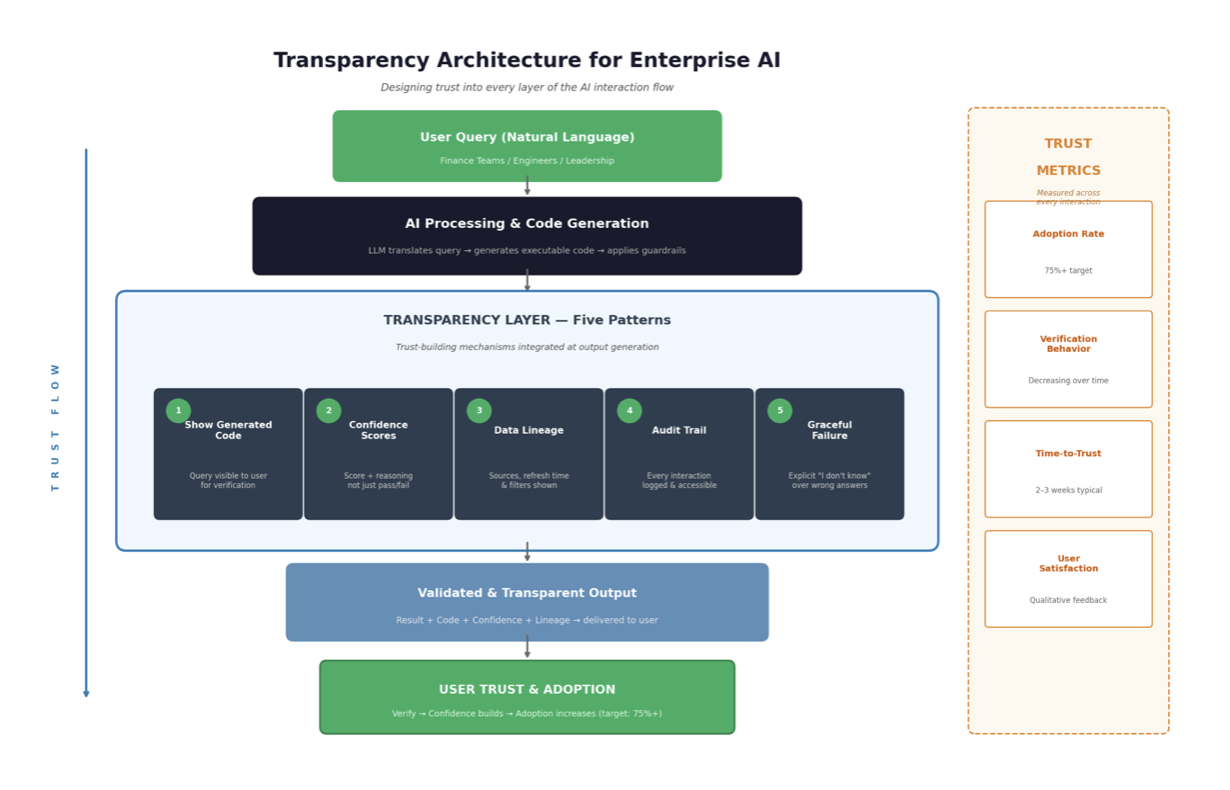
- Show the generated code, not just the result. When an AI system converts a natural language question into a database query, show the user the actual query that was executed. This single design decision transforms the interaction from “trust me” to “verify me.” Users who can read the query — or hand it to someone who can — develop confidence in the system far faster than users who only see the final output.
- Provide confidence scores with context. When an AI system evaluates an investment proposal or validates a dataset, don’t just return a pass/fail verdict. Return a confidence score with specific reasons. “85% confidence — projections are consistent with historical achievement rates, but the timeline assumption exceeds typical ranges by 20%” gives users something to evaluate. A bare “approved” or “flagged” gives them nothing.
- Make data lineage visible. Users need to know which data sources were queried, when the data was last refreshed, and what filters were applied. This is especially critical in financial contexts where stale data can lead to incorrect conclusions. Showing lineage isn’t just good practice — it’s often a compliance requirement.
- Log everything and make logs accessible. Complete audit trails serve dual purposes: they satisfy compliance requirements, and they give users a way to trace any output back to its inputs. When a user can pull up the exact query, data source, and timestamp for any AI-generated insight, trust follows naturally.
- Fail visibly and gracefully. When the AI doesn’t know the answer or generates low-confidence output, say so explicitly. Systems that always produce an answer — even when they shouldn’t — erode trust faster than systems that occasionally say “I don’t have enough information to answer this reliably.”
Below Diagram-1, visually summarizes the entire trust flow and gives a quick reference for how the patterns fit into the overall architecture
Diagram-1:
The Organizational Side of Trust
Technology design is only half the equation. The other half is organizational change management — and most AI deployments underinvest in it dramatically.
Start with the skeptics, not the enthusiasts. Most AI rollouts begin with early adopters who are already excited about the technology. This creates a false sense of adoption success. The real test is whether the cautious majority — the people who have been doing their jobs effectively without AI for years — will change their workflows. Engaging skeptics early, incorporating their feedback, and addressing their specific concerns builds broader trust than any demo or training session.
Create verification periods, not mandates. When deploying AI-powered analytics, give teams an explicit period where they’re encouraged to run AI-generated results alongside their traditional methods. This parallel-run approach lets users build confidence through direct comparison rather than blind faith. In practice, most teams discover within 2–3 weeks that the AI outputs are reliable — and they stop double-checking on their own, without being told to.
Measure adoption as a first-class metric. A system that’s technically excellent but used by only 20% of its target audience is delivering 20% of its potential value. Tracking adoption rates — not just accuracy metrics — forces teams to confront the trust gap rather than hiding behind technical benchmarks. Targeting 75% adoption within the first three months of deployment is an aggressive but achievable goal when transparency and change management are prioritized.
Comparing Transparent and Opaque AI System Design
The impact of transparency on trust and adoption becomes clear when examining these design dimensions side by side as shown in below Table-1:
Table-1:
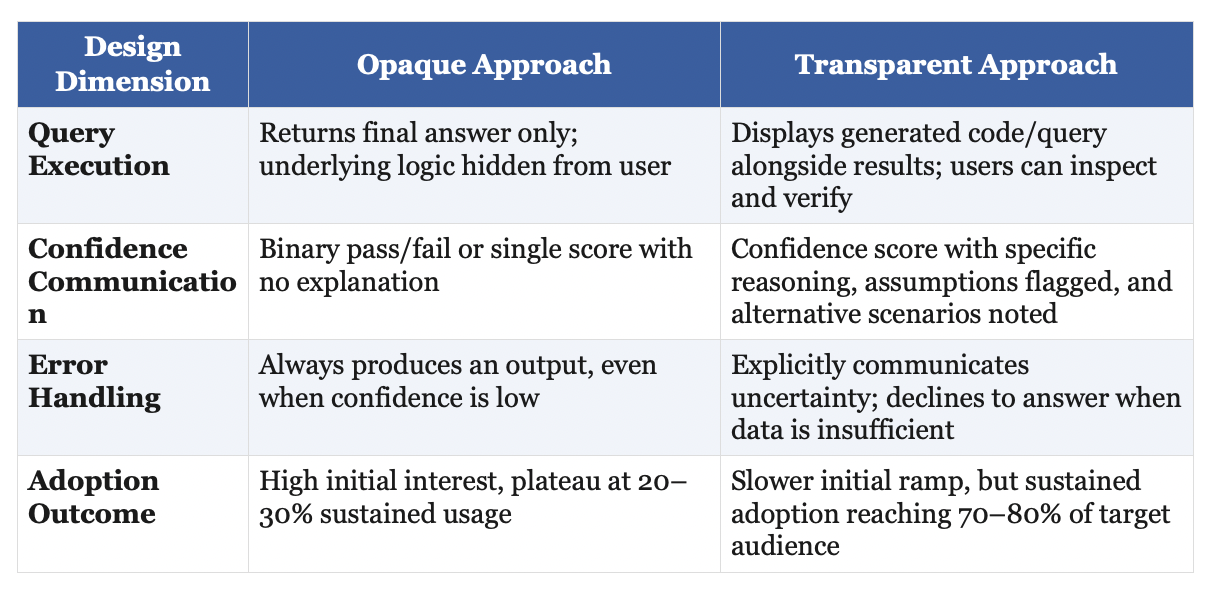
The pattern is clear: transparency costs more upfront in design effort but pays back exponentially in adoption and trust.
The Business Case for Trust
Trust isn’t a soft metric. It has direct, measurable business impact.
When users trust an AI system, they use it. When they use it, manual effort drops. When manual effort drops, teams can redirect capacity to higher-value work. The chain is straightforward, but it breaks at the first link if trust isn’t established.
In practical terms, the difference between 25% adoption and 75% adoption on an AI platform that saves 15–20 hours per week per user is the difference between a modest efficiency gain and a transformational shift in how an organization operates. The technology is identical in both scenarios. The trust architecture is what separates them.
The Path Forward
The enterprise AI industry has spent the last several years optimizing for capability — making models smarter, faster, and more accurate. That work matters. But the next frontier isn’t capability. It’s trust.
Three guiding principles for building trustworthy enterprise AI:
- Design for transparency from day one — Retrofitting explainability into an opaque system is exponentially harder than building it in from the start. Every AI output should be traceable, verifiable, and auditable by design.
- Measure trust, not just accuracy — Track adoption rates, user verification behavior, and time-to-trust alongside traditional ML metrics. If users are manually verifying every AI output, the system hasn’t earned trust yet — regardless of its accuracy score.
- Invest in organizational change as much as technology — The best AI system in the world delivers zero value if people don’t use it. Budget for change management, parallel-run periods, and skeptic engagement with the same rigor you budget for infrastructure and model development.
The trust gap is the single biggest obstacle to enterprise AI delivering on its promise. Closing it requires a fundamental shift in how we think about AI system design — from optimizing for accuracy to optimizing for transparency. The organizations that make this shift first will be the ones that actually realize the transformational potential of AI. The rest will have impressive demos and disappointing adoption numbers.
About the Author
Rohit Nagpal is a Senior Data Engineer at Amazon, where he leads AI automation and data engineering initiatives for enterprise finance operations. His work focuses on building transparent, production-grade AI platforms that prioritize user trust and organizational adoption alongside technical performance. He holds a Master of Science in Business Analytics from California State University, East Bay, where he graduated with a perfect 4.0 GPA.
Disclosure: I used AI to adjust narrative and tone of the article, but the core technical details and analysis are my original work based on my experience building these systems.