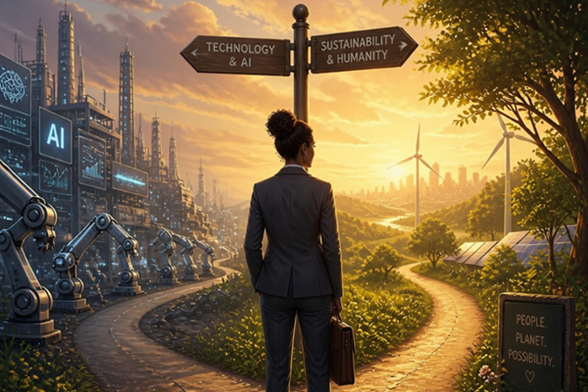
Balancing the seemingly never-ending possibilities of AI with corporate sustainability aspirations is becoming one of the defining challenges for businesses across all sectors.
While AI has enormous potential to accelerate sustainability goals, it also comes with environmental and social costs which need to be managed thoughtfully so that technology helps, rather than hinders, the CSR agenda. This means the pressing question has very much become: can businesses mitigate the risks while maximising the advantages to truly balance environmental and technological demands?
How AI can support sustainability
Technology can support efficiency and resource optimisation by reducing energy use; optimising logistics, supply chains and manufacturing efficiency; and minimising waste. For companies developing new materials, circular business models and renewable energy systems, AI can accelerate innovation and help teams to develop new ways of working.
And of course, the increased insight that can be gleaned through implementing AI can be useful when it comes to carbon accounting, lifecycle analysis, biodiversity monitoring and climate risk modelling, as well as data-led decision making – helping leaders identify sustainability opportunities and prioritise actions based on real data and case studies.
The sustainability challenges of AI
The amount of energy and water needed to power AI is a growing concern across the corporate world. The training required for a large AI model alone is estimated to use up to 10,000 GwH, the equivalent of powering a town the size of Chester or Salisbury for around 15 months.
Alongside the pressure on power grids, data centres also consume substantial amounts of fresh water for cooling purposes. The Environmental and Energy Study Institute estimates larger centres consume up to five million gallons of fresh water every day – enough for around half a million showers.
With only 3% of earth’s water being fresh, this has a substantial social impact and raises ethical questions about whether these systems are contributing significantly to drought and water availability in communities. Research published by Nature shows the area affected by drought has grown by 74% in the past 40 years, and the World Health Organization reports one in four people across the world do not have access to safe drinking water, meaning this is a critical – and growing – concern.
Novel technologies like immersion and liquid cooling can reduce consumption of energy and water through more efficient heat dissipation, but these are not yet developed or widespread enough to combat the problem entirely.
And it is not just water and energy we must consider, the infrastructure needed to support AI implementation is resource intensive and depends on elements such as lithium, cobalt, silica and copper alongside rare earth minerals like neodymium, praseodymium and dysprosium. As well as giving rise to concerns around resource depletion and electronic waste, the labour impacts and emissions associated with mineral mining are widely debated and somewhat controversial – meaning businesses must be mindful of tracing origins to avoid claims of eco-colonialism.
Being able to evidence sustainability also requires the effective use of AI; this has been undermined by various examples of poorly-governed systems which produce biased or unreliable outcomes, and have therefore had to be retrained, redesigned or scrapped altogether. Perhaps the most well-known of these was Amazon’s AI recruitment tool, which was abandoned after it was found to disadvantage female applicants having been built predominantly using men’s CV.
To avoid wasting resources, time and investment while ensuring AI delivers genuine value, companies must invest in robust governance, representative data and human oversight from the outset. Otherwise, any sustainability benefits they hope to achieve will be cancelled by the repair or replacement projects needed when significant problems arise.
Finding the balance
Organisations must resist the urge to rush head-first into AI projects without pausing to take a more pragmatic approach, ensuring sustainability is a key consideration throughout.
Leaders should be sure the AI is solving a genuine sustainability challenge rather than simply adding complexity, and that the environmental and social benefits outweigh the resource costs. In addition, building governance and ethical considerations into the overarching strategy should be a Day One consideration, alongside deciding how the footprint will be measured and reported – with consideration given to using smaller, more efficient models where feasible.
Rather than asking how we can use AI everywhere, a much more beneficial question is: where can AI create meaningful sustainability outcomes while minimising its own environmental and social impacts?
The businesses which succeed in today’s technology-filled world will likely be those who treat AI not as an end in itself or a human input replacement, but as a tool that supports both commercial objectives and long-term sustainability ambitions through intentional and responsible deployment. If we don’t maintain that balance then we are simply alleviating one set of problems around resource and efficiency, while significantly worsening the global challenges around climate change and sustainable practices.
Ultimately, businesses should not have to face a choice between technology and environment – but if they want both, then they must implement, manage and maintain AI systems in a way that supports rather than stalls their CSR efforts.