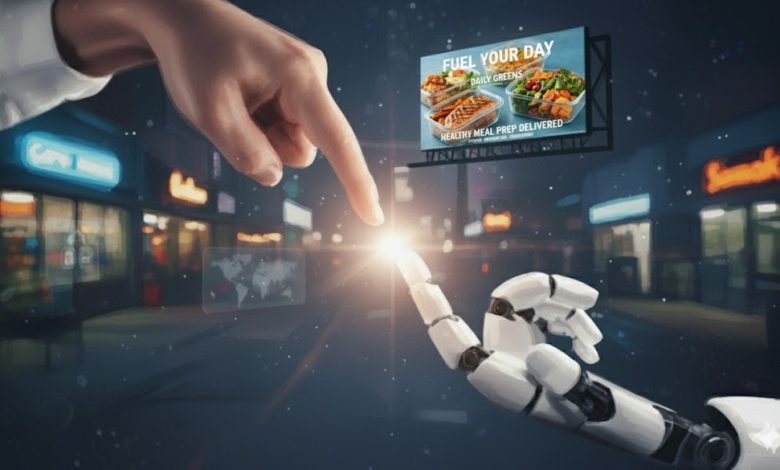
For decades, the story of small and midsize business (SMB) advertising has been about constraints. Budget constraints. Creative constraints. But most of all: access constraints.
If you were an SMB trying to buy a TV ad or run a multi-location digital billboard campaign, your options were to hire an expensive agency and hope they will be effective, run the gauntlet with media sales people, or simply don’t pursue it at all. Meanwhile, Google and Meta became default choices because they made it easy with self-serve or “plug-and-play” tools. You could write your own ad, pick a target, enter your credit card and be done.
But something big is shifting. In the span of a couple weeks, Magnite, Roku, NBCUniversal, Amazon, and Vibe.co all doubled down on investments to fuel AI-enabled experiences for marketers. Not a coincidence.
AI is finally making it possible for SMBs to access premium advertising channels once reserved for the “big guys.” Channels like connected TV (CTV) and digital out-of-home (DOOH) are being reimagined with AI-first tooling that removes the friction that once kept smaller brands on the sidelines.
The friction wall
Until now, even if an SMB had the ambition to go beyond Google and Meta, the logistics were overwhelming. Who writes the script for the ad? Who configures the campaign and books the campaign? What even is a programmatic bid? The learning curve was steep.
On top of that, campaign setup tools in premium media felt like enterprise software: complex, jargon-heavy, and built for agencies or Fortune 500 teams. Even if an SMB wanted to invest in CTV or DOOH, they needed time, talent, or a partner to translate.
AI is leveling the playing field
The new generation of AI-powered ad tools is collapsing the distance between ambition and execution. SMBs can now upload a product image, answer a few questions, and let AI generate video scripts, ad copy, and even media plans. Some tools will auto-generate localized DOOH ads based on weather or time of day. Others tap into predictive AI to recommend optimal placements based on your budget and goals.
Vibe.co is a good reference point for where the investor capital is moving to perpetuate the AI-assisted future. The company launched their company in the U.S. three years ago and reached $100 million in ARR in under two years, driven by a self-service product that lets SMBs launch campaigns on streaming TV with as little as $50 per day. Its AI-powered Vibe Studio enables ad creation in under 10 seconds.
This isn’t just about creative efficiency, it’s about unlocking entire categories of media. AI is making premium ad inventory as accessible as search and social once were.
What this unlocks for SMBs
Think about the small meal prep brand in Austin, Texas that now runs on Hulu and on gym screens across the city. Or the boutique skincare line promoting on a Times Square screen without flying to New York. These stories used to be rare edge cases. Now, they’re becoming an everyday occurrence.
AI brings three core benefits to SMBs:
- Simplicity: Setup flows that feel like consumer apps, not command centers.
- Scale: The ability to launch across multiple formats (i.e. CTV, DOOH, or online video) from a single interface.
- Smarts: Optimizations that learn and adapt, without requiring a full-time media buyer.
Follow the money
As AI drops the cost of entry, more SMB budgets are migrating into new formats. According to Borrell Associates’ 2025 Annual Digital Benchmarking Report, U.S. local digital ad spending reached $104.4 billion in 2024, up 12% from the year prior, with projections hitting $108.5 billion in 2025. This surge is fueled largely by SMBs embracing AI-powered, self-serve platforms that make premium video, DOOH, and CTV channels as accessible as search once was.
For years, SMB ad dollars were bottlenecked in just two places: Google and Meta. Now, frictionless interfaces and AI-generated creative are redirecting spend into high-impact formats that were previously too complex or cost-prohibitive to touch.
New startup adtech platforms are showing just how far this trend can go. With AI-enablement, integrated tracking, self-serve dashboards, and agency partnerships that offer a revenue share on TV spend, they’re expanding access to video advertising at a voracious velocity.
Who wins in the new access economy?
The platforms that build intuitive, AI-powered interfaces will dominate. The days of selling media like real estate are fading. In the same way Shopify enabled e-commerce without coding, AI-powered ad platforms will empower SMBs to launch omnichannel campaigns without the traditional gatekeepers.
Measurement providers that make outcomes easy to see will also rise. If you’re a business spending $10,000 per month, you don’t want a 40-page report, you want clarity. Did it work? What should I do next? AI will increasingly power those answers too.
The winners will be the ones who design for usability. Those who prioritize transparency. Those who think about long-tail demand as more than leftovers.
Education remains key
Without the proper education, not everything about this shift will be rosy. With more automation comes more risk, and SMBs that trust AI tools blindly may launch ineffective or even brand-damaging campaigns with measurement gaps causing misinformed budget decisions.
There’s also the risk of sameness. If everyone uses the same AI tools to generate ad creative, messaging could become generic. It will take intentionality and human oversight to keep the brand voice distinct.
And let’s not forget that access still has layers. Just because a tool is available doesn’t mean it’s known, understood, or trusted — and that is arguably the most limiting factor that could hold back the speed and scale of the AI unlock.
A new posture for media owners
For media sellers and publishers like Roku and NBCUniversal, this moment demands a shift in mindset. Historically, SMBs were seen as too fragmented to be worth the effort. But with AI, aggregation becomes easier. Platforms can offer bundled reach, smart targeting, and automated execution.
This makes the SMB opportunity not just possible, but profitable. The snowball has already started rolling, and for the next 18 months, we are likely to see:
- Continued convergence: Tools combining creative + media + measurement in a single flow.
- Verticalized solutions: AI ad platforms tailored to industries like fitness, food, or beauty.
- Real-time feedback: AI companions showing SMBs what’s working mid-flight.
- Voice and video generation: AI creating not just scripts but spokespeople.
- Community-powered learning: SMBs sharing prompts, playbooks, and AI-generated assets.
Conclusion: A creative middle class
The biggest unlock of AI in media buying isn’t just cheaper ads or faster workflows. It’s the creation of a new tier of advertisers, or a “creative middle class.”
These are the SMBs who finally get a seat at the table. Not with scraps, but with screens. Not begging for attention, but commanding it. And they bring diversity, experimentation, and local color back to media that had become increasingly homogenous.
If platforms embrace this, the result is not just revenue. It’s reinvention. Not just for advertisers, but for the very shape of the media economy.
And that is the real story and the real opportunity, for everyone.