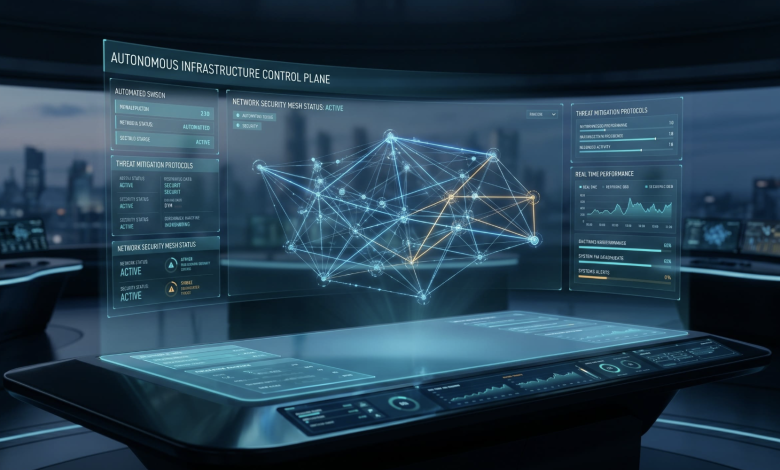
Introduction: Beyond the Reactive Security Paradigm
Modern enterprise security is currently undergoing a fundamental transition from human-centric monitoring to autonomous resilience. For decades, Security Operations Centers (SOCs) have relied on dashboard-driven methodologies, where human analysts respond to alerts generated by disparate telemetry sources. However, the sheer volume of modern vulnerabilities (CVEs) and the speed of zero-day exploits have rendered this reactive model obsolete. This article explores the emergence of AI-native “Auto-Heal” frameworks, specifically focusing on the Sentinel-Aura methodology.
The Rise of the Autonomous Control Plane
The evolution of cyber resilience necessitates a shift toward an Autonomous Control Plane (ACP). Unlike traditional Security Information and Event Management (SIEM) tools, an ACP does not simply flag a risk; it executes a remediation strategy without manual intervention. This transition aims to achieve a ‘Red-to-Green’ status, as illustrated in Figure 1. By moving a system from a vulnerable state (Red) to a compliant one (Green) through autonomous cycles, remediation happens in seconds rather than days. By embedding AI at the core of the infrastructure, enterprises can achieve a self-healing posture that scales with the complexity of the cloud environment.
Technical Architecture: The Telemetry Layer
The foundation of any autonomous framework is high-fidelity data ingestion. The Sentinel-Aura framework leverages the Microsoft Graph API and Azure Log Analytics to create a unified telemetry stream. This layer captures real-time data from identity, endpoints, and cloud applications to provide a holistic view of the security landscape. By integrating these disparate data points, the system can identify deviations from the desired state (the “compliance baseline”) with high precision.
The Intelligence Tier: KQL and LLM Integration
Data alone is insufficient; it requires an intelligent tier capable of interpreting complex compliance policies. Sentinel-Aura utilizes Kusto Query Language (KQL) to filter through terabytes of logs to identify specific non-compliant configurations or active threats. To bridge the gap between technical logs and organizational policy, Large Language Model (LLM) agents are employed. These agents interpret natural language security mandates—such as NIST or SOC2 requirements—and translate them into actionable technical logic.
Code Snippet 1: KQL Logic for Detecting Vulnerable Endpoints
// Identifying devices with critical vulnerabilities and missing patches
DeviceTvmSoftwareVulnerabilities
| join kind=inner (DeviceLogonEvents) on DeviceId
| where SeverityScore >= 9.0
| project DeviceName, OSPlatform, SoftwareName, VulnerabilitySeverityLevel
| summarize count() by DeviceName
The Sentinel-Aura Innovation: Usage-Pattern-Aware Remediation
The primary barrier to autonomous patching has historically been the risk of disrupting user productivity. Traditional “forced” updates often lead to downtime during critical business operations, causing friction between security and productivity. Sentinel-Aura introduces an original methodology: Usage-Pattern-Aware Remediation. This framework analyzes User Behavioral Analytics (UBA) to identify “low-utility” windows—periods when the user is not actively engaged in high-resource tasks.
Predictive Logic: The Risk-Utility Scoring System
At the heart of Sentinel-Aura is a “Risk-Utility” scoring algorithm. This system weighs the severity of a vulnerability (using Common Vulnerability Scoring System or CVSS metrics) against the criticality of the user’s current activity. If the risk is critical (e.g., an active ransomware exploit), the system may force immediate remediation. However, for standard patches, the system delays execution until a predicted period of user inactivity, ensuring security does not impede output.
Table 1: Risk-Utility Matrix Example
| Vulnerability Severity (CVSS) Taken | User Activity Level | Action |
| Critical (9.0 – 10.0) | High | Immediate Forced Patch |
| High (7.0 – 8.9) | Medium | 30-Minute Delay / User Prompt |
| Medium (4.0 – 6.9) | High | Trigger Usage-Pattern-Aware Delay: Defer to Predicted Low-Usage Window |
The Remediation Loop: Autonomous Execution
Once a remediation window is identified, the system enters the execution phase. This is achieved through a localized Remediation Loop that triggers PowerShell (for Windows environments) or Bash scripts (for Linux) autonomously. These scripts perform the necessary “Auto-Heal” actions, such as closing open ports, updating registry keys, or installing security patches. By removing the “Human-in-the-loop” for standard remediations, the framework drastically reduces the Mean Time to Remediate (MTTR).

Diagram 1 Description: The Telemetry-to-Remediation Loop
“Figure 1: The Sentinel-Aura Autonomous Remediation Loop. This framework utilizes real-time KQL telemetry and LLM-driven policy engines to execute usage-aware patching, moving endpoints from a vulnerable ‘Red’ state to a compliant ‘Green’ state with zero human intervention.
Verification and Post-Remediation Reporting
Every autonomous action must be followed by a verification cycle to ensure the “Red-to-Green” transition was successful. The Sentinel-Aura framework re-scans the telemetry layer immediately following script execution to confirm compliance. If the remediation fails, the system logs the error and escalates only the failed instance to a human administrator. This “Exception-Based Management” model allows small security teams to manage massive, global infrastructures efficiently.
Scholarly Context and Industry Standards
The development of Sentinel-Aura aligns with the Zero Trust Architecture (ZTA) principles defined by the National Institute of Standards and Technology (NIST SP 800-207). By treating every endpoint as potentially compromised and requiring continuous validation, the framework addresses the “Never Trust, Always Verify” mandate. Furthermore, the use of automated remediation fulfills the “Response” and “Recovery” pillars of the NIST Cybersecurity Framework (CSF).
Future Implications: The End of Manual Patching
The integration of AI-native frameworks represents a permanent shift in systems engineering. As threats evolve to include AI-generated malware, the defense must operate at machine speed to remain effective. Sentinel-Aura demonstrates that security and productivity are not mutually exclusive but can be harmonized through intelligent, usage-aware automation. The goal is an enterprise environment that is not just secure, but inherently resilient and self-sustaining.
Conclusion
The Sentinel-Aura framework offers a blueprint for the future of enterprise cyber resilience. By moving beyond simple detection and into the realm of usage-aware, autonomous remediation, organizations can eliminate the traditional trade-off between security and uptime. As these AI-native “Auto-Heal” systems become the industry standard, the role of the security professional will evolve from manual firefighter to the architect of autonomous systems.
External References & Citations
Author Bio
Harshavardhan Malla is a Systems & Security Engineering professional specializing in AI-driven infrastructure security. He holds a Bachelor of Technology in Computer Science and Engineering from Vellore Institute of Technology (VIT) and a Master of Science in Information Technology (MS-IT) from Arizona State University (ASU). With extensive experience in cloud-native security and automated systems, Harshavardhan focuses on developing frameworks that bridge the gap between complex cyber resilience and enterprise-level productivity. His research centers on the implementation of autonomous “Auto-Heal” architectures within global enterprise environments.