In recent years supply chains have become increasingly interconnected, creating both challenges and opportunities for change. While digitalisation has made our supply chains ‘smarter’, it’s also created new vulnerabilities to disruption for the industry, both in the physical and digital realms.
Cybersecurity is just one example. The ransomware attack on supply chain management specialist Blue Yonder in November provided clear evidence of the disruption such incidents can cause, with an attack on the company’s managed services environment causing delays to a number of grocery and retail stores in the UK, leaving retailers struggling to pay staff and manage their schedules on time.
Such incidents show just how important scenario planning can be to avert these crises. If plans to mitigate potential impacts are not mapped out in advance, these events have the potential to completely halt production and impact business revenues. Data is absolutely pivotal to the efficiency and efficacy of today’s supply chains, but incidents such as the above show supply chain data currently isn’t being safeguarded effectively, or optimised to circumvent real-world disruption.
That being said, many businesses are beginning to explore new technologies and techniques to improve resilience across their supply chains.
Supply chain data is being restricted
It’s no secret that the supply chain is a high-stakes, inherently complex industry. It’s made up of producers, warehouses, transport, distribution ports, and stores worldwide. If one blockage or breakdown takes place anywhere it can topple the entire system, meaning visibility is key to preventing knock-on effects.
However, extracting valuable insights from supply chain data in raw form can be difficult. Traditional data models struggle to analyse complex data due to their file-like structure; they predominantly consist of a rigid format of tables, rows, and columns that doesn’t capture the intricate connections between different sets of data.
The invisible string in the supply chain made visible
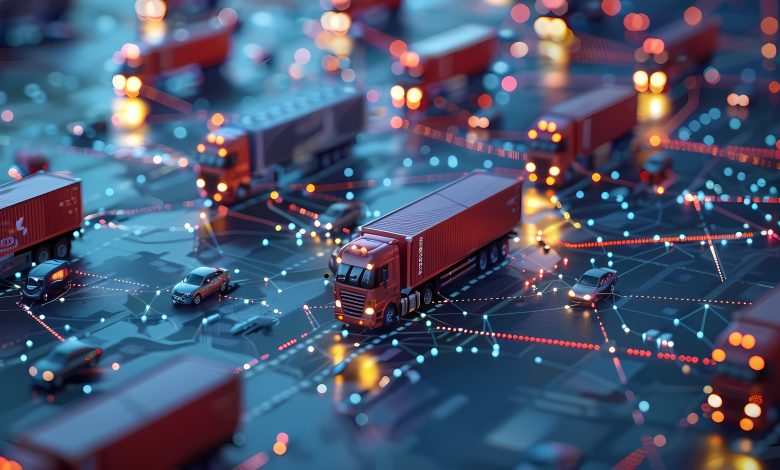
Unlike these legacy models, graph databases are uniquely structured using ‘nodes’ and ‘edges’. ‘Nodes’ are used to represent a person, a product, a place, or an existing entity in a graph, and ‘edges’ represent the relationship between two nodes – i.e. how they are connected to one another. These fundamental properties are invaluable for supply chain professionals looking to visualise their supply chain as the network that it is, in a digital form.
If a supply chain organisation wanted to optimise transportation, for example, they could create a node to represent each wholesaler and connected retailer, and then use an edge to show the distances between them and run the appropriate query, or request, in the model. The resulting output should highlight for the analyst what, in practice, should be the ‘best’ – fastest and cheapest – supplier from which goods can be transported ready for purchasing.
Understanding the relationship between two different entities ahead of time can be immensely useful in the event of unexpected disruption. Take the crisis in the Red Sea for instance, where shipping companies are enduring rocketing shipping costs and product delivery delays as a result of rebel attacks. Using graph technology in this way could allow those managing supply chains to pinpoint efficient alternative routes or solutions to get goods to suppliers, increasing resilience and minimising disruption.
It’s those edges linking each entity that make graph database technology a powerful tool for revealing insights – particularly in supply chains, which are graph-like networked structures, made up of a myriad of connections, after all. It’s a stark contrast with older, more rigid data models, where these relationships are much harder to uncover due to the way the data is structured.
Digital twins for combating cyber risks
Supply chain resilience isn’t purely about the physical realm, though. Incidents such as the cyber attack on Blue Yonder can have a huge impact on digital operations, and many organisations are exploring digital twin technology as a tool to combat attacks – from before they begin, through to post-incident analysis.
They’re doing so by creating virtual replicas of supply chains in what are called ‘knowledge graphs’ to test different scenarios and generate multiple outcomes of cybersecurity risks. In essence, this means a connected, virtual model of their supply chain is made available, in which companies gain a holistic, granular picture of a network: which systems connect to which systems, users and the groups they belong to, what permissions are given to members of the groups, and so on. The digital twin then becomes more accurate over time as details of recurring or interconnected events are captured, allowing cybersecurity and supply chain analysts to take faster and more effective action in the present, and inform how they respond in the future.
When those connections are made visible to cybersecurity analysts, it’s easier to identify where the greatest vulnerabilities impacting critical resources lie, and potential attack paths to those resources. Plus, they can also predict which attacks are the most likely to succeed by attaching the probabilities to each of those pathways, allowing them to bolster security accordingly.
That knowledge is immensely valuable because it clearly signposts when organisations need to map out other viable routes, transit times, and cost implications. The combination of cybersecurity modelling and supply chain optimisation becomes an impactful formula for organisations to stay ahead of curve balls in the real world and re-prioritise resources in quicker succession.
How the evolution of graph databases is mitigating against cyber threats
The complex web that is the global supply chain is constantly under threat, but organisations can become more resilient by tapping into the power of graph databases.
It’s the relationships in supply chain data that reveal the most efficient ways of rebounding from unforeseen incidents that would otherwise be detrimental to business. In both the real and the digital world that deeper understanding of complex networks, and their level of resilience, is what can truly set organisations apart.