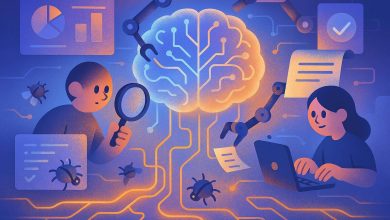
AI is evolving at a breakneck pace. 18 months ago, we were all wrapping our heads around how to use it; now it’s ubiquitous. The rise of Agentic AI is the next frontier. Instead of static tools and models that take inputs and provide outputs, Agents build systems that can act with context, memory, and intent. These systems can execute tasks, make decisions, and adapt within human-defined boundaries, which has huge implications for marketers.
The three pillars of modern marketing, research, strategy, and activation are being rebuilt around collaboration between humans and agents. Instead of manual workflows and one-off campaigns, teams are designing continuous, adaptive processes where AI agents learn, respond, and scale in partnership with their human counterparts.
Why agentic AI matters
In the past, AI focused on analyzing data to make predictions or automate a narrow set of tasks. Agentic AI understands goals, coordinates across data sources, and takes steps toward an outcome to remove manual busy work and improve both speed and creativity.
Consider a marketing manager preparing a quarterly campaign. Instead of manually reviewing dashboards, the manager works with an AI agent that gathers performance data, identifies audience patterns, drafts creative variations, and recommends timing based on previous results. The manager still sets the objectives and provides direction but can now focus on higher-value decisions rather than repetitive work.
The relationship becomes collaborative with humans defining purpose and standards and agents delivering scale, speed, and consistency. This structure creates a workflow where humans lead with creativity and strategy while agents manage the execution and iteration that would otherwise slow progress.
Zeta describes this model as “human in the loop” rather than “human out of the loop”. The distinction matters because it protects the role of human context, empathy, and ethical judgment that automation alone cannot replicate.
How agentic AI reshapes marketing work
Research, strategy, and activation are the areas most affected by agentic systems, each evolving into a more adaptive and connected process.
- Research: Instead of spending days compiling reports, teams can rely on agents to continuously monitor market data, customer behavior, and campaign results, then summarize what matters most.
- Strategy: Marketers can use agents to model different scenarios and test variations in creative, audience mix, or spend allocation before launching. The agent can learn from previous outcomes and refine its recommendations each time.
- Activation: Campaigns no longer run as one-time blasts but as living systems that adjust messaging and targeting based on live feedback. Human-defined guardrails maintain control while agents fine-tune performance in real time.
When agents take on the operational load, teams gain more time and mental space to focus on creative strategy and long-term growth.
Humans and agents as collaborators
Agentic AI works best when humans and machines operate as partners. Each brings a set of strengths that together create a more capable whole.
- Humans provide purpose, context, and judgment and define brand values, set direction, and decide what risk levels are acceptable.
- Agents contribute speed, reach, and consistency, managing large amounts of information and responding to signals in real time.
- Humans then interpret ambiguous outcomes and make decisions that reflect empathy and intent, while agents maintain the discipline to carry out those decisions at scale.
This exchange creates a continuous feedback loop. Agents surface findings, act within boundaries, and report outcomes. Humans adjust the boundaries and apply creative thinking to shape what comes next. The goal is to build an intelligent system where human insight and machine execution reinforce each other.
What organizations must get right
To realize the benefits of agentic AI, organizations need to adjust how they design work, define accountability, and build culture. The technology alone isn’tenough.
- Workflow redesign: Agentic systems perform best when processes are rebuilt from the ground up rather than bolted onto existing structures. Leaders should identify where human judgment drives value and where agents can safely take over execution.
- Governance and guardrails: As agents gain autonomy, companies need clear frameworks for oversight. Guardrails protect brand integrity and clarify decision boundaries.
- Upskilling and role evolution: Marketing roles are changing from execution to supervision and interpretation. Teams need training on how to collaborate with agents, read their output, and decide when to intervene.
- Integration and infrastructure: Agents depend on access to context. Fragmented data environments limit their effectiveness, while unified architectures allow them to operate across channels and customer touchpoints.
- Culture and adoption: Successful implementation depends more on people than code. Many organizations stall at pilot stage because employees don’t trust or understand the systems. Keeping teams informed and involved builds confidence and long-term adoption.
Challenges and considerations
Agentic AI has a lot of promise, but it also introduces complexity. Here are a few important considerations:
- Adoption: Success depends on measured adoption rather than speed, and its value will be realized through experimentation rather than instant transformation. Progress comes through iteration, adjustment, and learning from real results.
- The Human hole: As agents take on more responsibility, it will be critical to maintain human agency within the business. People still need to be accountable for strategy, ethics, and creative direction. The human role is not being diminished, simply redefined, and is shifting from task execution to oversight and judgment.
- Trust and transparency: Agents can reflect bias from their training data or make decisions that are difficult to explain. Marketers need visibility into how recommendations are formed and confidence that they align with brand values.
- Accountability: As human and agent collaboration becomes more normalized, companies may need to evolve their structures for accountability, incentives, and team design to support this new shared way of working.
How marketers can move forward
The best way to begin is through experimentation with focused, high-impact workflows. Identify areas where agents can increase human effectiveness, such as insight generation, audience segmentation, or adaptive campaign management.
- Build human oversight into every process: Define when human review is required and where agents can act independently within set limits. Treat agentic AI as a re-architecture of workflows rather than an additional tool. The goal is to design systems that connect thinking, action, and feedback into one continuous loop.
- Measure results by outcomes instead of activity: Speed, personalization, and creative quality should improve together. Most importantly, invest in your team’s ability to collaborate with AI. Future marketing organizations will depend on strategists, analysts, and supervisors who understand both data and direction.
A new chapter
The evolution of AI signals a broader change in how marketing work is conceived and executed. Agentic systems create new space for human creativity, strategy, and ethical judgment by handling repetitive and data-driven execution.
To succeed, organizations should keep humans engaged at key decision points, allow agents to handle operational work, and redesign workflows across research, strategy, and activation. They should also invest in governance, training, and measurement to maintain quality and trust.
The future of marketing will be defined by collaboration between people and intelligent systems acting with shared purpose. When this partnership works, it produces teams that are not only faster but also more thoughtful, adaptable, and capable of creating meaningful growth at scale.