Gamification is no longer a nice-to-have. With the global market projected to reach $112 billion by 2031 and cloud-based deployments growing at nearly 28% annually, engagement features like leaderboards have become table stakes for platforms targeting millions of users. Retail loyalty programs dominate current spend, but employee training and customer engagement applications are growing fastest.
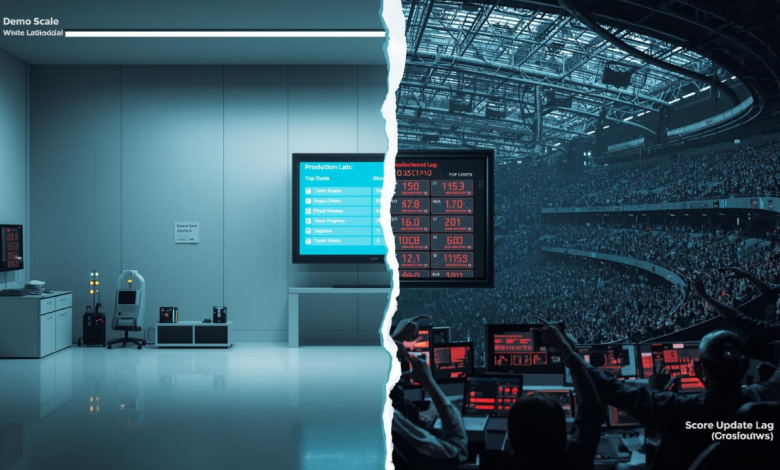
Yet most teams discover too late that building a leaderboard that works at demo scale is fundamentally different from building one that works at million-user scale. The system that updates smoothly with a hundred test users crumbles under a hundred thousand concurrent score updates. The queries that ran in milliseconds against a development database time out against production data. The experience that felt real-time becomes anything but.
This gap between demo and scale is where engagement initiatives fail. Here is what it takes to architect real-time leaderboards that actually work when your users show up.
The Data Model Trap
The hardest problem in real-time leaderboards is not computation. It is data modeling. Most teams start by storing user scores in a single table and querying it directly. For a few thousand users, this works. For a few million, it collapses.
The issue is write contention. When every user action generates a score update, and every leaderboard view requires aggregating thousands of records, the database becomes the bottleneck. Reads compete with writes. Latency spikes. Users staring at stale leaderboards stop competing.
The solution is separating the system into two layers. The first layer handles writes: every score update lands in an append-only event log. The second layer handles reads: pre-computed aggregates stored in structures optimized for fast retrieval. This is the difference between asking the database to calculate the top one hundred scores on every request and serving pre-calculated results from a cache.
Platforms that succeed at scale treat leaderboards as materialized views, not live queries. The aggregation work happens in the background, on a schedule, and the results are served instantly. Users get real-time freshness without real-time computation costs.
The Bucketing Problem
A related challenge is partition design. In a naive model, each user’s entire score history lives in a single partition. Highly active users generate massive partitions that slow down every query against them. Reads that should take milliseconds end up scanning gigabytes.
The fix is bucketing: splitting each user’s history into smaller, time-bound chunks. Instead of one partition per user, the system creates one partition per user per day or per week. Queries against recent activity touch only the relevant bucket. Older buckets are compressed and archived.
This approach requires thinking about partition size before the system goes live and adding bucketing after the fact means migrating live data, a process that risks downtime and data loss, the platforms that get this right design it from the start.
The Reset Reality
Leaderboards that reset weekly or monthly introduce another class of problems. A naive implementation simply deletes the old leaderboard and starts fresh but deletion at scale is expensive. It generates tombstones that must be processed during compaction. It creates write amplification, and it leaves the system unavailable during the reset window.
A better pattern is time-partitioned leaderboards. Each reset period gets its own table or partition. Queries against the current leaderboard target the active partition. When the reset happens, the system simply switches which partition is considered active. No deletes. No downtime. No stale data serving while cleanup runs.
This pattern also enables historical analysis. Users can compare their performance across weeks. Platforms can analyze engagement trends over time, and the system never goes dark during reset windows.
The Consistency Challenge
Real-time leaderboards face a fundamental trade-off between consistency and performance. Strong consistency means every read reflects every write but achieving this across distributed systems requires coordination, which adds latency.
Most successful platforms relax consistency for leaderboards. They accept that a score submitted milliseconds ago might not appear in the current view. They prioritize availability and low latency over perfect accuracy. Users care more that the leaderboard is fast than that it is perfectly up to the microsecond.
This trade-off manifests in architecture choices. Eventual consistency models allow writes to be processed asynchronously. The leaderboard updates within seconds, not milliseconds. For most engagement use cases, this is good enough. The user who just scored knows they are on the board. They do not need to see their rank reflected instantly.
The Caching Layer
No real-time leaderboard system is complete without a caching strategy. The top one hundred scores are requested far more often than they change. Computing them fresh on every request is wasteful.
The standard pattern is a two-tier cache. A local cache on each application server stores frequently accessed leaderboard views. A distributed cache like Redis stores the full set of pre-computed results. When a user requests the leaderboard, the system checks local cache first, then distributed cache, then falls back to the database.
Cache invalidation becomes the hard part. When a new score arrives, does the system invalidate the cached leaderboard immediately or let it serve stale data until the next refresh window? The answer depends on the use case. For competitive leaderboards where rank matters, immediate invalidation may be worth the cost. For engagement features where freshness is less critical, scheduled refreshes work fine.
The Monitoring Blind Spot
The final piece is observability. Real-time systems fail in ways that batch systems do not. Latency spikes. Queue backlogs. Cache misses. These failures compound quickly. A slow write path leads to a backlog, which leads to stale reads, which leads to user frustration.
Teams that succeed instrument everything. They track write latency per user. They monitor cache hit rates. They measure the time between score submission and leaderboard appearance. They set alerts for when any of these metrics deviate from baseline.
Without this visibility, problems hide until users report them. With it, teams detect degradation before it becomes downtime.
The Real-Time Mandate
Gamification adoption continues to accelerate, with employee-centric programs showing the strongest uptake and cloud-hosted platforms enabling real-time analytics across distributed teams. But poorly designed programs deliver negative ROI, and superficial point-and-badge deployments risk disengagement.
The organizations that win with engagement features will be those that treat leaderboards as infrastructure, not features. They will design data models that scale. They will partition intelligently. They will relax consistency where appropriate and cache aggressively where it matters. They will monitor everything and react before users notice.
Real-time is not a toggle you flip; It is a property of the entire system, from data model to deployment architecture. The platforms that build for it from day one will be the ones whose users keep coming back.