
There’s something effortless about speaking. Ideas flow faster, thoughts feel more natural, and communication becomes immediate. That’s why audio has become such a dominant format—whether in meetings, podcasts, voice notes, or interviews. But while speaking is easy, working with spoken content is not. Audio captures ideas, yet it doesn’t organize them.
This is where audio-to-text technology introduces a subtle but powerful shift. It takes something fluid and turns it into something structured. With tools like Devoice Ai, that transition is no longer slow or complicated—it’s immediate, accurate, and deeply practical.
Why Spoken Content Needs Structure
Audio is rich in detail, but it lacks flexibility. You cannot skim it, you cannot quickly extract key points, and you cannot easily reshape it into something new. Every time you need information, you must listen again.
Text changes that completely. Once words are written, they become manageable. You can scan, edit, rearrange, and refine them. What was once a linear experience becomes something you can control.
This transformation is not just about convenience—it’s about unlocking the full potential of what was said.
The Intelligence Behind Modern Transcription
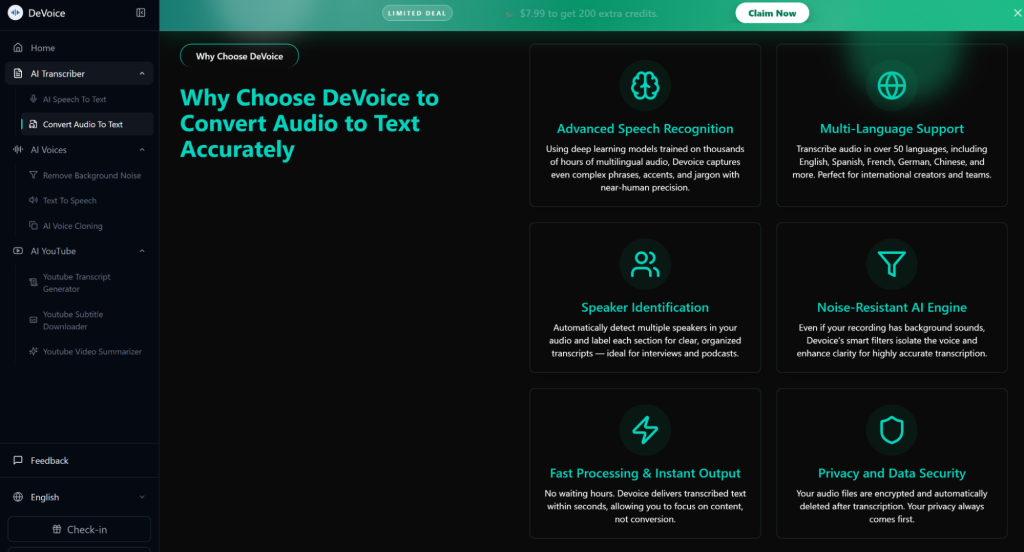
Today’s audio-to-text systems are built on advanced artificial intelligence that understands more than just sound. They recognize patterns, predict sentence flow, and adapt to different speaking styles.
This means transcription is no longer a mechanical process. It captures meaning, not just words. The result feels closer to natural writing, even though it originated from speech.
With Devoice Ai, this intelligence is refined into a tool that produces clean, readable text that reflects the original conversation without losing its essence.
Turning Moments into Material
Every conversation holds value, but without transcription, much of that value remains temporary. Once audio is converted into text, it becomes something you can build on.
A discussion can evolve into a report.
A voice note can become an article.
A recorded idea can turn into a structured plan.
This shift from moment to material is what makes audio-to-text technology so impactful. It ensures that ideas don’t just exist—they develop.
Speed Without Compromising Clarity
One of the most important aspects of modern workflows is speed. Waiting hours to transcribe content manually is no longer practical. AI-driven tools solve this by delivering results almost instantly.
But speed alone is not enough clarity matters just as much. Fast transcription is only useful if the output is accurate and easy to understand.
Devoice Ai balances both, providing quick results without sacrificing the quality of the final text.
Handling the Imperfections of Real Audio
Not all recordings are clean. Background noise, overlapping voices, and inconsistent sound quality are common challenges. These imperfections can make transcription difficult if the system is not advanced enough.
Modern tools are designed to adapt. They filter noise, distinguish between speakers, and interpret speech even when conditions are less than ideal.
With Devoice Ai, these challenges are managed effectively, allowing users to rely on consistent results across different types of recordings.
Making Content More Inclusive
Accessibility is often overlooked, but it plays a vital role in how content is shared and consumed. Audio alone limits who can engage with information. Text removes that limitation.
Transcripts make content accessible to people with hearing difficulties and provide an alternative for those who prefer reading. They also make it easier to translate and adapt content for different audiences.
This inclusivity expands the reach of any message, making it more impactful.
Strengthening the Life of Content
Content doesn’t need to exist in just one form. A single piece of audio can be extended into multiple formats once it becomes text. It can be edited into articles, broken into summaries, or adapted for different platforms.
This flexibility gives content a longer lifespan. Instead of being used once and forgotten, it can be reshaped and reused in meaningful ways.
The Future of Voice and Text Working Together
The connection between voice and text is becoming stronger. Real-time transcription is making live conversations more accessible. Multilingual capabilities are expanding communication across borders. Integration with other technologies is creating more connected systems.
This evolution suggests a future where speaking and writing are no longer separate processes. Instead, they will work together seamlessly, supporting faster and more efficient communication.
Choosing Clarity Over Complexity
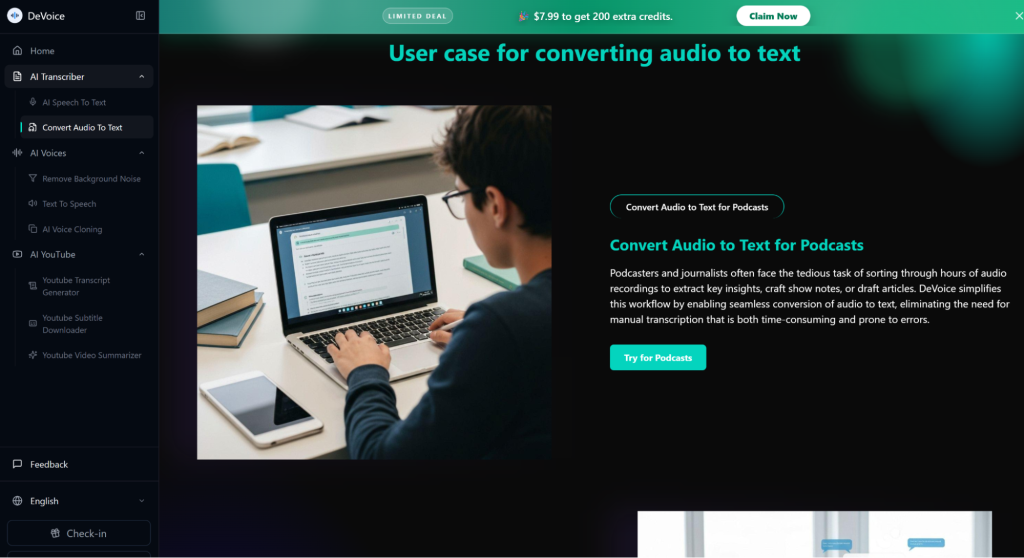
At its core, audio to text technology simplifies something that was once complicated. It removes the effort required to transform speech into usable content and replaces it with a process that is quick and reliable.
This shift allows individuals and businesses to focus on what truly matters—ideas, creativity, and communication.
Final Reflection:
Spoken words are powerful, but they are also fleeting. Without structure, they can be forgotten or underused. Converting them into text gives them permanence and purpose.
With Devoice Ai, this transformation becomes effortless. It turns voice into something you can shape, share, and build upon.